
Song Thrush vs Fieldfare
Turdus philomelos versus Turdus pilaris
Play a quiz with Song Thrush and Fieldfare
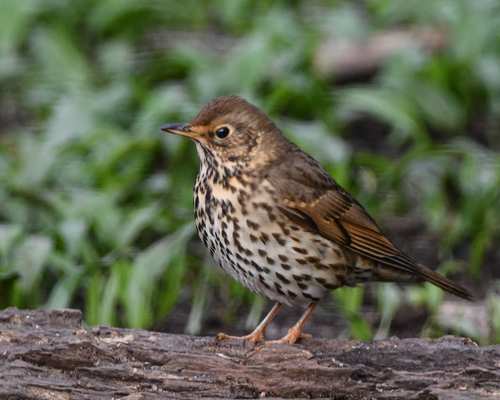 Song Thrush
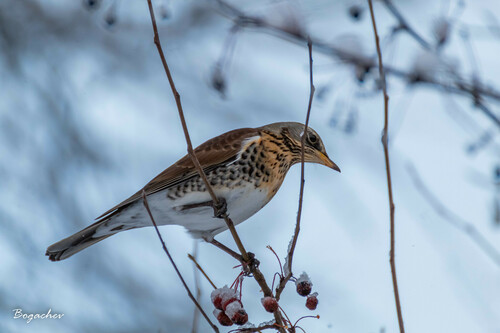 Fieldfare
In short
The most reliable field mark to separate Song Thrush from Fieldfare is the head and rump color: Fieldfare shows a striking slate-grey head and rump, while Song Thrush is plain brown above. In flight, Fieldfare flashes white underwing coverts and axillaries, whereas Song Thrush shows warm yellow underwings. Both species have spotted underparts, but Fieldfare's breast is more boldly speckled and the overall impression is colder and more contrasting. Juveniles of both can show pale streaks, but the overall pattern and structure remain distinctive. Voice and size also differ, but plumage and structure are the quickest ways to separate them in the field.
Identification tips
- Head and rump color: Fieldfare always shows a slate-grey head, nape, and rump, contrasting with a dark brown back. Song Thrush is plain brown above with no grey or black on the head or rump. This is the fastest way to separate them in any plumage.
- Underwing color in flight: Fieldfare flashes white underwing coverts and axillaries, especially obvious in flocks or when flushed. Song Thrush shows warm yellow underwings. This is diagnostic in flight for all ages.
- Breast spotting: Both have spotted breasts, but Fieldfare's are bolder, more extensive, and extend further down the breast. Song Thrush's spots are smaller, neater, and mostly on the upper breast.
- Facial pattern: Fieldfare has black lores and under-eye, a faint pale supercilium, and a more contrasting face. Song Thrush has a plain face with no dark markings or supercilium.
- Bill color: Fieldfare's bill is orange-yellow in winter, yellow in summer (males), with a darker tip. Song Thrush's bill is yellowish but lacks the strong orange or yellow tone and is more uniform.
- Tail: Fieldfare's tail is blackish with a rounded tip and some grey edging at the base. Song Thrush's tail is brown and less contrasting.
- Leg color: Song Thrush has pink legs and feet, while Fieldfare's are brown.
- Juvenile plumage: Both juveniles have pale streaks, but Song Thrush juveniles show buff or orange streaks on the back and wing coverts, while Fieldfare juveniles are duller and less contrasting, quickly moulting into adult-like plumage by autumn.
- Size and structure: Fieldfare is larger, bulkier, and stands more upright, with a longer body and broader wingspan. Song Thrush is smaller, more compact, and delicate in structure.
- Flocking behavior: Fieldfare is often in large flocks, especially in winter, while Song Thrush is more solitary or in pairs.
- Habitat preference: Fieldfare prefers open fields, woodland edges, and is more visible in open country, especially in winter. Song Thrush is more often in gardens, parks, and denser vegetation.
- Vocalizations: Song Thrush sings loud, musical, repeated phrases, often with mimicry. Fieldfare's call is a harsh 'tsak tsak', and its song is weak and mixed with squeaks and whistles.
- Seasonal context: In winter, large flocks of thrushes in open fields are much more likely to be Fieldfare. Song Thrush is more likely in sheltered spots year-round.
- Confusion risk: At a distance, both can look brownish with spotted breasts, but the grey head/rump and white underwing of Fieldfare are unique. Beware of juvenile Song Thrush, but even then, the lack of grey and overall warmer tones should point to Song Thrush.
- When marks fail: In poor light or at a distance, rely on size, flocking, and flight pattern. If the bird is alone and in dense cover, Song Thrush is more likely; if in a flock in open country, Fieldfare is probable.
Size
Fieldfare is noticeably larger and bulkier than Song Thrush, with an average body mass of 105 g versus 72 g for Song Thrush [wikidata]. Fieldfare also has a longer body (about 25 cm vs 20–23.5 cm) and a broader wingspan (39–42 cm vs Song Thrush's unlisted but smaller span). In the field, Fieldfare stands taller and appears more robust, while Song Thrush is more compact and delicate. This size difference is often apparent when both species are seen together, but can be subtle at a distance or in poor light.
Plumage
- Juvenile/immature birds: Both species' juveniles show pale streaks on the back and wing coverts, but Song Thrush juveniles have buff or orange streaks, while Fieldfare juveniles are duller overall with pale streaks on feathers that are dark-streaked in adults. After the first autumn moult, Fieldfare quickly assumes its adult plumage, which is much more contrasting than Song Thrush at any age.
- Adults: Song Thrush is plain brown above with neat black spots on cream or buff underparts, paler on the belly, and warm yellow underwings in flight. Fieldfare adults are much more patterned: slate-grey head, nape, and rump; dark brown back; blackish tail; and a boldly speckled creamy-buff breast. The underwing coverts and axillaries are white and very conspicuous in flight. Fieldfare's face has black lores and under-eye, with a faint pale supercilium, and the bill is orange-yellow (winter) or yellow (summer in males). Song Thrush lacks any grey or black on the head and has a yellowish bill and pink legs. Both have spotted breasts, but Fieldfare's are bolder and more extensive, while Song Thrush's are neater and more confined to the upper breast.
Behaviour
Fieldfare is often seen in flocks, especially in winter, feeding on the ground in open fields or perched high in trees. Song Thrush is more solitary or seen in pairs, usually in denser cover, gardens, or woodland edges. Fieldfare tends to be more upright and alert, while Song Thrush is more prone to foraging under cover and less gregarious. In flight, Fieldfare's white underwings and larger size make it stand out, especially when flying with other thrushes.
Habitat
Both species breed across the Palearctic and can overlap in range, but Fieldfare prefers open woodland, scrub, and fields, especially in northern Europe, and is strongly migratory, appearing in large flocks in winter. Song Thrush is more often found in gardens, parks, woodland edges, and denser vegetation. In winter, Fieldfare is much more likely to be seen in open country, while Song Thrush remains in more sheltered habitats.
Voice
Song Thrush is famous for its loud, clear, and musical song, with repeated phrases and mimicry, usually delivered from a prominent perch. Its call is a sharp 'tsip' or thin 'seep' on migration, and a 'chook-chook' alarm. Fieldfare's call is a harsh 'tsak tsak', usually given in flight or when alarmed, and its song is weak, mixing blackbird-like phrases with whistles and squeaks, often sung in flight or at communal roosts. The two are unlikely to be confused by song, but the calls could be mixed up in flight if only heard briefly.