

Sociable Weaver vs Common Waxbill
Philetairus socius versus Estrilda astrild
Play a quiz with Sociable Weaver and Common Waxbill
 Sociable Weaver
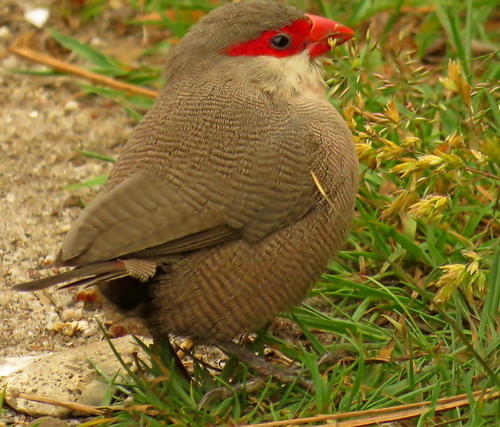 Common Waxbill
In short
The most reliable field mark to separate Sociable Weaver from Common Waxbill is the Sociable Weaver’s bold black chin and throat patch, which is never present on Common Waxbill. In contrast, Common Waxbill shows a bright red bill and a red stripe through the eye, features absent in Sociable Weaver. Juvenile Common Waxbills have a black bill and little or no red on the belly, which can cause confusion, but the Sociable Weaver’s scalloped back and barred flanks remain distinctive. Size is also a strong clue: Sociable Weaver is much bulkier and heavier than the slender, delicate Common Waxbill. Both species can be seen in southern Africa, but their preferred habitats and social behaviors differ markedly.
Identification tips
- Black chin/throat patch (Sociable Weaver only): Look for a bold black patch on the chin and throat—present in all ages and sexes of Sociable Weaver, never in Common Waxbill.
- Red bill and eye-stripe (Common Waxbill only): Adult Common Waxbills show a bright red bill and a red stripe through the eye. Sociable Weavers always have a dark, conical bill and lack any red on the face.
- Scalloped back and barred flanks (Sociable Weaver): The Sociable Weaver’s back is scalloped (pale-edged feathers) and the flanks are barred black—these marks are absent in Common Waxbill.
- Overall body shape: Sociable Weaver is stocky and robust, with a thick neck and heavy build. Common Waxbill is slender, with a fine, delicate structure and a longer, more graduated tail.
- Juvenile confusion: Juvenile Common Waxbills have a black bill and duller plumage, but still lack the Sociable Weaver’s black chin and scalloped back. If you see a small, plain bird with a black bill and no black throat, consider juvenile Waxbill.
- Tail shape: Sociable Weaver’s tail is relatively short and square-tipped, while Common Waxbill’s is longer and more graduated.
- Size in mixed flocks: If both species are present, Sociable Weaver will appear much larger and heavier—almost three times the mass of a Waxbill.
- Plumage contrast: Sociable Weaver’s plumage is more patterned and contrasting, with clear black and pale areas. Common Waxbill is more subtly barred and flushed with red or pink, especially on the belly and face.
- Social behavior: Large, noisy groups around massive communal nests point to Sociable Weaver. Small, loose flocks feeding quietly on grass seeds are more typical of Common Waxbill.
- Habitat context: Sociable Weavers are almost always near their giant nests in arid savannah; Common Waxbills prefer grassy or wet areas and are more likely in urban parks or near water.
- Flight style: Common Waxbill has a light, fluttery flight; Sociable Weaver’s flight is heavier and more direct.
- Bill shape: Sociable Weaver’s bill is thicker and more conical, suited to seed-cracking; Common Waxbill’s is finer and more delicate.
- No red on Sociable Weaver: Any red on the bill or face rules out Sociable Weaver.
- No black throat on Waxbill: Any black chin or throat patch rules out Common Waxbill, regardless of age.
- Vocalizations: If heard, Common Waxbill’s high-pitched, twittering calls and nasal song are distinctive, but voice is less reliable for Sociable Weaver due to lack of description in the notes.
Size
Sociable Weaver is substantially larger and heavier, averaging 27 g compared to the Common Waxbill’s 8.2 g. In length, Sociable Weaver reaches about 14 cm, while Common Waxbill is smaller at 9.5–13 cm. The weaver is stockier with a more robust build, while the waxbill is slender and light-bodied. Tail length is also greater in Sociable Weaver (42–48 mm), and the overall impression in the field is of a much chunkier bird for the weaver versus the dainty, fine-billed waxbill.
Plumage
-
Juveniles: Juvenile Common Waxbills lack the adult’s red bill and belly stripe, showing a black bill and duller, less barred plumage with little or no red—potentially confusing, but they still lack the Sociable Weaver’s black chin and throat patch and scalloped back. Sociable Weaver juveniles are not described as differing markedly from adults, so the black chin and barred flanks remain reliable.
-
Adults: Sociable Weaver has a diagnostic black chin and throat, black-barred flanks, and a scalloped (pale-edged feather) back. Common Waxbill adults are mostly grey-brown with fine dark barring, a bright red bill, a red eye-stripe, and often a reddish belly stripe (variable by subspecies). The Sociable Weaver never shows red in the bill or face, and the Waxbill never shows a black throat or chin. Sociable Weaver’s plumage is more patterned and contrasting, while Common Waxbill is more subtly barred and flushed with red.
-
Flight/wing pattern: No distinctive upperwing or flight pattern marks are noted for either species that would separate them in flight by age.
Behaviour
Sociable Weavers are highly social and famous for their massive communal nests, often seen in large, noisy groups. They are typically observed clinging to or foraging near these nests, giving a busy, bustling impression. Common Waxbills are also social, usually seen in small flocks, but they do not build communal nests. Their movements are more delicate and less frenetic, often feeding quietly on grass seeds. In flight, Waxbills appear light and fluttery, while Sociable Weavers are heavier and more direct.
Habitat
Sociable Weavers are endemic to arid savannah and dry woodland in southern Africa, especially the Northern Cape, and are closely associated with large, communal nests in trees or on man-made structures. Common Waxbills are found in a wider range of open habitats, including grasslands, wetlands, and urban parks, and have a much broader (often introduced) range. In southern Africa, Waxbills are more likely near water or grassy patches, while Sociable Weavers are tied to drier, open country and their distinctive nest colonies.
Voice
Common Waxbill has a variety of twittering and buzzing calls, plus a distinctive high-pitched flight call and a simple, harsh, nasal song. Sociable Weaver’s vocalizations are not described in the provided notes, so voice is less reliable for separation based on current information.