

Motmot

Snowy Owl vs Northern Hawk Owl

Bubo scandiacus versus Surnia ulula

Play a quiz with Snowy Owl and Northern Hawk Owl
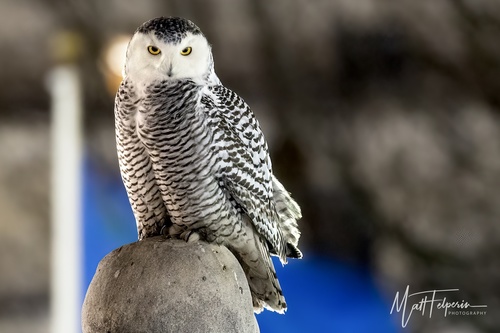
Snowy Owl (Bubo scandiacus) Snowy Owl
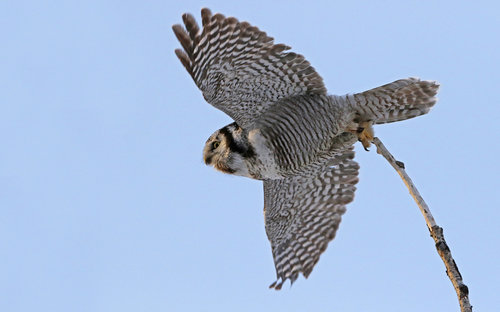
Northern Hawk Owl (Surnia ulula) Northern Hawk Owl

Media

Loading…

In short

The most reliable field mark between Snowy Owl and Northern Hawk Owl is overall coloration: Snowy Owl is predominantly white (especially adult males), while Northern Hawk Owl is dark brown above with heavy barring below and a strikingly marked face. Juvenile and female Snowy Owls can show more barring and spots, but never the brown-backed, hawk-like look of Northern Hawk Owl. In flight, Snowy Owl appears broad-winged and white, often with only scattered dark markings, while Northern Hawk Owl looks long-tailed and slim, with a brown-and-white barred pattern. Hawk Owls have a bold black border to the face and a long, banded tail, unlike the rounded, white-headed Snowy. Habitat and behavior also help: Snowy Owls are ground-dwelling tundra birds, often seen perched low or on the ground, while Hawk Owls perch upright in trees and hunt by scanning from exposed perches.

Identification tips

  1. Overall color: Snowy Owl is white-based, sometimes with brown barring or spots (especially females and immatures), but never overall brown above. Northern Hawk Owl is always dark brown above with white spots and brown barring below.
  2. Face pattern: Hawk Owl shows a white face with a bold black border and a black V on the nape; Snowy Owl has a rounded, white head with no strong facial border.
  3. Tail shape: Hawk Owl has a long, narrow, heavily banded tail (rounded in adults, pointed in first-years); Snowy Owl has a short, broad, faintly barred tail.
  4. Wing shape in flight: Snowy Owl is broad-winged and heavy, with slow, deep wingbeats; Hawk Owl is slim, with pointed wings and rapid, hawk-like flight.
  5. Perching behavior: Snowy Owl often sits on the ground or low perches in open country; Hawk Owl perches upright at the tops of trees or poles.
  6. Size: Snowy Owl is much larger and bulkier; Hawk Owl is medium-sized and slim.
  7. Sex/age confusion: Female and immature Snowy Owls can be quite heavily marked, but always have a white base color and lack the Hawk Owl's dark face border and brown back. The darkest Snowy Owl is still paler than the lightest Hawk Owl.
  8. Juvenile Hawk Owl: First-year Hawk Owls have pointed tail feathers, but otherwise look like adults; no Snowy Owl shows a long, pointed, banded tail.
  9. Flight jizz: Hawk Owl's flight is swift and direct, with a long tail trailing behind; Snowy Owl is slow, heavy, and broad-winged.
  10. Habitat: Snowy Owl is found in open tundra or fields, often far from trees; Hawk Owl is in or near boreal forest, rarely in open country.
  11. Facial disc: Snowy Owl's facial disc is shallow and plain; Hawk Owl's is bold and sharply defined.
  12. Ear tufts: Snowy Owl lacks visible ear tufts (very short and rarely raised); Hawk Owl has a smooth, rounded head with no tufts.
  13. Eyes: Both have yellow eyes, so this is not a useful separator.
  14. Seasonal context: Snowy Owls may irrupt south in winter, but still prefer open, treeless areas; Hawk Owls are resident or irruptive, but always associated with trees.
  15. Unique marks: The black V on the nape is unique to Hawk Owl; the nearly pure white male is unique to Snowy Owl, but beware pale females and immatures.

Size

Snowy Owl is much larger and heavier than Northern Hawk Owl. Snowy Owl is a true giant among owls, with a length of 52–71 cm and a wingspan of 125–150 cm [wikipedia], while Northern Hawk Owl is medium-sized, at 35–45 cm long and a wingspan of 69–82 cm [wikipedia]. Snowy Owl is also much bulkier, with a mass up to 2,950 g in females, compared to Hawk Owl's 300–340 g [wikipedia]. In the field, Snowy Owl looks massive and broad, while Hawk Owl is slim and long-tailed.

Plumage

Juvenile and immature Snowy Owls are darkly mottled above with heavy barring and spotting on a white base, but even the darkest birds never show the overall brown upperparts and crisp, dark face border of Northern Hawk Owl. First-year Hawk Owls have pointed tail feathers, but otherwise resemble adults: brown above with white spots, white face with a bold black border, and brown-banded underparts. Adult male Snowy Owls are nearly pure white with very few dark spots, while females and younger birds have more brown barring and spots, especially on the flanks and upper breast. However, even the most marked Snowy Owl is always white-based and lacks the Hawk Owl's dark brown back, black facial border, and long, banded tail. In flight, Snowy Owl shows broad, rounded wings and a short, white tail with faint barring; Hawk Owl has pointed wings and a long, narrow, strongly banded tail. The Hawk Owl's back of the neck shows a unique black V, never present in Snowy Owl.

Behaviour

Snowy Owl often sits on the ground or low perches, appearing as a white lump on open tundra or fields. It is mostly active at dawn, dusk, or even during the day in the far north. Northern Hawk Owl perches upright at the tops of trees or poles, scanning for prey, and is notably diurnal, often hunting in full daylight. In flight, Hawk Owl is swift and direct, with a hawk-like jizz due to its long tail and pointed wings, while Snowy Owl is heavy, slow, and broad-winged.

Habitat

Snowy Owl breeds on Arctic tundra and, in winter, favors open country such as fields, marshes, and coastal dunes, often far from trees. Northern Hawk Owl is a bird of boreal forests, especially open coniferous woods and forest edges, and is rarely seen far from trees. If you see an owl in a treeless, windswept landscape, especially on the ground, it's likely a Snowy Owl; if it's perched high in a tree in a forested area, it's likely a Hawk Owl.

Submit a better description

Use the same sections as the comparison. Your text is published immediately.

The most reliable field mark between Snowy Owl and Northern Hawk Owl is overall coloration: Snowy Owl is predominantly white (especially adult males), while Northern Hawk Owl is dark brown above with heavy barring below and a strikingly marked face. Juvenile and female Snowy Owls can show more barring and spots, but never the brown-backed, hawk-like look of Northern Hawk Owl. In flight, Snowy Owl appears broad-winged and white, often with only scattered dark markings, while Northern Hawk Owl looks long-tailed and slim, with a brown-and-white barred pattern. Hawk Owls have a bold black border to the face and a long, banded tail, unlike the rounded, white-headed Snowy. Habitat and behavior also help: Snowy Owls are ground-dwelling tundra birds, often seen perched low or on the ground, while Hawk Owls perch upright in trees and hunt by scanning from exposed perches.

  1. Overall color: Snowy Owl is white-based, sometimes with brown barring or spots (especially females and immatures), but never overall brown above. Northern Hawk Owl is always dark brown above with white spots and brown barring below.
  2. Face pattern: Hawk Owl shows a white face with a bold black border and a black V on the nape; Snowy Owl has a rounded, white head with no strong facial border.
  3. Tail shape: Hawk Owl has a long, narrow, heavily banded tail (rounded in adults, pointed in first-years); Snowy Owl has a short, broad, faintly barred tail.
  4. Wing shape in flight: Snowy Owl is broad-winged and heavy, with slow, deep wingbeats; Hawk Owl is slim, with pointed wings and rapid, hawk-like flight.
  5. Perching behavior: Snowy Owl often sits on the ground or low perches in open country; Hawk Owl perches upright at the tops of trees or poles.
  6. Size: Snowy Owl is much larger and bulkier; Hawk Owl is medium-sized and slim.
  7. Sex/age confusion: Female and immature Snowy Owls can be quite heavily marked, but always have a white base color and lack the Hawk Owl's dark face border and brown back. The darkest Snowy Owl is still paler than the lightest Hawk Owl.
  8. Juvenile Hawk Owl: First-year Hawk Owls have pointed tail feathers, but otherwise look like adults; no Snowy Owl shows a long, pointed, banded tail.
  9. Flight jizz: Hawk Owl's flight is swift and direct, with a long tail trailing behind; Snowy Owl is slow, heavy, and broad-winged.
  10. Habitat: Snowy Owl is found in open tundra or fields, often far from trees; Hawk Owl is in or near boreal forest, rarely in open country.
  11. Facial disc: Snowy Owl's facial disc is shallow and plain; Hawk Owl's is bold and sharply defined.
  12. Ear tufts: Snowy Owl lacks visible ear tufts (very short and rarely raised); Hawk Owl has a smooth, rounded head with no tufts.
  13. Eyes: Both have yellow eyes, so this is not a useful separator.
  14. Seasonal context: Snowy Owls may irrupt south in winter, but still prefer open, treeless areas; Hawk Owls are resident or irruptive, but always associated with trees.
  15. Unique marks: The black V on the nape is unique to Hawk Owl; the nearly pure white male is unique to Snowy Owl, but beware pale females and immatures.

Snowy Owl is much larger and heavier than Northern Hawk Owl. Snowy Owl is a true giant among owls, with a length of 52–71 cm and a wingspan of 125–150 cm [wikipedia], while Northern Hawk Owl is medium-sized, at 35–45 cm long and a wingspan of 69–82 cm [wikipedia]. Snowy Owl is also much bulkier, with a mass up to 2,950 g in females, compared to Hawk Owl's 300–340 g [wikipedia]. In the field, Snowy Owl looks massive and broad, while Hawk Owl is slim and long-tailed.

Juvenile and immature Snowy Owls are darkly mottled above with heavy barring and spotting on a white base, but even the darkest birds never show the overall brown upperparts and crisp, dark face border of Northern Hawk Owl. First-year Hawk Owls have pointed tail feathers, but otherwise resemble adults: brown above with white spots, white face with a bold black border, and brown-banded underparts. Adult male Snowy Owls are nearly pure white with very few dark spots, while females and younger birds have more brown barring and spots, especially on the flanks and upper breast. However, even the most marked Snowy Owl is always white-based and lacks the Hawk Owl's dark brown back, black facial border, and long, banded tail. In flight, Snowy Owl shows broad, rounded wings and a short, white tail with faint barring; Hawk Owl has pointed wings and a long, narrow, strongly banded tail. The Hawk Owl's back of the neck shows a unique black V, never present in Snowy Owl.

Snowy Owl often sits on the ground or low perches, appearing as a white lump on open tundra or fields. It is mostly active at dawn, dusk, or even during the day in the far north. Northern Hawk Owl perches upright at the tops of trees or poles, scanning for prey, and is notably diurnal, often hunting in full daylight. In flight, Hawk Owl is swift and direct, with a hawk-like jizz due to its long tail and pointed wings, while Snowy Owl is heavy, slow, and broad-winged.

Snowy Owl breeds on Arctic tundra and, in winter, favors open country such as fields, marshes, and coastal dunes, often far from trees. Northern Hawk Owl is a bird of boreal forests, especially open coniferous woods and forest edges, and is rarely seen far from trees. If you see an owl in a treeless, windswept landscape, especially on the ground, it's likely a Snowy Owl; if it's perched high in a tree in a forested area, it's likely a Hawk Owl.

Discard your changes?

You have unsaved edits. If you leave now, those changes will be lost.

Snowy Owl · Northern Hawk Owl · My Tricky Birds