

Snow Goose vs Sandhill Crane
Anser caerulescens versus Antigone canadensis
Play a quiz with Snow Goose and Sandhill Crane
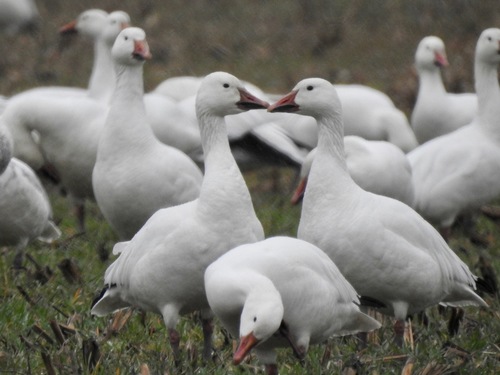 Snow Goose
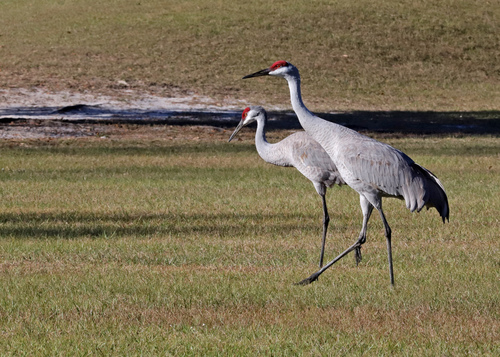 Sandhill Crane
In short
The most reliable way to separate Snow Goose from Sandhill Crane is by overall structure and flight style: Snow Goose is a compact, short-necked goose with a thick, pink bill and contrasting black primaries, while Sandhill Crane is a much taller, long-necked bird with a slender, pointed bill, trailing legs, and gray or ochre plumage. Immature Snow Geese (especially blue morph) can appear grayish and might confuse beginners, but even then, the goose's short neck and lack of trailing legs in flight are distinctive. Sandhill Cranes always show a straight, extended neck and long legs trailing well beyond the tail in flight. Bill shape, leg projection, and overall size are key, especially at a distance or in mixed flocks.
Identification tips
- Neck length in flight: Sandhill Crane always flies with a long, straight neck; Snow Goose's neck is much shorter and appears stubbier in flight. This is the single best mark at any distance.
- Leg projection: In flight, Sandhill Crane's long, dark legs trail well beyond the tail; Snow Goose's legs are short and never extend past the tail.
- Bill shape and color: Snow Goose has a short, thick, pink bill with a black 'grin patch'; Sandhill Crane's bill is long, straight, and dark, more like a heron's.
- Body shape: Snow Goose is compact and stocky; Sandhill Crane is tall, slender, and lanky, with a more upright posture when standing.
- Plumage (adult): Adult Snow Goose is either pure white with black wingtips (white morph) or blue-gray with a white head (blue morph); Sandhill Crane is always gray or ochre, never white, with a red forehead and white cheeks.
- Plumage (immature): Immature Snow Goose (blue morph) is slate-gray with little white, but still has a goose's bill and shape; immature Sandhill Crane is reddish-brown above, gray below, and lacks the red forehead.
- Wing pattern in flight: Snow Goose shows sharp black primaries contrasting with white or blue-gray wings; Sandhill Crane's wings are uniform grayish, with no black tips.
- Feet and legs color: Snow Goose has rose-red feet and legs (duller in immatures); Sandhill Crane's legs are always dark.
- Feeding behavior: Snow Geese graze in dense, noisy flocks on fields; Sandhill Cranes feed more slowly, often in pairs or small groups, in wetlands or grasslands.
- Vocalizations: Snow Goose gives loud, nasal honks; Sandhill Crane gives deep, trumpeting, rolling calls, often in synchronized duets.
- Flight style: Snow Geese flap steadily and fly in tight formations; Sandhill Cranes soar on thermals with slow, deep wingbeats, often seen circling high overhead.
- Head pattern: Sandhill Crane adults have a red forehead and white cheek patch; Snow Goose has a plain white or gray head (sometimes stained rusty from feeding).
- Habitat: If the bird is in a wetland edge or shallow marsh, especially standing tall and alone or in a pair, suspect Sandhill Crane; if in a dense flock on a dry field, suspect Snow Goose.
- Size comparison: If both species are present, Sandhill Crane will tower over Snow Goose, being much taller and longer-winged.
- Pitfalls: Immature blue-morph Snow Geese can look grayish and may confuse beginners, but always check for neck length, bill shape, and leg projection in flight.
Size
Sandhill Crane is substantially larger and taller than Snow Goose. While Snow Goose averages about 2.6 kg in body mass and stands 64–79 cm tall, Sandhill Crane males average 4.6 kg and females 4.0 kg, with typical heights of 80–136 cm. The crane's wingspan is also much greater (typically 200 cm, up to 230 cm), compared to the Snow Goose's 135–165 cm. In the field, cranes look lanky and towering, while geese are compact and stocky.
Plumage
- Immature/juvenile birds: Immature Snow Geese (especially blue morph) are slate-gray overall with little or no white on the head, neck, or belly, and duller pinkish bills and legs. Immature Sandhill Cranes are reddish-brown above and gray below, lacking the red forehead of adults. Both can appear grayish at a distance, but the crane's plumage is always more uniform and lacks the sharp black-and-white contrast of Snow Goose wings.
- Adults: Adult Snow Geese are either pure white with black wingtips (white morph) or have a mix of white and bluish-gray (blue morph), always with a white head and tail tip. Sandhill Cranes are gray overall, often stained ochre in breeding season, with a red forehead and white cheeks. In flight, Snow Goose shows black primaries sharply contrasting with the rest of the wing, while Sandhill Crane's wings are uniformly grayish with no black tips.
- In flight: Snow Goose never shows trailing legs beyond the tail; Sandhill Crane's long, dark legs trail well past the tail. Snow Goose has a short neck held straight; Sandhill Crane's neck is much longer and also held straight in flight.
Behaviour
Snow Geese typically feed and move in tight, noisy flocks, often on open fields or marshes, and fly in dense, organized groups. Sandhill Cranes are usually seen in pairs or loose flocks, often in wetlands or open grasslands, and their flight is more buoyant and soaring, often riding thermals with minimal wingbeats. Cranes are more likely to be seen walking slowly with deliberate steps, while geese graze in a more bustling, hunched manner.
Habitat
Snow Geese are most often found in open agricultural fields, marshes, and mudflats, especially in migration and winter. Sandhill Cranes prefer the edges of wetlands, marshes, bogs, and open prairies, often near shallow water. While both may be seen in open country, cranes are more closely tied to wetland edges and are less likely to be found feeding in dense flocks on dry fields.
Voice
Snow Geese are extremely vocal, producing loud, nasal honking calls that carry for miles and are often heard from large flocks. Sandhill Cranes have a distinctive, loud trumpeting call with a rolling 'r' quality, often given in unison by pairs. The crane's call is deeper, more resonant, and less nasal than the goose's, and can be heard over long distances, especially during migration.