

Silvered Antbird vs Spot-winged Antbird
Sclateria naevia versus Myrmelastes leucostigma
Play a quiz with Silvered Antbird and Spot-winged Antbird
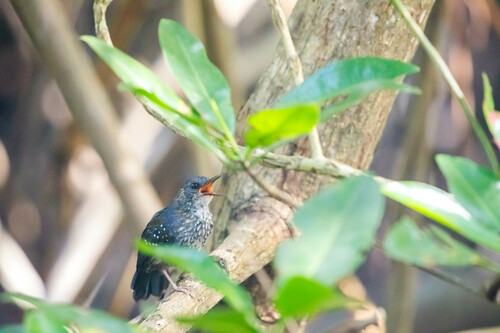 Silvered Antbird
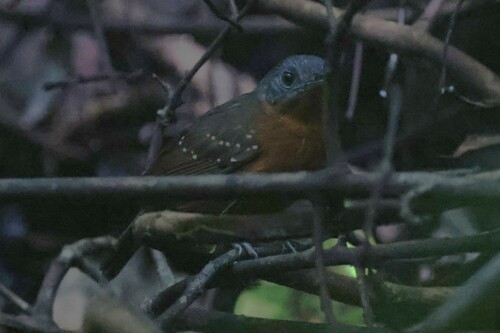 Spot-winged Antbird
In short
The most reliable field mark between Silvered Antbird and Spot-winged Antbird is the pattern and color of the wing coverts: both species show white or pale marks on the wing coverts, but the shape, size, and context differ by sex and age. Males of both species have dark gray upperparts and blackish wings with white-tipped coverts, but the Spot-winged Antbird's white spots are broader and more conspicuous, while the Silvered Antbird's are smaller and sometimes dot-like. Females are more distinct: Silvered Antbird females are grayish-brown above with cinnamon-tipped coverts, while Spot-winged Antbird females are cinnamon-brown above with pale cinnamon-rufous or rufous-brown tips. Underparts also differ: Silvered Antbird females are paler below with variable buff, while Spot-winged Antbird females are more uniformly tawny or rufous-brown. Both species are similar in size and structure, so careful attention to wing covert pattern, underpart color, and subtle facial tones is essential.
Identification tips
- Check the wing covert pattern: In males, Spot-winged Antbird shows broader and more conspicuous white tips on the wing coverts than Silvered Antbird, whose white marks are smaller or dot-like (especially in S. n. diaphora). In females, Silvered Antbird has cinnamon tips on grayish-brown coverts, while Spot-winged Antbird has pale cinnamon-rufous or rufous-brown tips on cinnamon-brown coverts.
- Assess underpart color in females: Silvered Antbird females are paler below, often white with buffy or deep buff sides, while Spot-winged Antbird females are more uniformly tawny or rufous-brown, with olive-brown flanks and undertail.
- Look for facial pattern: Silvered Antbird often shows a pale gray supercilium and a mostly dark gray face, especially in males. Spot-winged Antbird lacks a strong supercilium; females may show a brownish olive face depending on subspecies.
- Compare upperpart tones: Silvered Antbird males are dark gray above; females are grayish brown. Spot-winged Antbird males are also dark gray, but females are richer cinnamon-brown above.
- Note the tail and wing color: Both species have blackish wings and tail, but the context of covert tips is key. In flight, the white or pale spots may flash differently: Spot-winged Antbird's are larger and more obvious, especially in males.
- Consider habitat: If the bird is seen overhanging water or in riparian/flooded forest, Silvered Antbird is more likely. In terra firme forest away from water, Spot-winged Antbird is favored.
- Listen for song: Silvered Antbird's song starts with emphatic, higher notes and builds in intensity before dropping off; Spot-winged Antbird's song is more even-paced and ringing, with a slight decrease at the end.
- Leg color (when visible): Spot-winged Antbird can show pinkish or bluish-gray legs depending on subspecies; Silvered Antbird's leg color is not described as distinctive.
- Subspecies variation: Be aware that both species have subspecies with variable underpart and covert patterns. Always check multiple features.
- Juvenile/subadult confusion: Subadult Silvered Antbird males resemble adult females, so brownish birds with cinnamon covert tips could be either species or age/sex class. Use underpart color and facial pattern for further clues.
- Size is not helpful: Both species are nearly identical in size and structure; do not rely on this for separation.
- Army ant swarms: Spot-winged Antbird is more likely to be seen at ant swarms away from water, but this is not exclusive.
- Supercilium presence: A pale supercilium suggests Silvered Antbird, especially in males; its absence or weak presence leans toward Spot-winged Antbird.
- Underwing coverts: Silvered Antbird males have gray underwing coverts, but this is rarely visible in the field.
- Context and range: Both species overlap widely, but local abundance may differ; check eBird for local reports if in doubt.
Size
Both species are very similar in size, each measuring 14–16 cm in length. Silvered Antbird weighs 21–27 g, while Spot-winged Antbird ranges from 20–28.5 g. There is no meaningful difference in size or structure that can be used for field separation; both are medium-sized antbirds with similar proportions.
Plumage
-
Juvenile/immature (subadult) males: Silvered Antbird subadult males resemble adult females, lacking the crisp gray and white contrast of adult males. Spot-winged Antbird immatures are not described in detail, but likely resemble adult females as well; thus, confusion is most likely among brownish birds with pale wing covert tips.
-
Adult males: Both have dark gray upperparts and blackish wings with white-tipped coverts. The Spot-winged Antbird's white tips are described as 'wide' and more conspicuous, while Silvered Antbird's are smaller or dot-like (especially in S. n. diaphora). Underparts differ: Silvered Antbird males are white below with gray scalloping, while Spot-winged Antbird males are pale gray to gray below, with darker sides and belly. Subspecies variation can affect the prominence of these marks.
-
Adult females: Silvered Antbird females are grayish brown above with cinnamon tips on the wing coverts, and underparts range from white with buffy brown sides to deep buff. Spot-winged Antbird females are cinnamon-brown above with pale cinnamon-rufous or rufous-brown tips on the wing coverts, and underparts are pale tawny or rufous-brown, with olive-brown flanks and undertail coverts. The overall effect is that Spot-winged Antbird females are warmer and more rufous below and behind, while Silvered Antbird females are paler and less saturated.
-
Facial pattern: Silvered Antbird shows a pale gray supercilium and a mostly dark gray face; Spot-winged Antbird females have a gray face, sometimes brownish olive (subspecies dependent), but lack a strong supercilium.
Behaviour
Both species forage low in the understory, often near the ground. Spot-winged Antbird is known to attend army ant swarms but more often forages independently or in small groups, hopping along the ground and low branches. Silvered Antbird's foraging behavior is less detailed but is typical of antbirds, likely similar. There are no strong behavioral differences for field separation.
Habitat
Both species overlap in range across northern and central South America, but their preferred habitats differ subtly. Silvered Antbird is often found near water, especially in low branches overhanging streams or swampy areas. Spot-winged Antbird prefers terra firme evergreen forest, especially poorly drained areas and along small watercourses, but not necessarily right at the water's edge. Both can be found in dense understory, but Silvered Antbird is more closely associated with riparian or flooded forest edges.
Voice
Both species have rapid, trilled songs, but the details differ. Silvered Antbird's song is a long, rapid trill introduced by emphatic, higher notes, then building and dropping off sharply at the end. Spot-winged Antbird's song is a rapid, even-paced series of ringing notes, with pitch and pace decreasing slightly at the end. Both give downslurred whistles and abrupt notes, but Silvered Antbird's song is more variable in pitch and intensity, while Spot-winged Antbird's is more even. Calls are similar and not reliably diagnostic without experience.