

Short-tailed Swift vs Red-bellied Macaw
Chaetura brachyura versus Orthopsittaca manilatus
Play a quiz with Short-tailed Swift and Red-bellied Macaw
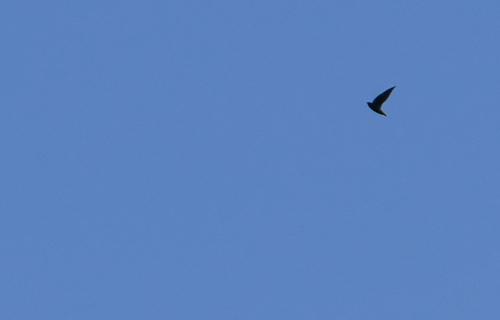 Short-tailed Swift
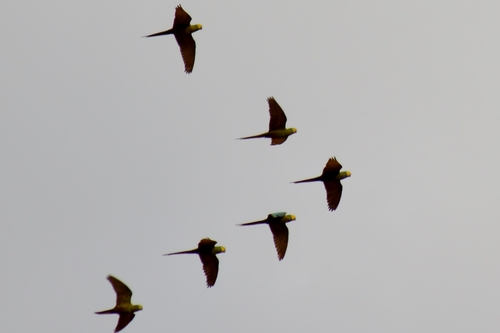 Red-bellied Macaw
In short
The most reliable field mark to separate these two is overall structure: Short-tailed Swift is a small, dark, fast-flying aerial insectivore with a very short tail and long, narrow wings, while Red-bellied Macaw is a much larger, mostly green parrot with a long, pointed tail and a distinctive maroon belly patch. Even at a distance, the swift’s rapid, erratic flight and compact shape contrast sharply with the macaw’s slower, more direct flight and heavy, parrot-like jizz. Juvenile macaws show a unique white stripe along the top of the beak, which is never present in swifts. If you see a bird perched, the macaw’s large, hooked bill and facial skin are unmistakable, while swifts virtually never perch in the open.
Identification tips
- Size and shape: Short-tailed Swift is tiny, compact, and fast, with long, narrow wings and a very short tail. Red-bellied Macaw is much larger, with a long, pointed tail and broad wings. Size alone is often enough to separate them at a distance.
- Bill: Swifts have a tiny, barely visible bill; macaws have a massive, hooked parrot bill. If you can see the bill, the difference is unmistakable.
- Tail shape: Short-tailed Swift has a very short, squared or slightly notched tail. Red-bellied Macaw has a long, pointed tail that tapers to a tip. In flight, the macaw’s tail is much longer than the body, while the swift’s is barely longer than the undertail coverts.
- Plumage color: Swifts are mostly blackish with a pale rump and tail, but these are similar in tone. Macaws are bright green with a maroon belly patch, bluish forehead, and yellowish facial skin. No swift shows any red, blue, or yellow in the plumage.
- Juvenile macaw beak stripe: Juvenile Red-bellied Macaws have a white stripe along the top of the beak (culmen), unique among macaws and absent in swifts. If you see this mark, it is diagnostic for a young macaw.
- Facial skin: Macaws have bare, mustard-yellow facial skin around the bill and eyes; swifts have fully feathered faces.
- Flight style: Swifts fly rapidly, with quick, erratic movements, often high in the air. Macaws have slower, more direct flight, often in pairs or small groups, and may call loudly in flight.
- Perching behavior: Macaws perch openly in trees, often on exposed branches or palm fronds. Swifts almost never perch in the open and are rarely seen perched except at nest sites.
- Feet: Macaws have strong, zygodactyl feet (two toes forward, two back) used for climbing and grasping; swifts have tiny, weak feet used only for clinging vertically.
- Underwing color: Macaws show dull olive yellow underwings and undertail; swifts are uniformly dark below.
- Context: If the bird is feeding on palm fruit or interacting with palm trees, it is a macaw. Swifts feed only on flying insects and are never seen eating fruit or perching in palms.
- Sex differences: Both species are sexually monomorphic in plumage; size difference (males larger) is subtle and not useful in the field.
- Habitat: Macaws are tied to palm-rich habitats; swifts are more generalist but always seen in the air.
- Pitfalls: At great distance, a macaw in fast flight could look superficially like a large swift, but the long tail and greenish color should be visible with binoculars. Swifts never show the maroon belly or bare facial skin of a macaw.
- Voice: Not covered in the provided notes, but in practice, macaws are loud and vocal, while swifts are usually silent or give high-pitched twittering calls.
Size
Short-tailed Swift is a very small bird, about 10.5 cm long and weighing 20 g [wikipedia]. In contrast, Red-bellied Macaw is much larger, about 46 cm in length (including its long tail) and weighing around 300 g [wikipedia]. The size gap is dramatic: the macaw is nearly four times as long and fifteen times heavier than the swift. Even at a distance, the macaw’s bulk and long tail are obvious compared to the swift’s compact, bullet-like silhouette.
Plumage
-
Juvenile/immature birds: Juvenile Red-bellied Macaws are duller green than adults and have a grey beak with a conspicuous white stripe along the top (culmen), a feature not found in any swift at any age. Short-tailed Swifts do not show age-specific plumage differences that are useful in the field; both adults and immatures are mainly blackish with a pale rump and tail, but the rump and tail are similar in tone, lacking strong contrast [wikipedia].
-
Adults: Adult Short-tailed Swifts are mostly blackish with a pale rump and tail, but the rump and tail are similar in shade, lacking the strong contrast seen in some related swifts. Adult Red-bellied Macaws are mostly green with a large maroon patch on the lower belly, bluish forehead, mustard-yellow bare facial skin, and a long, tapered tail. The underwings and undertail are dull olive yellow. The macaw’s bill is large and dark grey, while the swift’s bill is tiny and barely visible in the field.
-
In flight: Swifts show long, narrow, sickle-shaped wings and a very short tail, with no color patches. Macaws in flight show broad wings, long pointed tail, and may flash the maroon belly patch and yellowish underwings. Swifts never show any red or yellow plumage.
Behaviour
Short-tailed Swifts are almost always seen in rapid, agile flight, catching insects high in the air. They rarely perch in the open and are usually only seen perched at nest sites or roosts, often clinging vertically. Red-bellied Macaws are often seen flying in pairs or small flocks, with slower, more direct flight, and frequently perch openly in palm trees or on exposed branches. Macaws use their feet to manipulate food and climb, while swifts do not perch or use their feet in this way.
Habitat
Short-tailed Swifts are aerial foragers found over a wide range of open habitats, including forests, savannas, and near water, but are always seen in the air [wikipedia]. Red-bellied Macaws are closely tied to moriche palm swamps and palm-dominated savannas, where they feed, nest, and roost [wikipedia]. If you see a bird in a palm tree or feeding on palm fruit, it is almost certainly a macaw, not a swift.