

Motmot

Screaming Piha vs Yellow-rumped Cacique

Lipaugus vociferans versus Cacicus cela

Play a quiz with Screaming Piha and Yellow-rumped Cacique
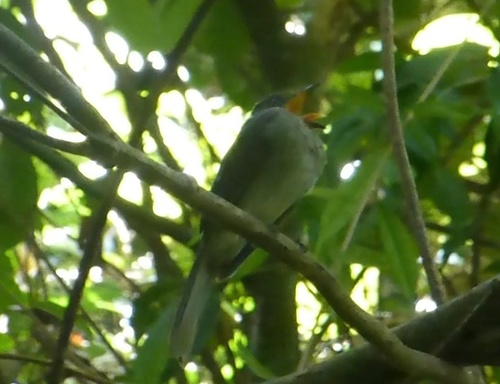
Screaming Piha (Lipaugus vociferans) Screaming Piha
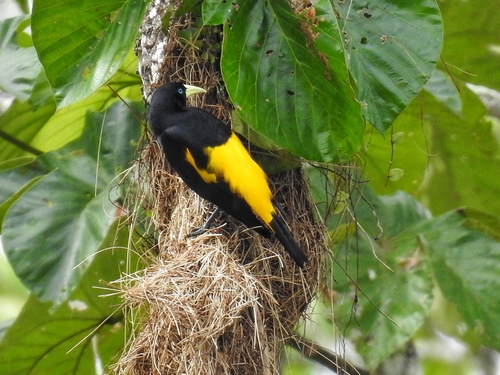
Yellow-rumped Cacique (Cacicus cela) Yellow-rumped Cacique

Media

Loading…

In short

The most reliable field mark to separate Screaming Piha from Yellow-rumped Cacique is the cacique’s bold yellow rump, lower belly, and wing epaulets, which are always absent in the uniformly gray Screaming Piha. Juvenile Pihas can show cinnamon rufous on the wing coverts and tail tips, but never the bright yellow of the cacique. Structurally, the cacique is slimmer, longer-tailed, and has a pale yellow pointed bill and blue eyes, while the piha is heavier-bodied with a dark bill and brownish iris. In flight or perched, the cacique’s contrasting yellow and black is unmistakable, while the piha remains plain grayish. Their voices are also dramatically different: the piha’s piercing, extremely loud whistles contrast with the cacique’s varied fluting, cackles, and mimicry.

Identification tips

  1. Yellow patches: Only Yellow-rumped Cacique shows bright yellow on the rump, lower belly, base of tail, and wing epaulets. Screaming Piha is always plain gray above and below, never yellow, at any age or sex.
  2. Juvenile confusion: Juvenile Screaming Piha may show cinnamon rufous on wing coverts and tail tips, but never yellow. Juvenile caciques are duller but still have yellow patches; their bill base is brown, and iris is dark.
  3. Bill color and shape: Piha has a dark, dusky bill (black maxilla, dusky mandible with pinkish base), while adult cacique has a pale yellow, sharply pointed bill. Juvenile cacique has a brown-based bill.
  4. Iris color: Piha’s iris is brown to grayish; adult cacique’s is blue, juvenile cacique’s is dark.
  5. Body structure: Piha is heavier-bodied and compact, with a shorter tail and less pointed bill. Cacique is slimmer, longer-tailed, and has a more pointed, pale bill.
  6. Plumage contrast: Piha is uniform gray with duskier wings and tail; cacique is glossy black with sharply contrasting yellow patches. Female and juvenile caciques are duller but still show yellow.
  7. Perched posture: Piha often sits quietly, upright or slightly hunched, in the mid-story or understory. Cacique is more active, often in groups, and perches more upright, especially at colony sites.
  8. Flight appearance: In flight, cacique’s yellow rump and wing epaulets flash conspicuously against black. Piha in flight remains plain gray-brown with no contrast.
  9. Vocalizations: Piha’s call is a loud, piercing whistle (qui, qui, yo), often repeated and extremely loud. Cacique’s song is a varied, musical mix of fluting, cackles, and mimicry, usually from colonies.
  10. Social context: Piha is usually solitary or in pairs, except at leks. Cacique is colonial and noisy, often in groups.
  11. Habitat: Piha prefers deep forest interior, mid-story to understory. Cacique favors edges, clearings, and riverine or disturbed areas, often near human activity.
  12. Sex differences: Both sexes of piha look alike. Male cacique is glossier black and larger; female and juvenile are duller but retain yellow.
  13. Leg color: Piha’s legs and feet are variable dark shades (green, brown, gray, black); not a strong field mark but may help if seen well. Cacique’s leg color is not distinctive.
  14. Nest association: If seen near large, hanging woven nests, it is almost certainly cacique, as piha does not nest colonially or build such nests.
  15. Mistaken context: If you see a plain grayish bird in a noisy, active group or at a colony, double-check for yellow patches—solitary, plain gray birds in the forest interior are likely piha.

Size

Screaming Piha is a medium-sized, chunky bird (81 g, 24–26 cm), while Yellow-rumped Cacique is slimmer and longer-tailed. Male caciques are slightly longer (28 cm) but lighter (104 g) than they appear, with females smaller (23 cm, 60 g). The piha has a heavier, more compact build, while the cacique looks sleeker and more elongated, especially in flight or when perched upright. Bill structure also differs: the piha’s bill is dark and less pointed, while the cacique’s is pale yellow and sharply pointed.

Plumage

Juvenile Screaming Pihas can be confused with other plain birds due to their cinnamon rufous wing coverts and tail tips, but they never show any yellow. Adults of both sexes are uniform medium gray above, paler below, with duskier wings and tail, and no strong contrast anywhere. In contrast, Yellow-rumped Cacique of all ages (though females and juveniles are duller) shows a striking bright yellow rump, lower belly, base of tail, and wing epaulets against otherwise black plumage. Juvenile caciques resemble duller females, with dark eyes and a brownish bill base, but still retain the yellow patches. The piha’s iris is brown to grayish, while the cacique’s is blue (adults) or dark (juveniles). Bill color is also a strong separator: always dark in piha, pale yellow in adult cacique, brown-based in young cacique.

Behaviour

Screaming Piha is usually solitary or in pairs, perching quietly in the forest mid-story or understory, but males become conspicuous when singing, tipping forward and back. Yellow-rumped Cacique is highly social, often seen in noisy colonies, moving actively in the canopy or at colony trees. Caciques are more likely to be seen in groups, especially near their large hanging nests, and are generally more active and conspicuous than the often motionless piha.

Habitat

Both species overlap widely in Amazonian and lowland forests of South America, but Screaming Piha is a bird of humid forest understory to mid-story, often deep inside the forest. Yellow-rumped Cacique prefers forest edges, clearings, and riverine areas, and is often found around human settlements or open areas where their colonies are visible. Caciques are more likely at forest edges or in open woodland, while pihas are more strictly interior forest birds.

Voice

Screaming Piha is famous for its incredibly loud, piercing whistles (qui, qui, yo), audible up to 400 m, often preceded by faint groo notes, and delivered with the male tipping forward and back. The volume is extreme, second only to White Bellbird. Yellow-rumped Cacique’s song is a complex, musical mix of fluting notes, cackles, wheezes, and mimicry, with colonies producing a constant background of varied calls. The piha’s voice is singular, loud, and whistled; the cacique’s is varied, musical, and social.

Submit a better description

Use the same sections as the comparison. Your text is published immediately.

The most reliable field mark to separate Screaming Piha from Yellow-rumped Cacique is the cacique’s bold yellow rump, lower belly, and wing epaulets, which are always absent in the uniformly gray Screaming Piha. Juvenile Pihas can show cinnamon rufous on the wing coverts and tail tips, but never the bright yellow of the cacique. Structurally, the cacique is slimmer, longer-tailed, and has a pale yellow pointed bill and blue eyes, while the piha is heavier-bodied with a dark bill and brownish iris. In flight or perched, the cacique’s contrasting yellow and black is unmistakable, while the piha remains plain grayish. Their voices are also dramatically different: the piha’s piercing, extremely loud whistles contrast with the cacique’s varied fluting, cackles, and mimicry.

  1. Yellow patches: Only Yellow-rumped Cacique shows bright yellow on the rump, lower belly, base of tail, and wing epaulets. Screaming Piha is always plain gray above and below, never yellow, at any age or sex.
  2. Juvenile confusion: Juvenile Screaming Piha may show cinnamon rufous on wing coverts and tail tips, but never yellow. Juvenile caciques are duller but still have yellow patches; their bill base is brown, and iris is dark.
  3. Bill color and shape: Piha has a dark, dusky bill (black maxilla, dusky mandible with pinkish base), while adult cacique has a pale yellow, sharply pointed bill. Juvenile cacique has a brown-based bill.
  4. Iris color: Piha’s iris is brown to grayish; adult cacique’s is blue, juvenile cacique’s is dark.
  5. Body structure: Piha is heavier-bodied and compact, with a shorter tail and less pointed bill. Cacique is slimmer, longer-tailed, and has a more pointed, pale bill.
  6. Plumage contrast: Piha is uniform gray with duskier wings and tail; cacique is glossy black with sharply contrasting yellow patches. Female and juvenile caciques are duller but still show yellow.
  7. Perched posture: Piha often sits quietly, upright or slightly hunched, in the mid-story or understory. Cacique is more active, often in groups, and perches more upright, especially at colony sites.
  8. Flight appearance: In flight, cacique’s yellow rump and wing epaulets flash conspicuously against black. Piha in flight remains plain gray-brown with no contrast.
  9. Vocalizations: Piha’s call is a loud, piercing whistle (qui, qui, yo), often repeated and extremely loud. Cacique’s song is a varied, musical mix of fluting, cackles, and mimicry, usually from colonies.
  10. Social context: Piha is usually solitary or in pairs, except at leks. Cacique is colonial and noisy, often in groups.
  11. Habitat: Piha prefers deep forest interior, mid-story to understory. Cacique favors edges, clearings, and riverine or disturbed areas, often near human activity.
  12. Sex differences: Both sexes of piha look alike. Male cacique is glossier black and larger; female and juvenile are duller but retain yellow.
  13. Leg color: Piha’s legs and feet are variable dark shades (green, brown, gray, black); not a strong field mark but may help if seen well. Cacique’s leg color is not distinctive.
  14. Nest association: If seen near large, hanging woven nests, it is almost certainly cacique, as piha does not nest colonially or build such nests.
  15. Mistaken context: If you see a plain grayish bird in a noisy, active group or at a colony, double-check for yellow patches—solitary, plain gray birds in the forest interior are likely piha.

Screaming Piha is a medium-sized, chunky bird (81 g, 24–26 cm), while Yellow-rumped Cacique is slimmer and longer-tailed. Male caciques are slightly longer (28 cm) but lighter (104 g) than they appear, with females smaller (23 cm, 60 g). The piha has a heavier, more compact build, while the cacique looks sleeker and more elongated, especially in flight or when perched upright. Bill structure also differs: the piha’s bill is dark and less pointed, while the cacique’s is pale yellow and sharply pointed.

Juvenile Screaming Pihas can be confused with other plain birds due to their cinnamon rufous wing coverts and tail tips, but they never show any yellow. Adults of both sexes are uniform medium gray above, paler below, with duskier wings and tail, and no strong contrast anywhere. In contrast, Yellow-rumped Cacique of all ages (though females and juveniles are duller) shows a striking bright yellow rump, lower belly, base of tail, and wing epaulets against otherwise black plumage. Juvenile caciques resemble duller females, with dark eyes and a brownish bill base, but still retain the yellow patches. The piha’s iris is brown to grayish, while the cacique’s is blue (adults) or dark (juveniles). Bill color is also a strong separator: always dark in piha, pale yellow in adult cacique, brown-based in young cacique.

Screaming Piha is usually solitary or in pairs, perching quietly in the forest mid-story or understory, but males become conspicuous when singing, tipping forward and back. Yellow-rumped Cacique is highly social, often seen in noisy colonies, moving actively in the canopy or at colony trees. Caciques are more likely to be seen in groups, especially near their large hanging nests, and are generally more active and conspicuous than the often motionless piha.

Both species overlap widely in Amazonian and lowland forests of South America, but Screaming Piha is a bird of humid forest understory to mid-story, often deep inside the forest. Yellow-rumped Cacique prefers forest edges, clearings, and riverine areas, and is often found around human settlements or open areas where their colonies are visible. Caciques are more likely at forest edges or in open woodland, while pihas are more strictly interior forest birds.

Screaming Piha is famous for its incredibly loud, piercing whistles (qui, qui, yo), audible up to 400 m, often preceded by faint groo notes, and delivered with the male tipping forward and back. The volume is extreme, second only to White Bellbird. Yellow-rumped Cacique’s song is a complex, musical mix of fluting notes, cackles, wheezes, and mimicry, with colonies producing a constant background of varied calls. The piha’s voice is singular, loud, and whistled; the cacique’s is varied, musical, and social.

Discard your changes?

You have unsaved edits. If you leave now, those changes will be lost.

Screaming Piha · Yellow-rumped Cacique · My Tricky Birds