

Motmot

Scarlet Macaw vs Red-and-green Macaw

Ara macao versus Ara chloropterus

Play a quiz with Scarlet Macaw and Red-and-green Macaw

Scarlet Macaw (Ara macao) Scarlet Macaw
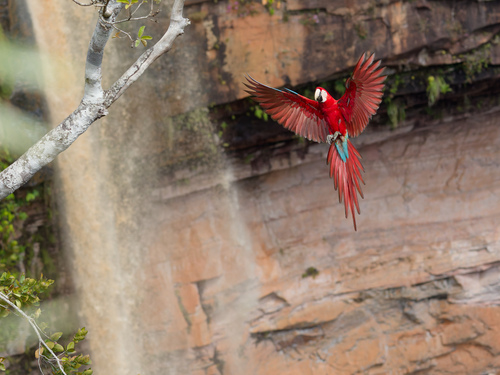
Red-and-green Macaw (Ara chloropterus) Red-and-green Macaw

Media

Loading…

In short

The most reliable field mark between Scarlet Macaw and Red-and-green (Green-winged) Macaw is the color of the upperwing coverts: Scarlet Macaw shows a broad yellow band across the middle of the upperwing, while Red-and-green Macaw has green upperwing coverts with no yellow. In addition, Red-and-green Macaw has distinctive red feather lines on the otherwise bare white facial skin, absent in Scarlet. Both are large, mostly red macaws, but Red-and-green is noticeably bulkier and longer. These differences are visible in both perched and flying birds, but the wing color is especially obvious in flight or when wings are spread. Juvenile and adult plumages are similar for field purposes, but eye color can help age Scarlet Macaw at close range.

Identification tips

  1. Upperwing coverts color (all ages): Scarlet Macaw shows a broad yellow band across the upperwing coverts, often edged with green (especially in South American birds); Red-and-green Macaw has solid green upperwing coverts with no yellow. This is the single most reliable field mark, especially in flight or when wings are spread.
  2. Facial skin pattern: Red-and-green Macaw has red feather lines on the otherwise bare white facial skin, forming a lined pattern around the eye; Scarlet Macaw's facial skin is plain white with only tiny scattered white feathers. This is visible at close range or in good photos.
  3. Body size and bulk: Red-and-green Macaw is noticeably larger and bulkier than Scarlet Macaw, but size overlap and posture can make this subtle unless birds are together.
  4. Tail shape and color: Scarlet Macaw's tail is more pointed and proportionally longer, with light blue on the rump and tail coverts; Red-and-green Macaw's tail is also long but shows iridescent teal surrounded by red. Tail color is best seen in good light or when the bird is perched with tail fanned.
  5. Bill color: Scarlet Macaw has a mostly pale horn upper mandible with a black lower mandible; Red-and-green Macaw's bill color is not specifically described as different, so not a reliable separator.
  6. Eye color (age-specific, Scarlet only): Juvenile Scarlet Macaws have dark eyes, while adults have pale yellow eyes. This can help age a Scarlet Macaw at close range but does not separate species.
  7. Breast color: Both species have bright red breasts, so this is not a separator.
  8. Flight jizz: Both species are strong, direct fliers with long tails, but Scarlet Macaw's yellow in the upperwing is obvious in flight; Red-and-green Macaw lacks this yellow flash.
  9. Voice: Both are extremely loud, with harsh, carrying calls; voice is not a reliable separator.
  10. Habitat and range: Both inhabit humid forests in overlapping regions; habitat is not a separator where both occur.
  11. Plumage variation (subspecies): Central American Scarlet Macaws are larger and have more blue in the wings, but still show yellow upperwing coverts. South American Scarlet Macaws may have more green edging the yellow, but never solid green like Red-and-green Macaw.
  12. Perched vs. flight views: The yellow upperwing band of Scarlet Macaw is visible both perched (with wings folded, as a yellow patch) and in flight (as a yellow flash); Red-and-green Macaw never shows yellow in the wing.
  13. Pitfalls: At a distance, both appear as large red macaws with long tails. Poor light or distant views can obscure the yellow in Scarlet's wing, making separation difficult. Always look for the facial feather lines and wing color when possible.
  14. Captivity context: Both are popular in aviculture, but Red-and-green Macaw is less common and more expensive than Scarlet Macaw. This is not a field mark, but may explain local abundance in collections.
  15. Sex and season: No sexual dimorphism or seasonal plumage differences are noted for either species; all field marks apply year-round and to both sexes.

Size

Red-and-green Macaw is the larger of the two, averaging 90–95 cm in length and 1,214 g in weight (range 1,050–1,700 g), making it one of the heaviest parrots. Scarlet Macaw is slightly smaller, typically 84 cm (Central American birds up to 89 cm) and about 1,000 g. In the field, Red-and-green Macaw appears bulkier and longer-tailed, but size overlap and posture can make this subtle unless the birds are side by side.

Plumage

For all ages, the key difference is the upperwing pattern: Scarlet Macaw has a broad yellow band across the upperwing coverts, often with some green at the edges (especially in South American birds), while Red-and-green Macaw's upperwing coverts are solid green, lacking yellow. In flight, this creates a strong yellow flash in Scarlet, absent in Red-and-green. Both species have mostly red heads and bodies, but Red-and-green Macaw has distinctive red feather lines on the white facial skin, while Scarlet's facial skin is plain white with tiny scattered white feathers. The tail of Scarlet Macaw is more pointed and proportionally longer, with light blue on the rump and tail coverts, while Red-and-green Macaw's tail is also long but shows iridescent teal surrounded by red. Juvenile Scarlet Macaws have dark eyes, while adults have pale yellow eyes; Red-and-green Macaw's eye color is not noted as distinctive for age separation.

Behaviour

Both species are typically seen in pairs or small groups, often flying high above the canopy and calling loudly. They are monogamous and nest in tree cavities. Aggressive behavior is most likely during breeding. No major behavioral differences are noted for field separation.

Habitat

Both species inhabit humid evergreen forests in Central and South America, with overlapping ranges. Scarlet Macaw's range extends from southeastern Mexico to Brazil, including Trinidad and Coiba, while Red-and-green Macaw is widespread in northern and central South America. Both have suffered local declines due to habitat loss and trapping, but habitat is not a reliable separator where ranges overlap.

Voice

Scarlet Macaw gives very loud, high and sometimes low-pitched, throaty squawks, squeaks, and screams, designed to carry over long distances. Red-and-green Macaw's voice is not described in detail here, but both species have loud, harsh calls typical of large macaws. Voice is not a reliable separator in the field.

Submit a better description

Use the same sections as the comparison. Your text is published immediately.

The most reliable field mark between Scarlet Macaw and Red-and-green (Green-winged) Macaw is the color of the upperwing coverts: Scarlet Macaw shows a broad yellow band across the middle of the upperwing, while Red-and-green Macaw has green upperwing coverts with no yellow. In addition, Red-and-green Macaw has distinctive red feather lines on the otherwise bare white facial skin, absent in Scarlet. Both are large, mostly red macaws, but Red-and-green is noticeably bulkier and longer. These differences are visible in both perched and flying birds, but the wing color is especially obvious in flight or when wings are spread. Juvenile and adult plumages are similar for field purposes, but eye color can help age Scarlet Macaw at close range.

  1. Upperwing coverts color (all ages): Scarlet Macaw shows a broad yellow band across the upperwing coverts, often edged with green (especially in South American birds); Red-and-green Macaw has solid green upperwing coverts with no yellow. This is the single most reliable field mark, especially in flight or when wings are spread.
  2. Facial skin pattern: Red-and-green Macaw has red feather lines on the otherwise bare white facial skin, forming a lined pattern around the eye; Scarlet Macaw's facial skin is plain white with only tiny scattered white feathers. This is visible at close range or in good photos.
  3. Body size and bulk: Red-and-green Macaw is noticeably larger and bulkier than Scarlet Macaw, but size overlap and posture can make this subtle unless birds are together.
  4. Tail shape and color: Scarlet Macaw's tail is more pointed and proportionally longer, with light blue on the rump and tail coverts; Red-and-green Macaw's tail is also long but shows iridescent teal surrounded by red. Tail color is best seen in good light or when the bird is perched with tail fanned.
  5. Bill color: Scarlet Macaw has a mostly pale horn upper mandible with a black lower mandible; Red-and-green Macaw's bill color is not specifically described as different, so not a reliable separator.
  6. Eye color (age-specific, Scarlet only): Juvenile Scarlet Macaws have dark eyes, while adults have pale yellow eyes. This can help age a Scarlet Macaw at close range but does not separate species.
  7. Breast color: Both species have bright red breasts, so this is not a separator.
  8. Flight jizz: Both species are strong, direct fliers with long tails, but Scarlet Macaw's yellow in the upperwing is obvious in flight; Red-and-green Macaw lacks this yellow flash.
  9. Voice: Both are extremely loud, with harsh, carrying calls; voice is not a reliable separator.
  10. Habitat and range: Both inhabit humid forests in overlapping regions; habitat is not a separator where both occur.
  11. Plumage variation (subspecies): Central American Scarlet Macaws are larger and have more blue in the wings, but still show yellow upperwing coverts. South American Scarlet Macaws may have more green edging the yellow, but never solid green like Red-and-green Macaw.
  12. Perched vs. flight views: The yellow upperwing band of Scarlet Macaw is visible both perched (with wings folded, as a yellow patch) and in flight (as a yellow flash); Red-and-green Macaw never shows yellow in the wing.
  13. Pitfalls: At a distance, both appear as large red macaws with long tails. Poor light or distant views can obscure the yellow in Scarlet's wing, making separation difficult. Always look for the facial feather lines and wing color when possible.
  14. Captivity context: Both are popular in aviculture, but Red-and-green Macaw is less common and more expensive than Scarlet Macaw. This is not a field mark, but may explain local abundance in collections.
  15. Sex and season: No sexual dimorphism or seasonal plumage differences are noted for either species; all field marks apply year-round and to both sexes.

Red-and-green Macaw is the larger of the two, averaging 90–95 cm in length and 1,214 g in weight (range 1,050–1,700 g), making it one of the heaviest parrots. Scarlet Macaw is slightly smaller, typically 84 cm (Central American birds up to 89 cm) and about 1,000 g. In the field, Red-and-green Macaw appears bulkier and longer-tailed, but size overlap and posture can make this subtle unless the birds are side by side.

For all ages, the key difference is the upperwing pattern: Scarlet Macaw has a broad yellow band across the upperwing coverts, often with some green at the edges (especially in South American birds), while Red-and-green Macaw's upperwing coverts are solid green, lacking yellow. In flight, this creates a strong yellow flash in Scarlet, absent in Red-and-green. Both species have mostly red heads and bodies, but Red-and-green Macaw has distinctive red feather lines on the white facial skin, while Scarlet's facial skin is plain white with tiny scattered white feathers. The tail of Scarlet Macaw is more pointed and proportionally longer, with light blue on the rump and tail coverts, while Red-and-green Macaw's tail is also long but shows iridescent teal surrounded by red. Juvenile Scarlet Macaws have dark eyes, while adults have pale yellow eyes; Red-and-green Macaw's eye color is not noted as distinctive for age separation.

Both species are typically seen in pairs or small groups, often flying high above the canopy and calling loudly. They are monogamous and nest in tree cavities. Aggressive behavior is most likely during breeding. No major behavioral differences are noted for field separation.

Both species inhabit humid evergreen forests in Central and South America, with overlapping ranges. Scarlet Macaw's range extends from southeastern Mexico to Brazil, including Trinidad and Coiba, while Red-and-green Macaw is widespread in northern and central South America. Both have suffered local declines due to habitat loss and trapping, but habitat is not a reliable separator where ranges overlap.

Scarlet Macaw gives very loud, high and sometimes low-pitched, throaty squawks, squeaks, and screams, designed to carry over long distances. Red-and-green Macaw's voice is not described in detail here, but both species have loud, harsh calls typical of large macaws. Voice is not a reliable separator in the field.

Discard your changes?

You have unsaved edits. If you leave now, those changes will be lost.

Scarlet Macaw · Red-and-green Macaw · My Tricky Birds