

Motmot

Scalloped Woodcreeper vs Peruvian Recurvebill

Lepidocolaptes falcinellus versus Syndactyla ucayalae

Play a quiz with Scalloped Woodcreeper and Peruvian Recurvebill
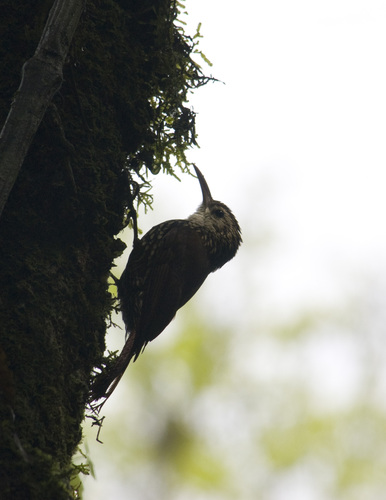
Scalloped Woodcreeper (Lepidocolaptes falcinellus) Scalloped Woodcreeper

Peruvian Recurvebill (Syndactyla ucayalae) Peruvian Recurvebill

Media

Loading…

In short

The most reliable field mark for separating Scalloped Woodcreeper from Peruvian Recurvebill is bill shape: the woodcreeper has a long, slender, slightly decurved bill, while the recurvebill has a heavy, wedge-shaped bill that is distinctly upturned. In addition, the Scalloped Woodcreeper shows a scaly, streaked pattern on the underparts and a pale, mottled face, while the Peruvian Recurvebill is more uniformly orange-rufous below with only faint streaking and a darker, reddish face. Juvenile Peruvian Recurvebills can show a strong black scalloped pattern below, but their structure still differs. Size is also a clue: the recurvebill is noticeably bulkier. Habitat and foraging behavior can help, but structure and underpart pattern are the best field marks.

Identification tips

  1. Bill shape is the most reliable mark: Scalloped Woodcreeper has a long, slender, slightly downcurved bill; Peruvian Recurvebill has a heavy, wedge-shaped, and distinctly upturned bill. This is obvious in profile, even at a distance.
  2. Underpart pattern: Adult Scalloped Woodcreeper shows bold, black-edged buff streaks on olive underparts, giving a scaly or 'scalloped' look. Adult Peruvian Recurvebill is orange-rufous below with only faint pale streaks, mostly on the breast and throat; the belly and flanks are nearly unstreaked.
  3. Juvenile confusion: Juvenile Peruvian Recurvebill can show a strong black scalloped pattern on paler underparts, but the bird is bulkier, the bill is upturned, and the face pattern differs (brighter supercilium, darker crown).
  4. Face and supercilium: Scalloped Woodcreeper has a creamy white face with blackish mottling and a clear pale supercilium. Peruvian Recurvebill's face is darker, with a faint rufous supercilium, reddish malar, and grizzled lores/ear coverts.
  5. Upperparts color: Scalloped Woodcreeper is olive-brown to cinnamon-brown above with a rufous-chestnut rump and tail. Peruvian Recurvebill is more uniformly reddish brown above, with a slightly more reddish collar and a dark reddish chestnut tail.
  6. Crown pattern: Scalloped Woodcreeper has a dusky to dull black crown and nape with obvious rich buff spots. Peruvian Recurvebill's crown is dark reddish brown with faint streaks on the forehead (adults) or dark rufescent spots (juveniles).
  7. Size and structure: Peruvian Recurvebill is substantially larger and bulkier (47 g vs. 28 g), with a heavier head and bill. Scalloped Woodcreeper is slimmer and more elongated.
  8. Leg and foot color: Scalloped Woodcreeper has greenish gray to greenish brown legs and feet; Peruvian Recurvebill's are olive to olive-green. This is subtle and rarely diagnostic in the field.
  9. Foraging behavior: Scalloped Woodcreeper hitches up trunks and branches, often in the mid-levels or canopy; Peruvian Recurvebill forages in dense bamboo or cane, often hammering or excavating, and usually stays low.
  10. Habitat: If the bird is in dense bamboo or riverside cane in the western Amazon, Peruvian Recurvebill is likely. In more open forest or edge habitats outside the Amazon, Scalloped Woodcreeper is expected.
  11. Flight and wing pattern: Neither species shows a distinctive upperwing panel or contrasting flight feather pattern that is diagnostic at a distance, but woodcreeper's flight feathers have brown outer webs and chestnut inner webs with blackish brown tips.
  12. Tail color: Both species have rufous to chestnut tails, but the recurvebill's is darker and more uniformly reddish chestnut.
  13. Voice: If you hear a short, harsh, ascending rattle (2–3 sec) or a loud, hoarse 'chack', this is Peruvian Recurvebill. Scalloped Woodcreeper's voice is not described here.
  14. Sexes similar: Both species have similar plumage in males and females; do not use sex as a field mark.
  15. Mixed flocks: Both may join mixed-species flocks, but recurvebill will stay low in bamboo, while woodcreeper may be higher in the canopy or on trunks.

Size

Peruvian Recurvebill is substantially heavier (47 g vs. 28 g) and slightly longer (19–20 cm vs. 17–20 cm) than Scalloped Woodcreeper. In the field, the recurvebill appears bulkier and more robust, especially in the head and bill, while the woodcreeper is slimmer and more elongated. This difference is most apparent when both species are seen side by side or with experience, but the recurvebill's larger size and heavier build are usually evident even at a distance.

Plumage

Juvenile Peruvian Recurvebills have a strong black scalloped pattern on paler underparts, a brighter supercilium, and a darker, less rufescent back compared to adults. Adults of both species have streaked or scalloped underparts, but the Scalloped Woodcreeper's streaks are bold, black-edged, and on an olive background, giving a distinctly scaly look. Its face is creamy white with blackish mottling and a clear pale supercilium. In contrast, adult Peruvian Recurvebill is orange-rufous below with only faint pale streaks on the breast and throat, and the face is darker with a faint rufous supercilium and reddish malar. The recurvebill's upperparts are more uniformly reddish brown, while the woodcreeper has olive-brown to cinnamon-brown back and rufous-chestnut rump and tail. In flight, the woodcreeper shows brown outer webs and chestnut inner webs to the flight feathers, with blackish brown tips, but neither species has a distinctive wing panel or contrasting upperwing pattern that is diagnostic at a distance.

Behaviour

Scalloped Woodcreeper typically forages by hitching up trunks and branches from the mid-level to the canopy, often joining mixed-species flocks and sometimes sallying for prey. It is more arboreal and spends less time in dense undergrowth. Peruvian Recurvebill, on the other hand, is a bamboo specialist, foraging mostly in dense bamboo thickets and the forest understory, rarely venturing above the mid-storey. It feeds by hammering, excavating, and flaking bamboo, showing a more ground-oriented, probing behavior. Both may join mixed flocks, but their foraging substrates and movements are quite different.

Habitat

Scalloped Woodcreeper is found in a range of forest types across southern Brazil, Paraguay, Uruguay, and northern Argentina, usually in more open or edge forest and not specifically tied to bamboo. Peruvian Recurvebill is a bamboo specialist of the western Amazon Basin (Peru, Bolivia, western Brazil), almost always found in or near dense Guadua bamboo or riverside cane thickets. If the bird is seen in extensive bamboo or riverside cane, especially in the western Amazon, recurvebill is far more likely; in more open or edge forest outside the Amazon, woodcreeper is expected.

Voice

Peruvian Recurvebill has a distinctive vocalization: a short, loud, harsh, ascending rattle lasting 2–3 seconds, with the last note sometimes dropping in pitch, and a loud, hoarse 'chack' call. No vocal description is available for Scalloped Woodcreeper in these notes, so voice is only diagnostic if the recurvebill's unique rattle is heard.

Submit a better description

Use the same sections as the comparison. Your text is published immediately.

The most reliable field mark for separating Scalloped Woodcreeper from Peruvian Recurvebill is bill shape: the woodcreeper has a long, slender, slightly decurved bill, while the recurvebill has a heavy, wedge-shaped bill that is distinctly upturned. In addition, the Scalloped Woodcreeper shows a scaly, streaked pattern on the underparts and a pale, mottled face, while the Peruvian Recurvebill is more uniformly orange-rufous below with only faint streaking and a darker, reddish face. Juvenile Peruvian Recurvebills can show a strong black scalloped pattern below, but their structure still differs. Size is also a clue: the recurvebill is noticeably bulkier. Habitat and foraging behavior can help, but structure and underpart pattern are the best field marks.

  1. Bill shape is the most reliable mark: Scalloped Woodcreeper has a long, slender, slightly downcurved bill; Peruvian Recurvebill has a heavy, wedge-shaped, and distinctly upturned bill. This is obvious in profile, even at a distance.
  2. Underpart pattern: Adult Scalloped Woodcreeper shows bold, black-edged buff streaks on olive underparts, giving a scaly or 'scalloped' look. Adult Peruvian Recurvebill is orange-rufous below with only faint pale streaks, mostly on the breast and throat; the belly and flanks are nearly unstreaked.
  3. Juvenile confusion: Juvenile Peruvian Recurvebill can show a strong black scalloped pattern on paler underparts, but the bird is bulkier, the bill is upturned, and the face pattern differs (brighter supercilium, darker crown).
  4. Face and supercilium: Scalloped Woodcreeper has a creamy white face with blackish mottling and a clear pale supercilium. Peruvian Recurvebill's face is darker, with a faint rufous supercilium, reddish malar, and grizzled lores/ear coverts.
  5. Upperparts color: Scalloped Woodcreeper is olive-brown to cinnamon-brown above with a rufous-chestnut rump and tail. Peruvian Recurvebill is more uniformly reddish brown above, with a slightly more reddish collar and a dark reddish chestnut tail.
  6. Crown pattern: Scalloped Woodcreeper has a dusky to dull black crown and nape with obvious rich buff spots. Peruvian Recurvebill's crown is dark reddish brown with faint streaks on the forehead (adults) or dark rufescent spots (juveniles).
  7. Size and structure: Peruvian Recurvebill is substantially larger and bulkier (47 g vs. 28 g), with a heavier head and bill. Scalloped Woodcreeper is slimmer and more elongated.
  8. Leg and foot color: Scalloped Woodcreeper has greenish gray to greenish brown legs and feet; Peruvian Recurvebill's are olive to olive-green. This is subtle and rarely diagnostic in the field.
  9. Foraging behavior: Scalloped Woodcreeper hitches up trunks and branches, often in the mid-levels or canopy; Peruvian Recurvebill forages in dense bamboo or cane, often hammering or excavating, and usually stays low.
  10. Habitat: If the bird is in dense bamboo or riverside cane in the western Amazon, Peruvian Recurvebill is likely. In more open forest or edge habitats outside the Amazon, Scalloped Woodcreeper is expected.
  11. Flight and wing pattern: Neither species shows a distinctive upperwing panel or contrasting flight feather pattern that is diagnostic at a distance, but woodcreeper's flight feathers have brown outer webs and chestnut inner webs with blackish brown tips.
  12. Tail color: Both species have rufous to chestnut tails, but the recurvebill's is darker and more uniformly reddish chestnut.
  13. Voice: If you hear a short, harsh, ascending rattle (2–3 sec) or a loud, hoarse 'chack', this is Peruvian Recurvebill. Scalloped Woodcreeper's voice is not described here.
  14. Sexes similar: Both species have similar plumage in males and females; do not use sex as a field mark.
  15. Mixed flocks: Both may join mixed-species flocks, but recurvebill will stay low in bamboo, while woodcreeper may be higher in the canopy or on trunks.

Peruvian Recurvebill is substantially heavier (47 g vs. 28 g) and slightly longer (19–20 cm vs. 17–20 cm) than Scalloped Woodcreeper. In the field, the recurvebill appears bulkier and more robust, especially in the head and bill, while the woodcreeper is slimmer and more elongated. This difference is most apparent when both species are seen side by side or with experience, but the recurvebill's larger size and heavier build are usually evident even at a distance.

Juvenile Peruvian Recurvebills have a strong black scalloped pattern on paler underparts, a brighter supercilium, and a darker, less rufescent back compared to adults. Adults of both species have streaked or scalloped underparts, but the Scalloped Woodcreeper's streaks are bold, black-edged, and on an olive background, giving a distinctly scaly look. Its face is creamy white with blackish mottling and a clear pale supercilium. In contrast, adult Peruvian Recurvebill is orange-rufous below with only faint pale streaks on the breast and throat, and the face is darker with a faint rufous supercilium and reddish malar. The recurvebill's upperparts are more uniformly reddish brown, while the woodcreeper has olive-brown to cinnamon-brown back and rufous-chestnut rump and tail. In flight, the woodcreeper shows brown outer webs and chestnut inner webs to the flight feathers, with blackish brown tips, but neither species has a distinctive wing panel or contrasting upperwing pattern that is diagnostic at a distance.

Scalloped Woodcreeper typically forages by hitching up trunks and branches from the mid-level to the canopy, often joining mixed-species flocks and sometimes sallying for prey. It is more arboreal and spends less time in dense undergrowth. Peruvian Recurvebill, on the other hand, is a bamboo specialist, foraging mostly in dense bamboo thickets and the forest understory, rarely venturing above the mid-storey. It feeds by hammering, excavating, and flaking bamboo, showing a more ground-oriented, probing behavior. Both may join mixed flocks, but their foraging substrates and movements are quite different.

Scalloped Woodcreeper is found in a range of forest types across southern Brazil, Paraguay, Uruguay, and northern Argentina, usually in more open or edge forest and not specifically tied to bamboo. Peruvian Recurvebill is a bamboo specialist of the western Amazon Basin (Peru, Bolivia, western Brazil), almost always found in or near dense Guadua bamboo or riverside cane thickets. If the bird is seen in extensive bamboo or riverside cane, especially in the western Amazon, recurvebill is far more likely; in more open or edge forest outside the Amazon, woodcreeper is expected.

Peruvian Recurvebill has a distinctive vocalization: a short, loud, harsh, ascending rattle lasting 2–3 seconds, with the last note sometimes dropping in pitch, and a loud, hoarse 'chack' call. No vocal description is available for Scalloped Woodcreeper in these notes, so voice is only diagnostic if the recurvebill's unique rattle is heard.

Discard your changes?

You have unsaved edits. If you leave now, those changes will be lost.

Scalloped Woodcreeper · Peruvian Recurvebill · My Tricky Birds