

Sand Martin vs Southern Rough-winged Swallow
Riparia riparia versus Stelgidopteryx ruficollis
Play a quiz with Sand Martin and Southern Rough-winged Swallow
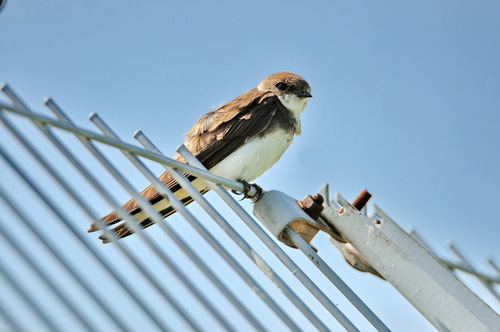 Sand Martin
 Southern Rough-winged Swallow
In short
The most reliable field mark to separate Sand Martin from Southern Rough-winged Swallow is the presence of a distinct, narrow brown breast band on Sand Martin of all ages, which Southern Rough-winged Swallow lacks. Juvenile Sand Martins also show rufous-tipped wing coverts and secondary edges, while juvenile Southern Rough-winged Swallows have pale-edged back feathers but not the same wing markings. Sand Martin is smaller and more compact, with a quicker, jerkier flight, compared to the slightly larger, square-tailed, and slower-flying Southern Rough-winged Swallow. Both species are brown above and pale below, but throat and breast coloration differ: Sand Martin has a white throat and belly, while Southern Rough-winged Swallow shows a cinnamon or tawny-buff throat and a yellowish-gray-brown belly. In perched or flight views, focus on the breast band and throat color for the clearest separation.
Identification tips
- Breast Band (all ages): Sand Martin always shows a narrow, well-defined brown breast band across the upper chest. Southern Rough-winged Swallow never has a breast band; its breast is plain or slightly darker than the belly but unmarked.
- Throat Color: Sand Martin has a clean white throat, contrasting with the brown breast band. Southern Rough-winged Swallow has a cinnamon, tawny-buff, or duller brownish throat (depending on subspecies and age), blending into the breast and lacking sharp contrast.
- Belly and Underparts: Sand Martin's belly and undertail are bright white. Southern Rough-winged Swallow's belly is yellowish-gray-brown, and undertail coverts are white, but the overall effect is dingier and less crisp than Sand Martin.
- Juvenile Wing Coverts: Juvenile Sand Martins have rufous tips to the wing coverts and rufous edges to the secondaries, visible in good light or close views. Juvenile Southern Rough-winged Swallows have pale edges to back feathers, not on the wings, so check for rufous in the wing area for Sand Martin.
- Tail Shape: Sand Martin's tail is slightly forked, especially noticeable in flight. Southern Rough-winged Swallow's tail is square.
- Size and Structure: Sand Martin is smaller and more compact, with a short bill and quick, jerky flight. Southern Rough-winged Swallow is heavier, bulkier, and has a more relaxed, slower flight.
- Upperparts: Both are brown above, but Southern Rough-winged Swallow is darker and may show a paler or whitish rump in some subspecies. Sand Martin's back is plain brown.
- Sex Differences: Only male Southern Rough-winged Swallows have stiff recurved barbs on the outer primaries, but these are not visible in the field.
- Flight Style: Sand Martin's flight is rapid and erratic, with quick turns and dips. Southern Rough-winged Swallow flies more steadily and often forages higher or in looser flocks.
- Habitat and Range: In North America, only Sand Martin occurs. In South America, especially near water or in open country, both may be present in the non-breeding season, but Sand Martin is a migrant and Southern Rough-winged Swallow is resident.
- Perched Posture: Sand Martin often appears more compact and upright when perched, while Southern Rough-winged Swallow may look longer-bodied and heavier.
- Voice: Sand Martin gives a gravelly twittering in flight; Southern Rough-winged Swallow's call is not distinctive in the provided notes.
- Subspecies Variation: Southern Rough-winged Swallow subspecies may show paler rumps or more tawny throats, but none develop a true breast band.
- Colony Behavior: Sand Martin breeds in large colonies in sandy banks; Southern Rough-winged Swallow breeds singly or in small groups.
- Seasonal Context: If seen in large numbers in the Holarctic during the breeding season, it's Sand Martin. In South America outside the breeding season, check for the breast band to confirm Sand Martin among resident Southern Rough-winged Swallows.
Size
Sand Martin is slightly smaller, measuring 12–13 cm in length and weighing 11–16 g (up to 19.5 g pre-migration) [wikipedia]. Southern Rough-winged Swallow is about 13 cm long and heavier at 14–18 g [wikipedia]. Wingspan is only given for Sand Martin (26.5–29 cm), but overall, Southern Rough-winged Swallow appears bulkier and heavier-built. Tail shape also differs: Sand Martin has a slightly forked tail, while Southern Rough-winged Swallow's tail is square.
Plumage
- Juveniles: Sand Martin juveniles show rufous tips to the wing coverts and rufous margins to the secondaries, which can be visible in flight or at rest. Southern Rough-winged Swallow juveniles have pale edges on back feathers, but not on the wing coverts or secondaries, so this is a key difference for immatures.
- Adults: Sand Martin of all ages and sexes has a clear, narrow brown breast band separating the white throat from the white belly. Southern Rough-winged Swallow lacks any breast band; instead, adults have a cinnamon (or tawny-buff, depending on subspecies) throat and a yellowish-gray-brown belly, with a dark gray-brown breast that blends into the underparts. Their upperparts are both brown, but Southern Rough-winged Swallow is darker and may show a paler rump in some subspecies. Sand Martin's underparts are clean white except for the breast band, while Southern Rough-winged Swallow's are dingier and more washed with brown or yellowish tones.
- Wing and tail: Sand Martin has a slightly forked tail; Southern Rough-winged Swallow's tail is square. Only male Southern Rough-winged Swallows have stiff recurved barbs on the outer primaries (not visible in the field).
Behaviour
Sand Martin typically flies with rapid, jerky wingbeats and quick changes of direction, often low over water or open ground. Southern Rough-winged Swallow has a slower, more relaxed flight style, often foraging in small flocks and sometimes higher above ground or water. Sand Martin is more likely to be seen in large colonies during breeding, while Southern Rough-winged Swallow breeds singly or in small groups. Both species catch insects in flight, but Sand Martin's flight is more frenetic and compact.
Habitat
Sand Martin breeds in colonies in sandy banks, river edges, and similar open habitats, mostly in the Holarctic (Europe, Asia, North America), and winters in Africa, southern Asia, and South America. Southern Rough-winged Swallow is resident or migratory in Central and South America (except Chile), found in a wide range of open habitats, especially near water, but also in clearings within forests and up to high elevations in the Andes. Overlap is possible only in South America during the non-breeding season, but Sand Martin is generally a migrant there, while Southern Rough-winged Swallow is resident or a partial migrant.
Voice
Sand Martin gives a continuous, gravelly twittering in flight and a conversational undertone when perched, with a harsh alarm call in response to predators. No distinctive vocalization is described for Southern Rough-winged Swallow in the provided notes, so voice is not a reliable separator in the field based on these sources.
Sand Martin · Southern Rough-winged Swallow · My Tricky Birds