

Sand Martin vs Eurasian Crag Martin
Riparia riparia versus Ptyonoprogne rupestris
Play a quiz with Sand Martin and Eurasian Crag Martin
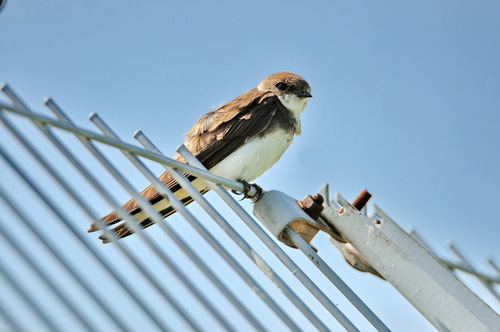 Sand Martin
 Eurasian Crag Martin
In short
The most reliable way to separate Sand Martin from Eurasian Crag Martin is by looking for the Sand Martin's narrow brown breast band (all ages), which the crag martin completely lacks. In flight, crag martins show distinctive white patches near the tips of the tail feathers, absent in Sand Martin. Crag martins are also noticeably larger and bulkier, with broader wings and a squarer tail. Juvenile Sand Martins have rufous-tipped wing coverts, while juvenile crag martins show buff-brown tips to the head, upperparts, and coverts. Both species can appear superficially similar at a distance, but careful attention to these details will reliably separate them.
Identification tips
- Breast Band (All Ages): Sand Martin always shows a narrow, well-defined brown breast band across the white underparts; crag martin never has this band—its underparts are plain and slightly dirty-looking.
- Tail Pattern (All Ages): Crag martin has distinctive white patches near the tips of most tail feathers, best seen in flight or when tail is spread; Sand Martin's tail is plain brown with no white spots.
- Size and Structure: Crag martin is noticeably larger, heavier, and bulkier, with broader wings and a squarer, shorter tail; Sand Martin is smaller, slimmer, and more delicate in build.
- Upperparts Color: Sand Martin is a uniform brown above; crag martin is ash-brown, sometimes appearing slightly greyer or duskier, but this can be subtle in poor light.
- Underwing and Undertail Coverts: Crag martin has blackish underwing and undertail coverts, contrasting with its paler belly; Sand Martin's underwings are plainer and less contrasting.
- Juvenile Plumage: Juvenile Sand Martins have rufous tips to wing coverts and secondaries; juvenile crag martins have buff-brown tips to head, upperparts, and coverts—look for these subtle edges in fresh autumn birds.
- Flight Style: Sand Martin's flight is quick, jerky, and agile, often low over water; crag martin's flight is slower, with regular glides and broader, more flexible wings—often seen near cliffs or buildings.
- Perched Posture: Crag martin looks bulkier and tends to perch on rocky ledges or vertical surfaces; Sand Martin is slimmer and more likely to perch on wires or reeds.
- Habitat Context: Sand Martin is usually found near sandy banks or water during breeding; crag martin is tied to rocky or urban stone habitats. If you see a swallow near a cliff or stone building, crag martin is more likely.
- Vocalizations: Listen for the Sand Martin's continuous twittering versus the crag martin's short, high, clipped calls.
- Bill and Legs: Both have small, dark bills and brownish legs, not reliably separable in the field.
- Sexes: Both species are sexually monomorphic—males and females look alike.
- Seasonal Pitfalls: During migration or in winter, both species may occur together, but the structural and plumage differences above still apply.
- Confusion Risk: At long range or in poor light, the breast band and tail spots are the most reliable marks. Juveniles may be trickier, but the presence or absence of the breast band and tail spots remains diagnostic.
- When in Doubt: If you cannot see the breast band or tail spots, use size, structure, and flight style in combination with habitat context to make the best call.
Size
Eurasian Crag Martin is significantly larger and heavier than Sand Martin. Crag martin length is 13–15 cm with a wingspan of 32–34.5 cm and an average mass of about 20–23 g. Sand Martin is smaller at 12–13 cm length, 26.5–29 cm wingspan, and 11–16 g (up to 19.5 g pre-migration). Crag martin also appears broader-bodied and more robust, with broader wings and tail compared to the more slender, delicate Sand Martin.
Plumage
- Juveniles: Sand Martin juveniles have rufous tips to the wing coverts and secondaries, while juvenile crag martins have buff-brown tips to the head, upperparts, and coverts. These subtle differences are best seen at close range or in good light.
- Adults: Adult Sand Martins are brown above, white below, with a crisp, narrow brown breast band and a white throat. Crag martins are ash-brown above, paler below, but lack any breast band. Instead, they have a uniform, slightly dirty-looking underside. Crag martins show distinctive white patches near the tips of all but the central and outermost tail feathers, visible especially in flight or when the tail is spread. Sand Martins have a plain brown tail without white spots. Crag martins also have blackish underwing and undertail coverts, which can contrast with the paler underparts, while Sand Martins have plainer underwings.
Behaviour
Sand Martins have a quick, jerky flight style typical of small swallows, often seen twisting and darting low over water or open ground. Eurasian Crag Martins fly with slower, more deliberate wingbeats interspersed with glides, and are often seen maneuvering near cliffs or rocky faces. Crag martins frequently soar or glide with wings held flat, showing their broader wings and larger size. When perched, crag martins look bulkier and more robust, often sitting on rocky ledges or buildings, while Sand Martins are more likely to perch on wires or reeds.
Habitat
Sand Martins breed in colonies in sandy banks, river cliffs, and gravel pits, often near water. Eurasian Crag Martins prefer rocky habitats, such as cliffs, gorges, and mountainous areas, and are often seen around human structures in suitable terrain. While both can be seen in flight over open areas, Sand Martins are more closely tied to water and soft earth for nesting, whereas crag martins are associated with rock faces and urban stonework. Overlap may occur during migration or in winter, but breeding habitats are usually distinct.
Voice
Sand Martin gives a continuous, gravelly twittering in flight, which becomes softer and more conversational when perched. Its alarm call is harsh and used in response to predators. Crag Martin calls are described as short, high 'pli', 'piieh', and 'tshir' notes, somewhat resembling linnet or house martin calls. Their vocalizations are less continuous and more clipped compared to the Sand Martin's twittering.