

Rufous-tailed Foliage-gleaner vs Buff-browed Foliage-gleaner
Anabacerthia ruficaudata versus Syndactyla rufosuperciliata
Play a quiz with Rufous-tailed Foliage-gleaner and Buff-browed Foliage-gleaner
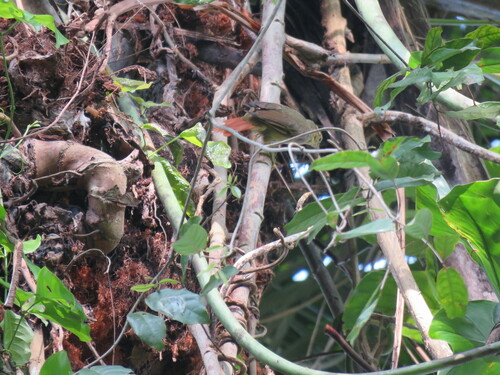 Rufous-tailed Foliage-gleaner
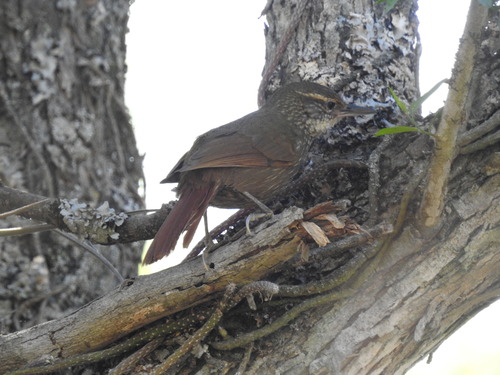 Buff-browed Foliage-gleaner
In short
The most reliable field mark to separate Rufous-tailed Foliage-gleaner from Buff-browed Foliage-gleaner is the combination of tail color and supercilium: Rufous-tailed shows a brighter, more distinctly rufous tail and a narrower, ochraceous-buff supercilium, while Buff-browed has a duller rufous tail and a broader, paler buff supercilium extending to the nape. Juvenile differences are subtle but present, with Rufous-tailed showing a more prominent ochraceous supercilium and browner upperparts, while Buff-browed juveniles have spotted (not streaked) underparts. Both species are medium-sized foliage-gleaners with similar structure, but Buff-browed tends to have a slightly thicker, more upcurved bill. Careful attention to face pattern, tail tone, and underpart streaking is key, especially in mixed flocks or poor light.
Identification tips
- Tail Color: Rufous-tailed Foliage-gleaner has a brighter, more saturated rufous tail, while Buff-browed's tail is duller rufous or chestnut, sometimes with a chestnut wash in some subspecies. This is often visible even in shaded forest.
- Supercilium (Eyebrow): Rufous-tailed shows a narrow, ochraceous-buff supercilium, while Buff-browed has a broader, paler buff supercilium that extends well behind the eye to the nape—this is especially obvious in side views.
- Eyering: Rufous-tailed has a wide ochraceous buff eyering, contrasting with the face; Buff-browed's eyering is tawny-buff but less conspicuous due to the broader supercilium.
- Face Pattern: Rufous-tailed features a dark olive line behind the eye and olive-brownish lores/ear coverts with yellowish buff flecks; Buff-browed has a brownish face with small buff markings, lacking the strong contrast of Rufous-tailed.
- Crown and Back: Rufous-tailed has a dark olive crown with faint pale spots/streaks at the rear, and an upper back with pale streaks; Buff-browed's crown is dull olive-brown with only vague whitish streaks at the rear, and the back/rump are plain olive-brown.
- Underparts: Rufous-tailed's throat is buff-yellow (sometimes clearer yellow in some subspecies), breast and belly are dull buff yellow with faint olive streaks, and flanks/undertail coverts are more olivaceous. Buff-browed's throat is whitish with brownish feather tips, breast is buffy whitish with olive-brown feather edges (scalloped), and the belly shows wide, blurry buffy-whitish streaks that fade toward the rear.
- Juvenile Underparts: Juvenile Rufous-tailed has darker, less yellowish underparts and a more prominent ochraceous supercilium; juvenile Buff-browed has spotted (not streaked) underparts—a subtle but diagnostic mark if seen well.
- Bill Shape: Buff-browed has a thicker, slightly upcurved bill, while Rufous-tailed's bill is wedge-shaped and less robust. This can be tricky to judge unless seen side-by-side.
- Uppertail Coverts: Rufous-tailed's uppertail coverts are dark olive with rufous tips; Buff-browed's are plain olive-brown or may have a chestnut wash in some subspecies.
- Throat Color (Subspecies): Some Rufous-tailed subspecies (e.g., subflavescens, flavipectus) show a clearer yellow or darker yellowish throat, while Buff-browed subspecies vary from buff-tinged to more ochraceous, but always paler than the rufous tail.
- Underpart Streaking: Rufous-tailed's streaking is faint and mostly on the upper breast; Buff-browed's streaks are broader, blurrier, and most prominent on the belly, fading toward the vent.
- Leg Color: Both species have legs in the olive to brownish range; not a reliable field mark.
- Habitat Context: In strictly Amazonian terra firme or várzea, Rufous-tailed is more likely; in southern Atlantic or Andean foothill forests, Buff-browed is more likely. In overlap zones, use plumage and structure.
- Vocalization: If heard, Rufous-tailed's song is a loud, staccato series of 'te' or 'ke' notes, descending and accelerating at the end. Buff-browed's song is not described here.
- Pitfalls: Both species can show variable supercilium and throat color by subspecies and age. Always check multiple features, especially tail color, supercilium width/length, and underpart pattern. Juveniles are best separated by underpart pattern (spotted in Buff-browed, darker and less yellow in Rufous-tailed).
Size
Both species are very close in size, with Buff-browed Foliage-gleaner averaging 17–18 cm in length and 22–33 g in mass (mean 25.6 g), while Rufous-tailed Foliage-gleaner is 16–17 cm and 21–32 g. In the field, this size difference is negligible and not a reliable separation point. Structure is also similar, but Buff-browed may appear slightly bulkier due to its thicker, more upcurved bill.
Plumage
- Juveniles: Rufous-tailed Foliage-gleaner juveniles show a more prominent ochraceous supercilium, browner upperparts, and darker, less yellowish underparts. Buff-browed juveniles are similar to adults but have spotted (rather than streaked) underparts—this is the best age-specific mark if seen well.
- Adults: Rufous-tailed Foliage-gleaner has a wide ochraceous buff eyering, narrow buff-yellow supercilium, dark olive crown/back with pale streaks (especially on upper back), and a bright rufous tail. Underparts are buff-yellow with faint olive streaks. Buff-browed Foliage-gleaner shows a broader, paler buff supercilium extending to the nape, dull olive-brown crown/back with vague whitish streaks only at the rear, and a dull rufous tail. Underparts are buffy whitish with olive-brown feather edges (scalloped look), with blurry buffy-whitish streaks on the belly that fade toward the rear. Subspecies differences exist but are subtle and mostly affect supercilium and throat color.
Behaviour
Both species forage in similar ways, moving methodically through foliage, often as part of mixed-species flocks. No major behavioral differences are noted that would help in field separation.
Habitat
Rufous-tailed Foliage-gleaner is primarily a bird of lowland Amazonian terra firme and seasonally flooded forests, mostly below 850 m but up to 1300 m in Venezuela. Buff-browed Foliage-gleaner has a broader range, found from Amazonia into southern Brazil, Argentina, Paraguay, Uruguay, and Andean foothills, occupying a wider variety of forest types. Overlap occurs in parts of Brazil, Peru, and Bolivia, but Buff-browed is more likely in southern and southeastern forests, while Rufous-tailed is more strictly Amazonian.
Voice
Rufous-tailed Foliage-gleaner gives a loud, staccato series of up to 25 'te' or 'ke' notes, descending and accelerating at the end, or sometimes on a single pitch with acceleration then slight deceleration. Buff-browed's song is not described in the provided notes, so vocal differences cannot be reliably used for separation based on this information.
Rufous-tailed Foliage-gleaner · Buff-browed Foliage-gleaner · My Tricky Birds