

Rufous Hornero vs Great Pampa-Finch
Furnarius rufus versus Embernagra platensis
Play a quiz with Rufous Hornero and Great Pampa-Finch
 Rufous Hornero
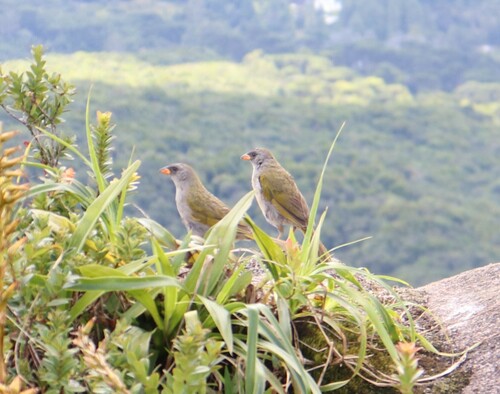 Great Pampa-Finch
In short
The most reliable field mark to separate Rufous Hornero from Great Pampa-Finch is overall coloration and head pattern: Rufous Hornero is a uniform reddish-brown bird with a dull brown crown and pale underparts, while Great Pampa-Finch is grass-green above with a gray head and a bold dark facial mask. In flight or perched, the Hornero shows a square tail and cinnamon wingbars, whereas the Pampa-Finch has a long tail and greenish wings with dark tertials. Bill shape also differs: Hornero's bill is slender and slightly decurved, while the Pampa-Finch has a thick, conical bill. Both species overlap in range and habitat, but their structure and plumage are distinct if seen well.
Identification tips
- Overall color: Rufous Hornero is warm reddish-brown above and below, while Great Pampa-Finch is grass-green above with a gray head and mostly gray underparts.
- Head pattern: Look for the Pampa-Finch's bold dark mask through the eye on a gray head; Hornero lacks any facial mask and has a plain dull brown crown.
- Bill shape: Hornero has a slender, slightly decurved bill; Pampa-Finch's bill is thick, conical, and orange with a black culmen—especially obvious at close range.
- Tail shape and length: Hornero has a short, square tail; Pampa-Finch's tail is long and pointed, with greenish central feathers and dusky outer feathers edged green.
- Wing pattern: Hornero shows cinnamon wingbars on pale brown wings with blackish flight feathers; Pampa-Finch's wings are grass-green with wide blackish tertials but lack distinct wingbars.
- Underparts: Hornero is pale buffy brown below, sometimes slightly paler in juveniles; Pampa-Finch is mostly gray below with a paler throat and off-white belly, sometimes with a cinnamon wash.
- Back and mantle: Hornero is uniform rufous-brown; Pampa-Finch (nominate) has dark streaks on the greenish back and mantle (note: streaking may be absent in some subspecies).
- Leg color: Pampa-Finch has dull pinkish or bright yellow to orange legs (depending on subspecies); Hornero's leg color is not distinctive in the field.
- Behavior: Hornero is often seen walking on the ground, upright, and near human structures; Pampa-Finch is more often perched in grass or shrubs, less tied to buildings.
- Nest type: If you see a large clay 'oven' nest nearby, it's Hornero; Pampa-Finch builds a small cup nest in vegetation.
- Song and display: Hornero's rapid trilled duet, with wing-beating display, is unique; if seen, this confirms Hornero.
- Size and jizz: Hornero appears chunkier and more compact; Pampa-Finch is longer-tailed and sleeker.
- Habitat context: In urban or agricultural settings, Hornero is more likely; in open natural grassland or pampas, Pampa-Finch is typical.
- Sex and age: Both species are similar in both sexes and ages, but juvenile Horneros are only slightly paler below; no strong age-specific marks in either species.
- Pitfalls: In poor light, Pampa-Finch's green and gray may look brownish, but the facial mask and bill shape remain reliable. Hornero never shows a dark facial mask or green tones.
Size
Rufous Hornero is slightly heavier, averaging 53 g, and measures 18–20 cm in length. Great Pampa-Finch is a bit longer, at 20.5–23 cm, but lighter, weighing 45–47 g. The Hornero appears more compact with a shorter tail and a square-ended profile, while the Pampa-Finch is longer-tailed and slimmer-bodied. In the field, the Hornero may look chunkier and more upright, whereas the Pampa-Finch gives a sleeker, more horizontal impression.
Plumage
- Juvenile/immature marks: Juvenile Rufous Horneros are only slightly paler below than adults, with no dramatic change in upperwing pattern. No age-specific wing pattern is described for either species, so age is not a strong separator in flight.
- Adult Rufous Hornero is overall reddish-brown (rufous), with a dull brown crown, whitish throat, and pale buffy underparts. The wings are pale brown with blackish flight feathers and cinnamon wingbars. The tail is short and square.
- Adult Great Pampa-Finch is grass-green above with a gray head and a distinctive dark mask from the lores past the eye. The nape is gray with green tones, and the mantle/back have dark streaks (in nominate). The wings are mostly grass-green with wide blackish tertials, and the tail is long with greenish central feathers and dusky outer feathers edged green. Underparts are mostly gray with a paler throat and off-white belly, sometimes with a cinnamon wash. Bill is orange with a black culmen.
- Both sexes are similar in both species, and plumage is consistent year-round.
Behaviour
Rufous Hornero is typically seen walking on the ground, foraging for insects, and is often found near human habitation. It is famous for building large, clay 'oven' nests on trees or man-made structures and is usually seen in pairs. Pampa-Finch is more often seen perched on shrubs or tall grass, sometimes foraging on the ground but less synanthropic. Its nest is a cup of sticks and grass, placed low in vegetation. Hornero's upright stance and ground-foraging habits contrast with the more horizontal, perching behavior of the Pampa-Finch.
Habitat
Both species overlap broadly in range (Argentina, Bolivia, Brazil, Paraguay, Uruguay) and can be found in open country. Rufous Hornero favors savannas, pastures, agricultural land, and is highly synanthropic, often near buildings and roads. Great Pampa-Finch prefers grasslands, pampas, and shrubby edges, usually away from dense human settlement. If seen near buildings or on fence posts, Hornero is more likely; in tall grass or open shrubland, Pampa-Finch is typical.
Voice
Rufous Hornero is well known for its loud, rapid trilled duet, with males and females differing in trill speed. During song, both sexes beat their wings in time with the trill. Great Pampa-Finch's vocalizations are not described in the provided notes, so song is not a reliable separator here unless the Hornero's distinctive duet is heard.