

Rufous-capped Spinetail vs Cinereous-breasted Spinetail
Synallaxis ruficapilla versus Synallaxis hypospodia
Play a quiz with Rufous-capped Spinetail and Cinereous-breasted Spinetail
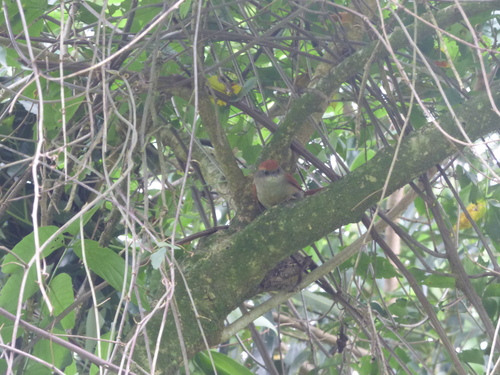 Rufous-capped Spinetail
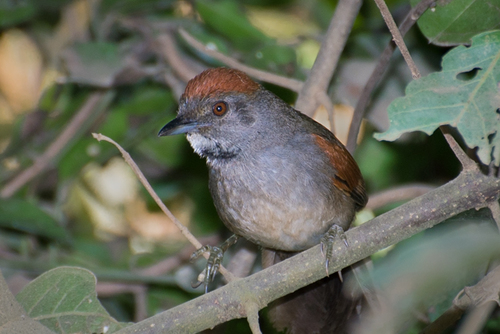 Cinereous-breasted Spinetail
In short
The most reliable field mark to separate Rufous-capped Spinetail from Cinereous-breasted Spinetail is the bold, wide buff supercilium and bright orange-rufous crown of the Rufous-capped, contrasting with the Cinereous-breasted's faint gray supercilium and darker, less contrasting crown. Juvenile plumages differ subtly: Rufous-capped juveniles show a duller rufous crown and ochraceous-washed underparts, while Cinereous-breasted juveniles have a gray-brown crown and clay-brown underparts. Both species have chestnut in the wings and tail, but the Rufous-capped's tail is brighter chestnut and more pointed, while the Cinereous-breasted's is darker and rounder-tipped. Habitat and behavior can help: Rufous-capped is a forest and bamboo specialist, while Cinereous-breasted prefers open, wet grasslands and scrub near water. Vocalizations differ in quality and rhythm, but both can be variable and subtle.
Identification tips
- Supercilium (eyebrow): Rufous-capped shows a wide, buff supercilium that stands out in all ages; Cinereous-breasted has only a faint gray supercilium, often barely visible in the field.
- Crown and nape color: Adult Rufous-capped has a bright orange-rufous crown and nape, contrasting with the face; Cinereous-breasted's crown and nape are chestnut-rufous but less bright, with a dark gray-brown forecrown.
- Juvenile crown: Juvenile Rufous-capped has a duller rufous crown; Cinereous-breasted juvenile has a gray-brown crown, which can be a subtle but useful distinction in young birds.
- Throat pattern: Rufous-capped has a tiny tawny chin spot (adults), whitish throat with faint gray streaks; Cinereous-breasted has a mostly whitish throat but with blackish lower throat feathers edged whitish, forming a more defined patch.
- Breast and belly: Rufous-capped's upper breast is grayish, rest of underparts paler buffy-brownish; Cinereous-breasted has a cinereous (ash-gray) breast, whitish belly, and brownish flanks/undertail coverts.
- Tail color and shape: Rufous-capped's tail is chestnut, graduated, and pointed-tipped; Cinereous-breasted's tail is darker brown, also graduated but with rounded tips.
- Wing color: Both have chestnut in the wings, but Rufous-capped's is more extensive and brighter; Cinereous-breasted's wing coverts are chestnut-rufous, but flight feathers are dark brown with rufescent edges.
- Juvenile underparts: Rufous-capped juveniles show ochraceous or brownish wash below; Cinereous-breasted juveniles are more clay-brown below, with a less distinct throat patch.
- Bill and legs: Both have blackish maxilla and grayish mandible, but leg color is variable and not reliably diagnostic (Rufous-capped: greenish gray; Cinereous-breasted: olive/grayish olive to brownish yellow).
- Tail tip shape: Rufous-capped's tail feathers are pointed; Cinereous-breasted's are rounded at the tips—best seen in perched birds with fanned tails.
- Habitat context: Dense forest or bamboo undergrowth points to Rufous-capped; open, seasonally wet grassland or scrub near water strongly favors Cinereous-breasted.
- Foraging behavior: Rufous-capped often joins mixed flocks and forages in the forest understorey or mid-storey; Cinereous-breasted is usually in pairs, foraging 1–2 m above ground in open areas.
- Song and call: Rufous-capped gives a fast, nasal, mechanical trill or rattle; Cinereous-breasted's song is a loud, hurried chatter, often accelerating, or a sharp 'tut-Drrrrrrruh'.
- Size: Cinereous-breasted is slightly larger and heavier, but this is rarely obvious unless both are seen together.
- Pitfalls: Both species can appear similar in poor light or when views are brief; focus on supercilium width, crown brightness, throat pattern, and habitat for best separation.
Size
Both species are similar in size, but Cinereous-breasted Spinetail is slightly larger and heavier (15–16 cm, 15–18 g) than Rufous-capped Spinetail (13–17 cm, 12–16 g, [wikidata]). This difference is subtle and rarely diagnostic in the field, but Cinereous-breasted may appear a bit bulkier if seen side-by-side.
Plumage
Juveniles are best separated by crown and underpart color: Rufous-capped juveniles have a duller rufous crown and ochraceous or brownish underparts, lacking the adult's tiny chin spot, while Cinereous-breasted juveniles have a gray-brown crown and more clay-brown underparts with a less distinct throat patch. In adults, Rufous-capped shows a wide buff supercilium, bright orange-rufous crown and nape, rufescent brown back, and a chestnut, pointed tail. The Cinereous-breasted has a faint gray supercilium, dark gray-brown forecrown, chestnut-rufous crown and nape, dark brown back, and a darker brown, round-tipped tail. Both have chestnut in the wings, but Rufous-capped's chestnut is more extensive and brighter. Underparts differ: Rufous-capped has a whitish, faintly streaked throat and paler buffy-brownish underparts, while Cinereous-breasted has a mostly whitish throat with blackish-edged lower throat feathers and a cinereous (ash-gray) breast.
Behaviour
Both species forage in pairs and glean arthropods from foliage and branches, but Rufous-capped is more likely to join mixed-species flocks and forages in the forest understorey, sometimes up to the mid-storey or even on the ground. Cinereous-breasted typically stays 1–2 m above ground in open habitats and is less likely to join mixed flocks. Both are generally unobtrusive and skulk in dense cover, but their preferred foraging height and association with flocks may help in context.
Habitat
Habitat is a strong clue: Rufous-capped Spinetail is a forest undergrowth specialist, especially in montane and lowland evergreen forests with dense Chusquea bamboo, ranging from sea level to 1,400 m in southeastern Brazil, eastern Paraguay, and northern Argentina. Cinereous-breasted Spinetail favors open, seasonally wet grasslands, scrub, campina, and savannah, usually near water, at lower elevations (to about 700 m), with a more disjunct range across Brazil, Bolivia, Peru, and Paraguay. If the bird is in dense forest or bamboo, Rufous-capped is much more likely; in open wet grassland or scrub, expect Cinereous-breasted.
Voice
Rufous-capped Spinetail gives a fast, nasal, and somewhat mechanical song (e.g., 'di-di-di-réét', 'tdrrrWit', or 'drrrrrt wee') and a low-pitched trill or dry rattle ('tshrrr', 'trrrrruh'). Cinereous-breasted Spinetail's main vocalization is a hurried, loud chatter on a single pitch, accelerating at the end (e.g., 'chéw, chew-chee-chee-chee-ee-ee-ee-ee-ee-eu'), or a high, sharp 'tut-Drrrrrrruh' with a staccato, descending ending. Rufous-capped's song is more nasal and less chattery; Cinereous-breasted's is sharper, more chattering, and accelerates.
Rufous-capped Spinetail · Cinereous-breasted Spinetail · My Tricky Birds