

Ruddy Turnstone vs Curlew Sandpiper
Arenaria interpres versus Calidris ferruginea
Play a quiz with Ruddy Turnstone and Curlew Sandpiper
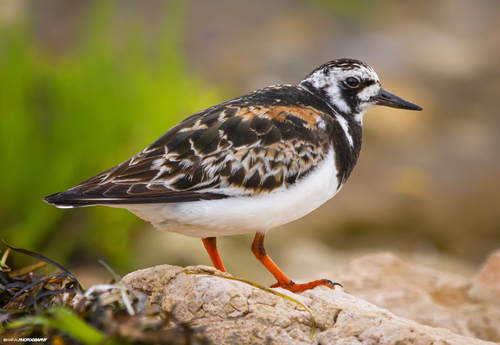 Ruddy Turnstone
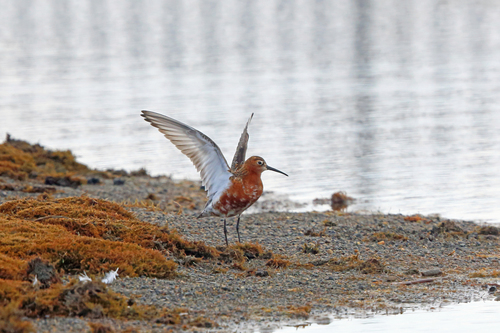 Curlew Sandpiper
In short
The most reliable way to separate Ruddy Turnstone from Curlew Sandpiper is by overall structure and bill shape: Turnstone is a stocky, short-legged bird with a short, wedge-shaped, slightly upturned bill, while Curlew Sandpiper is more slender, longer-legged, and has a distinctly long, downcurved bill. In flight, both show white wing markings and a white rump, but Turnstone's wingbar is bolder and its tail has dark bands, while Curlew Sandpiper's rump is cleaner white and its wingstripe is narrower. Juvenile Turnstones look scaly above, but so do juvenile Curlew Sandpipers, so focus on structure and bill. Turnstone's bright orange legs and harlequin plumage are unique among waders; Curlew Sandpiper is much plainer, especially in non-breeding plumage. These differences hold at all ages, but are especially clear in direct comparison.
Identification tips
- Bill shape: Turnstone has a short, wedge-shaped, slightly upturned bill; Curlew Sandpiper has a long, slender, distinctly downcurved bill. This is the single most reliable field mark at all ages.
- Leg color: Turnstone has bright orange legs in all plumages; Curlew Sandpiper's legs are dark grey to black. This is visible when birds are standing or walking.
- Body structure: Turnstone is compact, stocky, and short-legged, often appearing hunched; Curlew Sandpiper is slim, long-legged, and stands more upright.
- Flight pattern: In flight, Turnstone shows a bold white wingbar, white patch at wing base, white lower back and rump, and a white tail with dark bands. Curlew Sandpiper shows a white rump and a narrower white wingstripe, but lacks the strong dark tail bands.
- Juvenile upperparts: Both can look scaly above, but Turnstone juveniles have a pale brown head and more contrast; Curlew Sandpiper juveniles are buffier and less sharply marked, with a clear white eyebrow.
- Head pattern: Turnstone has a striking head pattern in breeding plumage (white with black mask and streaks), and even in non-breeding is darker and more patterned than Curlew Sandpiper, which has a plain grey-brown head with a white eyebrow.
- Breast pattern: Turnstone always shows a black breast band (broadest in breeding plumage), while Curlew Sandpiper is plain-breasted or, in breeding, has uniform reddish underparts.
- Upperpart color: Breeding Turnstone is reddish-brown above with black markings; Curlew Sandpiper is rufous below and plainer above. In non-breeding, Turnstone is dark grey-brown with black mottling; Curlew Sandpiper is plain grey above.
- Tail pattern: Turnstone's tail is white with distinct dark bands; Curlew Sandpiper's tail is mostly white with broad pale grey feathers and lacks strong bands.
- Foraging behavior: Turnstone flips stones and debris, often on rocky shores; Curlew Sandpiper probes mud or sand, rarely manipulates objects.
- Habitat: Turnstone prefers rocky or debris-strewn coasts; Curlew Sandpiper prefers mudflats and sandy estuaries.
- Size and jizz: Turnstone is bulkier and shorter-legged; Curlew Sandpiper is more delicate and long-legged.
- Voice: Turnstone's call is a rattling staccato, especially in breeding season; Curlew Sandpiper's call is softer and less distinctive.
- Sex and age variation: Female Turnstone is duller, but still patterned; female Curlew Sandpiper is less rufous in breeding plumage. Juvenile differences are subtle—structure and bill remain the best clues.
- Pitfalls: Both juveniles can look scaly above; always check bill shape, leg color, and body structure before relying on plumage.
Size
Ruddy Turnstone is slightly larger and much bulkier: 22–24 cm long, 85–150 g, with a wingspan of 50–57 cm [wikipedia]. Curlew Sandpiper is slimmer and lighter: 18–23 cm long, 44–117 g, wingspan 38–46 cm [wikipedia]. In the field, Turnstone appears compact and thickset, Curlew Sandpiper more delicate and elongated, especially on long legs and bill.
Plumage
- Juvenile/First-winter: Both species show pale fringing on upperparts, creating a scaly look. However, Turnstone juveniles have a pale brown head and a more contrasting, patterned appearance, while Curlew Sandpiper juveniles are buffier and less contrasting, with a more evenly scaly back and a distinct white eyebrow.
- In flight (all ages): Turnstone shows a bold white wingbar, a white patch at the wing base, and a white lower back, rump, and tail with dark bands near the tip. Curlew Sandpiper also has a white rump and a white wingstripe, but the tail is mostly white with broad pale grey feathers and lacks the strong dark tail bands of Turnstone.
- Adult breeding: Turnstone is strikingly patterned with reddish-brown upperparts, a white head with black streaks and mask, and a black breast band. Curlew Sandpiper in breeding plumage is mostly reddish below and on the head, with a white belly and a less contrasting back.
- Adult non-breeding: Turnstone becomes duller but retains a dark, patterned head and upperparts with some white; Curlew Sandpiper is plain grey above and white below, with a white eyebrow and little head pattern.
- Sex differences: Female Turnstone is slightly duller and browner than male; female Curlew Sandpiper is less intensely rufous in breeding plumage than male.
Behaviour
Ruddy Turnstone is often seen actively flipping stones, seaweed, or debris to find food, using its bill in a variety of ways (flicking, bulldozing, pecking, probing, hammering). It is bold and often forages in groups, sometimes showing aggressive, dominant behavior. Curlew Sandpiper feeds by probing and picking in mud or shallow water, moving more delicately and often in flocks with other small waders. Turnstone's foraging is more energetic and involves more manipulation of objects; Curlew Sandpiper is more typical of sandpipers, probing for invertebrates.
Habitat
Turnstone is most often found on rocky or shingle shores, jetties, and beaches, especially where there is debris or seaweed to flip. Curlew Sandpiper prefers tidal mudflats, saltpans, and sandy estuaries, rarely venturing onto rocky shores. If you see a bird on rocks or among seaweed piles, Turnstone is far more likely; on open mud or sand, especially with other small waders, Curlew Sandpiper is the default.
Voice
Turnstone has a staccato, rattling call and a chattering alarm, most often heard in the breeding season. Curlew Sandpiper's calls are not described in detail in these notes, but are generally softer and less rattling than Turnstone. In mixed flocks, Turnstone's call is more likely to stand out.