

Ruddy Kingfisher vs Black-capped Kingfisher
Halcyon coromanda versus Halcyon pileata
Play a quiz with Ruddy Kingfisher and Black-capped Kingfisher
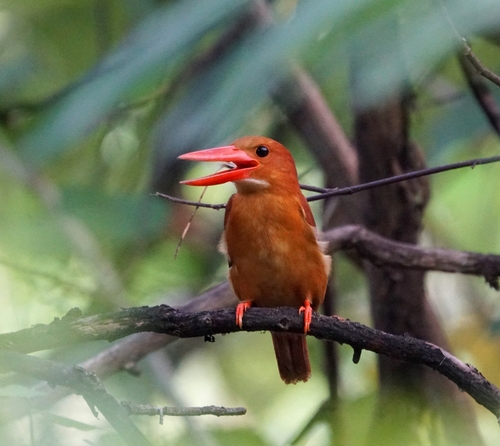 Ruddy Kingfisher
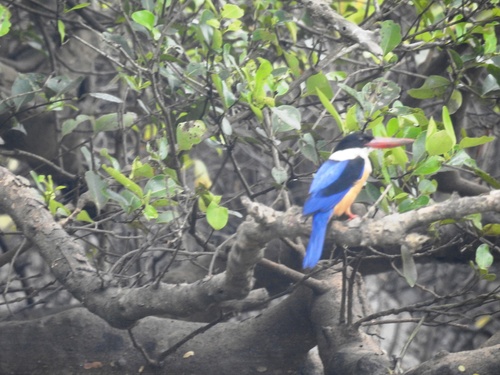 Black-capped Kingfisher
In short
The most reliable field mark to separate Ruddy Kingfisher from Black-capped Kingfisher is head and wing color: Black-capped Kingfisher always shows a striking black cap and purple-blue wings with large white patches in flight, while Ruddy Kingfisher is entirely rust-red to purplish with no black or blue anywhere. Both have large red bills and legs, but only Black-capped has a white throat and collar contrasting with its dark head. Juvenile Black-capped Kingfishers are duller and show throat streaks, but still retain the black cap and blue wings. Habitat can help: Ruddy prefers dense forests, Black-capped is usually in mangroves or open coastal areas. If you see a kingfisher with a black cap or blue wings, it is not a Ruddy.
Identification tips
- Head color is decisive: Black-capped Kingfisher always has a jet-black cap and nape, sharply contrasting with a white throat and collar. Ruddy Kingfisher is entirely rusty-red to purplish, with no black or white on the head or throat at any age.
- Wing color and flight pattern: Black-capped Kingfisher shows purple-blue wings and back, with large white patches ('mirrors') at the base of the primaries visible in flight. Ruddy Kingfisher's wings and back are the same rusty-red as the rest of the body, with no blue or white patches.
- Bill and legs: Both species have large, bright red bills and legs. This is not a useful field mark for separation.
- Underparts: Both have rufous underparts, but only Black-capped has a sharp transition from white throat to rufous belly. Ruddy is uniformly rusty-red below, with no white.
- Juvenile marks: Juvenile Black-capped Kingfishers are duller and show throat streaks, but retain the black cap and blue wings with white patches. Ruddy Kingfisher juveniles are not well described but are not known to show any black, blue, or white.
- Tail and back: Black-capped has a purple-blue back and tail, contrasting with the rufous belly. Ruddy is rusty-red to purplish all over, with the tail sometimes deeper purple but never blue.
- Perched posture: Black-capped often perches openly in mangroves or on wires, sometimes far from dense cover. Ruddy is much more secretive and usually stays hidden in forest.
- Habitat clues: Ruddy is almost always in dense forest, rarely in open or coastal areas. Black-capped is typical of mangroves, estuaries, and open coastal woodlands, but can wander inland.
- Voice: Ruddy gives a high, descending whistle; Black-capped gives a loud, cackling 'ki-ki-ki-ki-ki'. If you hear a cackling call, think Black-capped.
- Sex and seasonal variation: Both species show little sexual dimorphism. Ruddy males may be slightly brighter, but this is not reliable. No strong seasonal plumage change in either species.
- Size: Black-capped is slightly larger (28 cm vs. 25 cm), but this is rarely useful unless birds are side by side.
- Behavioral context: If the bird is shy, staying in deep cover, and only glimpsed or heard, suspect Ruddy. If it is bold, perching in the open, especially in mangroves, suspect Black-capped.
- Flight style: Black-capped has rapid, direct flight with whirring, rounded wings and flashes of white wing patches. Ruddy's flight is less described but lacks the white wing flashes.
- Common pitfalls: Do not rely on bill or leg color, as both are red. Lighting can make Black-capped's blue look dark, but the black cap and white throat remain obvious. Immature Black-capped may look dull, but never lose the black cap or blue wings.
- Geographic overlap: Both species can occur in overlapping ranges in Asia, so always check head and wing color, not just location.
Size
Black-capped Kingfisher is slightly larger, averaging about 28 cm in length, compared to Ruddy Kingfisher's 25 cm. Both are robust, big-billed kingfishers, and size alone is rarely diagnostic in the field unless the birds are side by side. Both have large, bright red bills and legs.
Plumage
- Juvenile/immature birds: Black-capped Kingfisher juveniles are duller than adults and show streaks on the throat, but still have a black cap and blue wings with white patches in flight. Ruddy Kingfisher juveniles are not described in detail, but no evidence suggests they ever show a black cap, blue wings, or white wing patches; they are overall rusty-red to purplish.
- Adults: Ruddy Kingfisher is entirely rust-red, deepening to purple at the tail, with no white or blue anywhere. Black-capped Kingfisher adults have a black cap and nape, white throat and neck collar, purple-blue wings and back, rufous underparts, and prominent white wing patches visible in flight. The bill and legs are bright red in both species. Sexes are similar in both, though Ruddy males may be slightly brighter.
Behaviour
Ruddy Kingfisher is shy, often heard rather than seen, and prefers to stay hidden in dense forest, usually alone or in pairs. Black-capped Kingfisher is more conspicuous, often perching openly in mangroves or on wires, and is easily flushed. Both hunt by diving, mainly for fish and large insects, but Black-capped is more likely to be seen in open or coastal habitats, while Ruddy is a forest specialist.
Habitat
Ruddy Kingfisher is a bird of dense forests, including thick jungle and rainforest, from temperate to tropical zones. It is rarely seen outside heavy cover. Black-capped Kingfisher is most often found near coasts, especially in mangroves, estuaries, and along rivers, but can also appear inland, especially in winter or after rainfall. If you find a kingfisher in deep forest, it is more likely Ruddy; if in mangroves or open coastal areas, Black-capped is much more likely.
Voice
Ruddy Kingfisher gives a high, descending call, often heard in dense forest. Black-capped Kingfisher has a cackling 'ki-ki-ki-ki-ki' call, which is louder and more rattling. Calls are quite different, but both species are often detected by voice before being seen.
Ruddy Kingfisher · Black-capped Kingfisher · My Tricky Birds