

Motmot

Ruddy Ground Dove vs Picui Ground Dove

Columbina talpacoti versus Columbina picui

Play a quiz with Ruddy Ground Dove and Picui Ground Dove
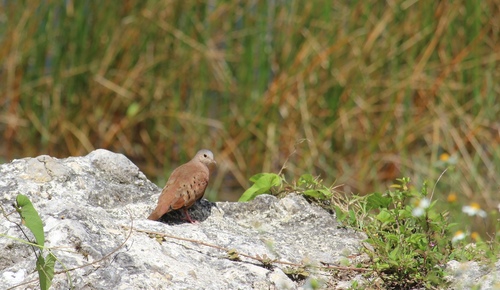
Ruddy Ground Dove (Columbina talpacoti) Ruddy Ground Dove
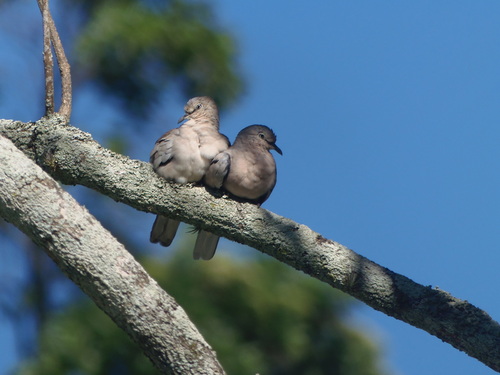
Picui Ground Dove (Columbina picui) Picui Ground Dove

Media

Loading…

In short

The most reliable field mark to separate Ruddy Ground Dove from Picui Ground Dove is the wing pattern: Ruddy Ground Dove (all ages) shows black spots on the wing coverts, while Picui Ground Dove (adult and juvenile) has two distinct white wing bands bordered by black, visible on the folded wing and in flight. Adult male Ruddy Ground Doves are richer rufous with a pale gray head, whereas Picui males are gray-crowned with a whitish face and throat and lack the rufous tones. Females and juveniles of both species are duller, but the wing pattern remains the best separator. Both species overlap in much of South America and can be found in open and urban habitats, but careful attention to the wing and head pattern will resolve nearly all confusion.

Identification tips

  1. Check the wing pattern first: Ruddy Ground Dove (all ages) has black spots on the wing coverts, while Picui Ground Dove (all ages) shows two white wing bands bordered by black on the folded wing and in flight. This is the single most reliable field mark.
  2. Perched birds: On a sitting bird, look for the black-spotted wing coverts of Ruddy versus the white wing bands of Picui. Even in dull light, the spots versus bands are usually visible at close range.
  3. In flight: Both species show distinctive upperwing patterns. Ruddy shows black-spotted coverts and cinnamon-black underwings; Picui flashes two white wing bands on a pinkish-fawn background.
  4. Head and face pattern (adult males): Ruddy males have a pale gray or bluish-gray head contrasting with rich rufous upperparts; Picui males have a gray crown and nape, whitish forehead and throat, and a narrow black line in front of the eye.
  5. Female and juvenile plumage: Female Ruddy is all brown with less contrast between head and body, but still shows black wing spots. Female and juvenile Picui are duller and browner than males, but always lack black wing spots and have the white wing bands (though less crisp in juveniles).
  6. Breast and belly color: Picui has a pinkish-gray breast and white belly; Ruddy is paler brown below, without the crisp white belly.
  7. Tail pattern: Ruddy has a short tail edged black; Picui's central tail feathers are brownish-gray, matching the back, but tail pattern is subtle and less reliable than wing marks.
  8. Underwing color: Ruddy Ground Dove shows cinnamon and black underwings, sometimes visible in flight or during wing displays; Picui does not have this contrast.
  9. Behavioral cues: Ruddy Ground Dove males may display aggression by raising a wing or striking with it, sometimes exposing black underwing feathers. Picui is not noted for this behavior.
  10. Habitat overlap: Both species occur in similar open and urban habitats, so do not rely on context unless you are at the northern edge of Ruddy's range, where Picui does not occur.
  11. Size and structure: Both species are nearly identical in size and shape; do not use size as a separator.
  12. Voice: Ruddy gives a soft 'cur-WOO' coo; Picui's voice is not described here, so do not rely on vocalizations for separation with current information.
  13. Season and location: Both species are resident in much of their range; season is not a reliable separator except in the far north (USA/Mexico), where only Ruddy occurs.
  14. Juvenile confusion: Even dull juveniles can be separated by wing pattern: black spots (Ruddy) vs. white bands (Picui).
  15. Pitfalls: Faded or worn birds may show less contrast overall, but the wing pattern remains diagnostic. Do not confuse the rufous tones of Ruddy with the pinkish-fawn of Picui's wings; always look for spots vs. bands.

Size

Both species are very similar in size and mass, with Ruddy Ground Dove averaging about 46.5 g and Picui Ground Dove about 48 g [wikidata]. Both are around 17–18 cm in length, so size is not a reliable separator in the field. Structure, such as tail or bill shape, is not distinctly different according to available notes.

Plumage

The most diagnostic plumage difference is the wing pattern, visible both when perched and in flight. Ruddy Ground Dove (all ages and sexes) shows a series of black spots on the wing coverts. In contrast, Picui Ground Dove (adults and juveniles) has two crisp white wing bands bordered by black on a pinkish-fawn background, which are visible even on the folded wing. Adult male Ruddy Ground Doves have a rich rufous body with a pale gray (sometimes bluish-gray) head, while females are a more uniform brown. Picui males have a gray crown and nape, whitish forehead and throat, and a pinkish-gray breast, with the rest of the upperparts brownish-gray; females are duller with less pink, and juveniles are even browner and duller, but always lack the black wing spots of Ruddy. The underwings of Ruddy Ground Dove are cinnamon and black, sometimes visible in flight or when sunbathing. Picui's belly is white, and the tail is brownish-gray with central feathers matching the back.

Behaviour

Both species are ground foragers, often seen in open areas, fields, and urban settings. Ruddy Ground Dove is noted for being quite aggressive with conspecifics, especially males, which may display by raising a wing or striking with it. Picui Ground Dove's behavior is not described as particularly aggressive. Both species can be approachable and may feed alongside pigeons and other doves. Ruddy Ground Dove is sometimes described as 'friendly and naive,' but this is not a reliable field mark.

Habitat

Both species are widespread in open country, including scrub, agricultural land, and urban areas throughout much of South America. Ruddy Ground Dove has expanded into cities and is common in human-altered environments, especially in Brazil. Picui Ground Dove shares much of the same range and habitat, so context is not usually helpful for separation, except at the northern edge of Ruddy's range (Mexico, Central America, and southern USA), where Picui does not occur.

Voice

Ruddy Ground Dove gives a soft cooing 'cur-WOO.' There is no detailed vocal description for Picui Ground Dove in the notes, so voice is not a reliable separator with the provided information.

Submit a better description

Use the same sections as the comparison. Your text is published immediately.

The most reliable field mark to separate Ruddy Ground Dove from Picui Ground Dove is the wing pattern: Ruddy Ground Dove (all ages) shows black spots on the wing coverts, while Picui Ground Dove (adult and juvenile) has two distinct white wing bands bordered by black, visible on the folded wing and in flight. Adult male Ruddy Ground Doves are richer rufous with a pale gray head, whereas Picui males are gray-crowned with a whitish face and throat and lack the rufous tones. Females and juveniles of both species are duller, but the wing pattern remains the best separator. Both species overlap in much of South America and can be found in open and urban habitats, but careful attention to the wing and head pattern will resolve nearly all confusion.

  1. Check the wing pattern first: Ruddy Ground Dove (all ages) has black spots on the wing coverts, while Picui Ground Dove (all ages) shows two white wing bands bordered by black on the folded wing and in flight. This is the single most reliable field mark.
  2. Perched birds: On a sitting bird, look for the black-spotted wing coverts of Ruddy versus the white wing bands of Picui. Even in dull light, the spots versus bands are usually visible at close range.
  3. In flight: Both species show distinctive upperwing patterns. Ruddy shows black-spotted coverts and cinnamon-black underwings; Picui flashes two white wing bands on a pinkish-fawn background.
  4. Head and face pattern (adult males): Ruddy males have a pale gray or bluish-gray head contrasting with rich rufous upperparts; Picui males have a gray crown and nape, whitish forehead and throat, and a narrow black line in front of the eye.
  5. Female and juvenile plumage: Female Ruddy is all brown with less contrast between head and body, but still shows black wing spots. Female and juvenile Picui are duller and browner than males, but always lack black wing spots and have the white wing bands (though less crisp in juveniles).
  6. Breast and belly color: Picui has a pinkish-gray breast and white belly; Ruddy is paler brown below, without the crisp white belly.
  7. Tail pattern: Ruddy has a short tail edged black; Picui's central tail feathers are brownish-gray, matching the back, but tail pattern is subtle and less reliable than wing marks.
  8. Underwing color: Ruddy Ground Dove shows cinnamon and black underwings, sometimes visible in flight or during wing displays; Picui does not have this contrast.
  9. Behavioral cues: Ruddy Ground Dove males may display aggression by raising a wing or striking with it, sometimes exposing black underwing feathers. Picui is not noted for this behavior.
  10. Habitat overlap: Both species occur in similar open and urban habitats, so do not rely on context unless you are at the northern edge of Ruddy's range, where Picui does not occur.
  11. Size and structure: Both species are nearly identical in size and shape; do not use size as a separator.
  12. Voice: Ruddy gives a soft 'cur-WOO' coo; Picui's voice is not described here, so do not rely on vocalizations for separation with current information.
  13. Season and location: Both species are resident in much of their range; season is not a reliable separator except in the far north (USA/Mexico), where only Ruddy occurs.
  14. Juvenile confusion: Even dull juveniles can be separated by wing pattern: black spots (Ruddy) vs. white bands (Picui).
  15. Pitfalls: Faded or worn birds may show less contrast overall, but the wing pattern remains diagnostic. Do not confuse the rufous tones of Ruddy with the pinkish-fawn of Picui's wings; always look for spots vs. bands.

Both species are very similar in size and mass, with Ruddy Ground Dove averaging about 46.5 g and Picui Ground Dove about 48 g [wikidata]. Both are around 17–18 cm in length, so size is not a reliable separator in the field. Structure, such as tail or bill shape, is not distinctly different according to available notes.

The most diagnostic plumage difference is the wing pattern, visible both when perched and in flight. Ruddy Ground Dove (all ages and sexes) shows a series of black spots on the wing coverts. In contrast, Picui Ground Dove (adults and juveniles) has two crisp white wing bands bordered by black on a pinkish-fawn background, which are visible even on the folded wing. Adult male Ruddy Ground Doves have a rich rufous body with a pale gray (sometimes bluish-gray) head, while females are a more uniform brown. Picui males have a gray crown and nape, whitish forehead and throat, and a pinkish-gray breast, with the rest of the upperparts brownish-gray; females are duller with less pink, and juveniles are even browner and duller, but always lack the black wing spots of Ruddy. The underwings of Ruddy Ground Dove are cinnamon and black, sometimes visible in flight or when sunbathing. Picui's belly is white, and the tail is brownish-gray with central feathers matching the back.

Both species are ground foragers, often seen in open areas, fields, and urban settings. Ruddy Ground Dove is noted for being quite aggressive with conspecifics, especially males, which may display by raising a wing or striking with it. Picui Ground Dove's behavior is not described as particularly aggressive. Both species can be approachable and may feed alongside pigeons and other doves. Ruddy Ground Dove is sometimes described as 'friendly and naive,' but this is not a reliable field mark.

Both species are widespread in open country, including scrub, agricultural land, and urban areas throughout much of South America. Ruddy Ground Dove has expanded into cities and is common in human-altered environments, especially in Brazil. Picui Ground Dove shares much of the same range and habitat, so context is not usually helpful for separation, except at the northern edge of Ruddy's range (Mexico, Central America, and southern USA), where Picui does not occur.

Ruddy Ground Dove gives a soft cooing 'cur-WOO.' There is no detailed vocal description for Picui Ground Dove in the notes, so voice is not a reliable separator with the provided information.

Discard your changes?

You have unsaved edits. If you leave now, those changes will be lost.

Ruddy Ground Dove · Picui Ground Dove · My Tricky Birds