

Ruddy Ground Dove vs Eared Dove
Columbina talpacoti versus Zenaida auriculata
Play a quiz with Ruddy Ground Dove and Eared Dove
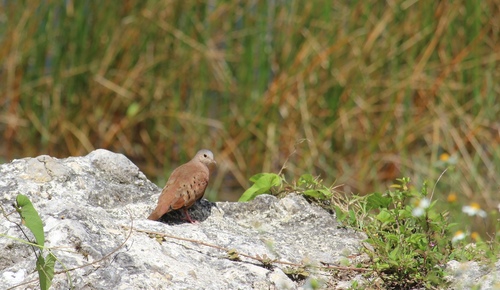 Ruddy Ground Dove
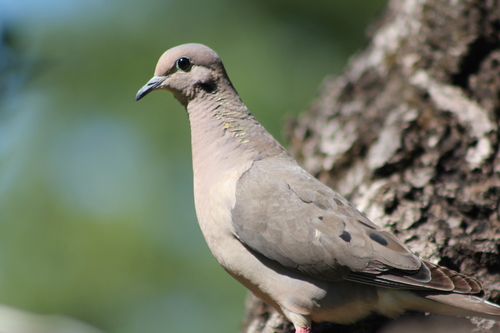 Eared Dove
In short
The most reliable field mark to separate Ruddy Ground Dove from Eared Dove is overall size and tail shape: Ruddy Ground Dove is much smaller and noticeably short-tailed, while Eared Dove is larger with a long, wedge-shaped tail. In flight or perched, Ruddy Ground Dove males show a pale gray head and rich rufous upperparts with black spots on the wing coverts, while Eared Dove males are olive-brown above with a gray crown and distinctive black marks behind the eye and on the lower ear coverts. Females and immatures of both species are duller, but the Eared Dove is always bulkier and longer-tailed. Both species show black spots on the wing coverts, but the context and proportions are key. Juvenile/immature Eared Doves are especially dull and brownish, lacking the rufous tones of young Ruddy Ground Doves. Use structure and tail length first, then plumage and head pattern for confirmation.
Identification tips
- Size and bulk: Ruddy Ground Dove is much smaller and more compact than Eared Dove. If the bird appears pigeon-sized or larger, it's almost certainly Eared Dove. This is reliable for all ages and sexes.
- Tail length and shape: Ruddy Ground Dove has a short, squared tail; Eared Dove has a long, wedge-shaped tail. In flight or perched, the tail of Eared Dove is noticeably longer and pointed.
- Head pattern (adult males): Ruddy Ground Dove males have a pale gray head and neck contrasting with rufous upperparts. Eared Dove males have a gray crown, black line behind the eye, and blue-black lower ear coverts ('ear' mark); no rufous tones.
- Upperparts color: Ruddy Ground Dove males are rich rufous above, females are brown; Eared Dove is olive-brown above in both sexes, lacking rufous.
- Wing coverts: Both species have black spots on the wing coverts, but in Ruddy Ground Dove these are set against rufous or brown, while in Eared Dove the background is olive-brown.
- Underwing color: Ruddy Ground Dove shows cinnamon and black underwings, especially when sunning or in flight; Eared Dove lacks this strong underwing contrast.
- Facial markings: Eared Dove has a distinctive black line behind the eye and blue-black lower ear coverts; Ruddy Ground Dove lacks these marks.
- Underparts: Ruddy Ground Dove is paler brown below; Eared Dove has vinous (wine-colored) underparts.
- Tail tip: Eared Dove's tail is tipped cinnamon; Ruddy Ground Dove's tail is edged black.
- Female/immature confusion: Female Ruddy Ground Dove is all brown, but still small and short-tailed. Immature Eared Doves are dull gray-brown with pale barring, always larger and longer-tailed than any Ruddy Ground Dove.
- Behavior: Ruddy Ground Dove is often solitary or in small groups, Eared Dove is frequently in large flocks, especially in open fields.
- Perching habits: Eared Dove often perches on wires and posts; Ruddy Ground Dove is more often seen on the ground or low perches.
- Habitat overlap: Both can occur in urban and rural areas, but Eared Dove dominates in large open agricultural landscapes and is more likely to be seen in massive flocks.
- Vocalizations: Ruddy Ground Dove's call is a soft cur-WOO; Eared Dove's is a deeper oo-ah-oo. Use only as supporting evidence.
- Pitfalls: Do not rely solely on black wing spots or ground-feeding behavior; use size, tail, and head pattern for confident ID, especially in mixed flocks or urban settings.
Size
Ruddy Ground Dove is significantly smaller and lighter, with an average body mass of about 46.5 g and a length of 12–18 cm. Eared Dove is much larger, typically around 24 cm in length and weighing about 112 g. The size difference is obvious in direct comparison or when seen together, but even singly, Ruddy Ground Dove appears compact and short-tailed, while Eared Dove is noticeably bulkier with a long, wedge-shaped tail. This size and tail contrast is reliable across all ages and sexes.
Plumage
- Juveniles/immatures: Young Ruddy Ground Doves already show sex-based color hints: males are rufous with a pale gray head, females are all brown, both with black spots on the wing coverts. Immature Eared Doves are very dull, grayish-brown with pale barring and lack any rufous or strong contrast; their head pattern is muted, but the long tail is still evident.
- Adult males: Ruddy Ground Dove males have a pale gray head and neck, rich rufous upperparts, and black-spotted wing coverts. Eared Dove males are olive-brown above, with a gray crown, black line behind the eye, and blue-black lower ear coverts (the 'eared' mark), vinous underparts, and a cinnamon-tipped tail.
- Adult females: Ruddy Ground Dove females are overall gray-brown with less contrast between head and body, still showing black-spotted wing coverts. Eared Dove females are duller than males but retain the long tail and black facial marks, though less pronounced. Both sexes of Eared Dove have a more uniform, olive-brown appearance compared to the warmer, rufous tones of Ruddy Ground Dove.
- Wings in flight: Both species show black spots on the wing coverts, but Ruddy Ground Dove's underwings are cinnamon and black (especially visible when sunbathing or in flight), while Eared Dove lacks this strong underwing contrast.
Behaviour
Ruddy Ground Dove is often seen in pairs or small groups, feeding on the ground and can be quite approachable. Males are aggressive toward each other, displaying by raising a wing and sometimes sunbathe with one wing stretched up, revealing black underwing feathers. Eared Dove is much more gregarious, often forming large flocks, especially outside breeding. Its flight is high, fast, and direct, similar to pigeons, but the long tail is obvious. Eared Doves are also more likely to be seen perched on wires or in large communal roosts.
Habitat
Both species thrive in open country, cultivated land, and urban environments. Ruddy Ground Dove is especially common in scrub, open areas, and city parks, often seen feeding alongside feral pigeons. Eared Dove is abundant in savannahs, open fields, and urban areas, and is particularly numerous in agricultural regions with grain crops. In some regions, Eared Dove is displacing Ruddy Ground Dove from urban habitats. Both adapt well to human-altered landscapes, but Eared Dove is more likely to be found in very large flocks in open fields.
Voice
Ruddy Ground Dove gives a soft, cur-WOO cooing call. Eared Dove has a deeper, soft oo-ah-oo call. Both are soft and dove-like, but Eared Dove's call is deeper and more drawn-out. These vocal differences are subtle and not always diagnostic in the field, especially with background noise.