

Roseate Tern vs Sandwich Tern
Sterna dougallii versus Thalasseus sandvicensis
Play a quiz with Roseate Tern and Sandwich Tern
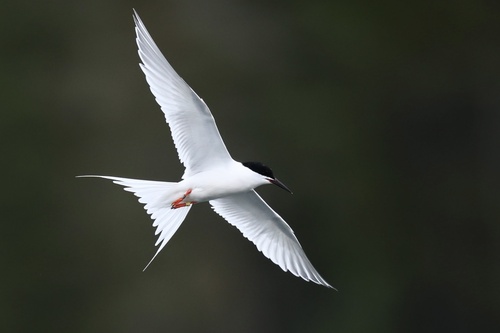 Roseate Tern
 Sandwich Tern
In short
The most reliable field mark to separate Roseate Tern from Sandwich Tern is the bill: Roseate Tern has a thin black bill with a red base (often more extensive in breeding season), while Sandwich Tern shows a longer, stouter black bill with a distinct yellow tip. Juvenile and immature birds can be tricky, but Roseate Tern is smaller, with very long tail streamers and orange-red legs, while Sandwich Tern is larger, with a shorter tail and black legs. In flight, both appear pale with darkening primaries in summer, but Roseate Tern is shorter-winged and has a faster, more agile flight. Voice and subtle plumage differences, especially in the head pattern and bill color, are key in non-breeding plumage.
Identification tips
- Bill color and shape (all ages): Roseate Tern has a thin, sharp black bill with a red base (becoming more extensive in breeding season), while Sandwich Tern has a longer, stouter black bill with a yellow tip. In juveniles, Sandwich Tern's bill is all-blackish but never shows the red base of Roseate.
- Leg color (adults): Roseate Tern has orange-red legs, while Sandwich Tern's legs are black. This is visible when birds are perched or landing.
- Tail streamers (adults): Roseate Tern has very long, flexible tail streamers, often extending well beyond the wingtips when perched. Sandwich Tern's tail is shorter and less deeply forked.
- Size and structure: Sandwich Tern is larger and bulkier, with a longer wingspan and heavier build. Roseate Tern is more delicate, shorter-winged, and lighter overall.
- Flight style: Roseate Tern has faster, more agile wingbeats and appears shorter-winged in flight. Sandwich Tern is more languid and powerful, with longer wings.
- Juvenile crown pattern: Juvenile Roseate Tern has a fuller black cap, while juvenile Sandwich Tern has less black on the crown.
- Juvenile tail: Juvenile Sandwich Tern has dark tips to the tail, a feature not noted for Roseate Tern.
- Juvenile upperparts: Both species are scaly above, but this is not a reliable separation mark between them.
- Adult summer underparts: Roseate Tern develops a pinkish tinge to the underparts in breeding plumage; Sandwich Tern remains white below.
- Adult winter head: Both species develop a white forehead in winter, but Sandwich Tern's is more extensive and the bill retains a yellow tip; Roseate Tern's bill becomes all black.
- Leg color in flight: If legs are visible, Roseate's orange-red legs can be a clincher, especially in flight or when landing.
- Voice: Roseate Tern's 'chuwit' call is quite distinct from Sandwich Tern's grating 'kear-ik'; use this when birds are calling.
- Habitat and context: In Europe, Roseate Tern is rare and localized, often in protected colonies with nest boxes, while Sandwich Tern is more widespread and abundant.
- Association with other terns: Roseate Tern often breeds among Common and Arctic Terns, relying on them for defense; Sandwich Tern is often in larger, more open colonies.
- Pitfalls: Both species look very pale in flight with darkening primaries in summer, so do not rely solely on overall paleness. Bill color, leg color, and tail length are more reliable.
Size
Roseate Tern is a small-medium tern, measuring 33–36 cm in length with a 67–76 cm wingspan [wikipedia]. Sandwich Tern is notably larger, at 36–41 cm long and a 95–105 cm wingspan [wikipedia]. This size difference is often visible in mixed flocks, with Sandwich Tern appearing bulkier and longer-winged. The weight difference is also substantial: Sandwich Tern averages 200–300 g, while Roseate Tern is lighter (exact mass not given, but smaller size indicates less weight) [avonet].
Plumage
- Juvenile/immature birds: Both species have a scaly appearance on the back and wings, but juvenile Roseate Tern has a fuller black cap, while juvenile Sandwich Tern has less black on the crown and dark tips to the tail. Juvenile Sandwich Tern's bill is all-blackish (sometimes yellowish at the base), lacking the yellow tip, while Roseate Tern's juvenile bill is black with a possible reddish base.
- Adults (breeding): Roseate Tern shows a thin black bill with a red base (sometimes almost fully red in some populations), very long, flexible tail streamers, and orange-red legs. The upper wings are pale grey, underparts white, and in summer, adults develop a pinkish tinge on the breast. Sandwich Tern has a stouter black bill with a yellow tip, black legs, and a shorter tail. Its upper wings are pale grey, underparts white, and the primaries darken in summer. Both look pale in flight, but Sandwich Tern is larger and more robust.
- Adults (non-breeding): Both species develop a white forehead in winter, but Sandwich Tern's is more extensive. Roseate Tern's bill becomes all black in winter; Sandwich Tern's bill remains black with a yellow tip.
- Flight: Roseate Tern is shorter-winged and has faster wingbeats; Sandwich Tern is longer-winged and more languid in flight. Both appear pale, but Roseate Tern's tail streamers are more prominent.
Behaviour
Roseate Tern is more agile and buoyant in flight, with faster wingbeats and a shorter-winged, more delicate appearance. It often nests in partly hidden sites or under vegetation, sometimes using nest boxes. Sandwich Tern is bulkier and more powerful in flight, with longer wings and a more direct, less fluttery flight style. Both species are colonial nesters, but Roseate Tern is less defensive of its nest, often relying on other tern species for protection.
Habitat
Both species breed in colonies on coasts and islands, often with other seabirds. Roseate Tern prefers more concealed nest sites, often under vegetation or in nest boxes, while Sandwich Tern is less particular about cover. In Europe, Roseate Tern is much rarer and more localized, with strongholds in Ireland and a few UK sites, whereas Sandwich Tern is more widespread and abundant along suitable coasts.
Voice
Roseate Tern gives a characteristic 'chuwit' call, which is quite distinct from other terns and somewhat similar to the call of a spotted redshank. Sandwich Tern is very vocal, with a loud, grating 'kear-ik' or 'kerr ink' call. These calls are usually diagnostic if heard well.