

Rose-coloured Starling vs White's Thrush
Pastor roseus versus Zoothera aurea
Play a quiz with Rose-coloured Starling and White's Thrush
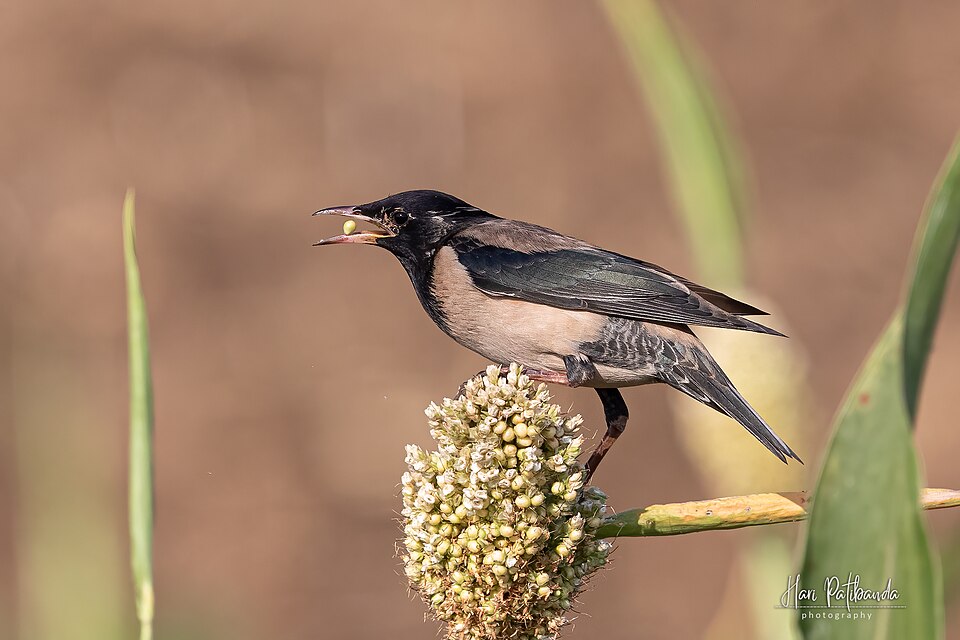 Rose-coloured Starling
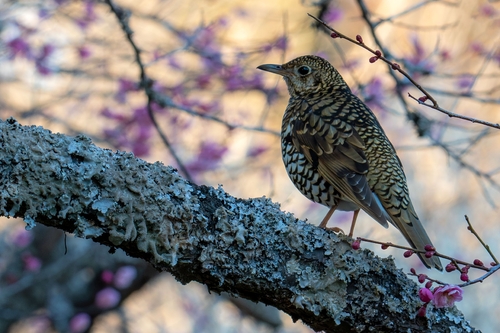 White's Thrush
In short
The most reliable field mark to separate Rose-coloured Starling from White's Thrush is overall plumage: adult Rose-coloured Starlings in breeding plumage show a striking pink body with glossy black wings, head, and tail, while White's Thrush is heavily patterned with black scaling on a pale yellowish or white background. In flight, White's Thrush shows a bold black band on the white underwing, a feature never present in Rose-coloured Starling at any age. Juvenile Rose-coloured Starlings are pale buffy brown and can look superficially thrush-like, but lack the strong scaling and underwing pattern of White's Thrush. Structure, bill shape, and typical posture also differ markedly between these two species.
Identification tips
- Underwing pattern in flight: White's Thrush always shows a bold black band on the white underwing, visible in flight at all ages. Rose-coloured Starling never shows this feature—its underwing is uniform dark or pale depending on age, but never banded.
- Juvenile confusion: Juvenile Rose-coloured Starlings are pale buffy brown with a short yellow bill, lacking any strong patterning or scaling. White's Thrush juveniles are already boldly scaled and patterned, and show the underwing band.
- Adult breeding plumage: Adult Rose-coloured Starlings in breeding plumage are unmistakable: pink body, glossy black wings, head, and tail, with a wispy crest in males. White's Thrush never shows pink or glossy black, and lacks a crest.
- Non-breeding/immature plumage: Non-breeding and immature Rose-coloured Starlings are duller and greyer, but still lack the thrush's scaling and underwing pattern. Females and first-year males may appear less crisp, but never show the thrush's marks.
- Scaling vs. plainness: White's Thrush is always heavily scaled with black on a pale background, giving a patterned, almost reptilian look. Rose-coloured Starling is plain or two-toned, never scaled.
- Bill shape and color: Rose-coloured Starling has a short, pointed bill (pink-tipped in breeding adults, yellowish in juveniles), while White's Thrush has a longer, more robust bill suited to a thrush.
- Crest: Breeding male Rose-coloured Starlings have a wispy crest, especially when excited. White's Thrush never shows a crest.
- Size and structure: White's Thrush is much larger, bulkier, and longer-tailed than the compact, short-tailed Rose-coloured Starling. The difference is obvious with experience or in mixed flocks.
- Posture and movement: Rose-coloured Starling is often upright, perching openly, and moves with quick, social energy. White's Thrush is more secretive, often on the ground or in cover, and moves with a slower, more deliberate gait.
- Habitat context: In open country, agricultural fields, or among large flocks, Rose-coloured Starling is more likely. In dense woodland or forest edge, especially if alone or in pairs, White's Thrush is more probable.
- Vocalizations: Listen for a jumble of squeaks and rattles from Rose-coloured Starling, versus the loud, spaced whistles of White's Thrush.
- Flock size: Large, noisy flocks are typical of Rose-coloured Starling; White's Thrush is usually solitary or in small family groups.
- Seasonal context: Rose-coloured Starling is a strong migrant and may appear in large numbers during irruptions, especially in open habitats. White's Thrush is less likely to be seen in open or urban settings.
- Sex differences: Male Rose-coloured Starlings in breeding plumage have a longer crest and sharper pink/black contrast than females; White's Thrush sexes are similar.
- Pitfalls: Immature Rose-coloured Starlings may appear thrush-like at a distance due to plainness, but always check for scaling and underwing pattern to confirm White's Thrush.
Size
White's Thrush is substantially larger than Rose-coloured Starling, with a length of 27–31 cm compared to the starling's 19–22 cm. The starling is also lighter (average mass 73 g) and more compact, while White's Thrush is bulkier with a longer tail and a more robust, upright stance. The difference in size is usually obvious when seen well, especially if context or nearby birds are available for comparison.
Plumage
- Juvenile/immature birds: Juvenile Rose-coloured Starlings are pale buffy brown with a short yellow bill and lack any strong patterning; they do not show the bold black scaling or the black-and-white underwing of White's Thrush. White's Thrush of all ages has a distinctive pattern of black scaling on a pale background and, in flight, a diagnostic black band across the white underwing (shared only with Siberian Thrush).
- Adult breeding plumage: Adult Rose-coloured Starlings are unmistakable in full breeding plumage: pink body, glossy black wings, head, and tail, with a wispy crest in males. White's Thrush never shows pink or glossy black, instead always appearing scaled and patterned.
- Non-breeding/immature plumage: Non-breeding Rose-coloured Starlings are duller, with greyish-pink body and shorter crest, but still lack the thrush's scaling and underwing pattern. Young starlings may appear less contrasting, but never show the thrush's bold marks.
Behaviour
Rose-coloured Starlings are highly gregarious, often seen in large flocks, especially outside the breeding season. They are restless, social, and frequently perch on wires or in open, exposed spots. White's Thrush is typically solitary or in pairs, shy, and prefers to skulk in dense cover. Its movement is more deliberate, often walking or hopping on the ground, and it flushes with a strong, bounding flight showing the underwing pattern.
Habitat
Rose-coloured Starling favors open country, steppes, agricultural land, and is often seen in human-modified landscapes, especially during irruptions. White's Thrush prefers dense woodland, forest edges, and well-vegetated areas, rarely venturing into open fields. If seen in a treeless or agricultural setting, Rose-coloured Starling is far more likely.
Voice
Rose-coloured Starling produces a typical starling mix of squeaks and rattles, often with wing trembling, especially in flocks. White's Thrush has a loud, far-carrying mechanical whistle, with long pauses between phrases—very different from the starling's chattering. If you hear a mechanical, whistled 'tuuu...tuuu...tuuu', it's White's Thrush; if you hear a jumble of squeaks and rattles, it's the starling.