

Rock Ptarmigan vs Spruce Grouse
Lagopus muta versus Canachites canadensis
Play a quiz with Rock Ptarmigan and Spruce Grouse
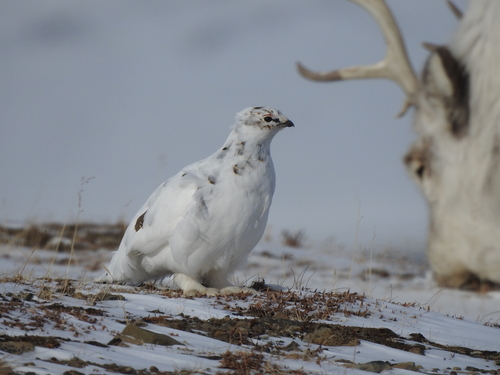 Rock Ptarmigan
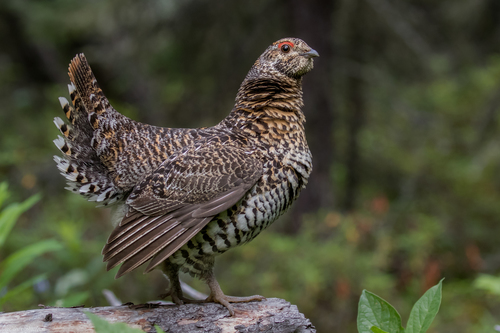 Spruce Grouse
In short
The most reliable field mark between Rock Ptarmigan and Spruce Grouse is the Rock Ptarmigan's seasonal white plumage, especially in winter, versus the Spruce Grouse's consistent barred and spotted pattern. If you see a medium-sized grouse in pure white (except for black tail and eye line), it's a Rock Ptarmigan in winter; Spruce Grouse never turns white. In summer, Rock Ptarmigan males have a slimmer bill and more extensive white on the wings and underparts, while Spruce Grouse males are darker below with white spots and a red eyebrow comb. Habitat is also a strong clue: Rock Ptarmigan favors open, barren, often higher elevation terrain, while Spruce Grouse is tied to dense coniferous forests. Bill shape, tail pattern, and behavior (especially arboreal habits in Spruce Grouse) also help separate them.
Identification tips
- Winter plumage is decisive: If the bird is entirely white except for black tail and (in males) a black eye stripe, it is a Rock Ptarmigan. Spruce Grouse never turns white.
- Habitat is a strong clue: Rock Ptarmigan is found in open, rocky, or tundra habitats, often above treeline; Spruce Grouse is in dense coniferous forests.
- Bill shape: Rock Ptarmigan has a slender bill; Spruce Grouse's bill is stouter and more typical of forest grouse.
- Red eyebrow comb: Adult male Spruce Grouse shows a prominent red eyebrow comb; Rock Ptarmigan males have red eye combs but also a black eye stripe in breeding plumage, which Spruce Grouse lacks.
- Tail pattern: Spruce Grouse has a dark tail with a pale terminal band; Rock Ptarmigan's tail is black-tipped and shorter.
- Underparts: In breeding season, Rock Ptarmigan males have white underparts; Spruce Grouse males are black below with white spots.
- Upperparts: Rock Ptarmigan males are greyish above in summer; Spruce Grouse males are more uniformly grey above, but with white spotting on the sides.
- Female/immature confusion: Female and juvenile Spruce Grouse are brown or grey and barred, with a dark tail and pale band; Rock Ptarmigan females are more cryptic and blend with rocky ground in summer, but become white in winter.
- Arboreal vs terrestrial: Spruce Grouse is often seen perched in trees; Rock Ptarmigan is almost always on the ground.
- Behavior: Spruce Grouse is notably tame and still, sometimes allowing close approach; Rock Ptarmigan is more alert and may flush at a distance, but is also well-camouflaged.
- Vocalizations: Rock Ptarmigan males are much more vocal, especially in spring, with croaking and rattling calls; Spruce Grouse is mostly silent, but males may produce wing-claps or soft drumming.
- Flight display: Rock Ptarmigan males perform aerial displays with rapid wingbeats and gliding, accompanied by vocalizations; Spruce Grouse males may end short flights with a wing-clap (franklinii subspecies).
- Seasonal change: Only Rock Ptarmigan undergoes a complete white winter moult; Spruce Grouse's plumage remains similar year-round.
- Size is not reliable: Both are medium-sized grouse with overlapping measurements; use plumage and habitat instead.
- Geographic context: If you are in Arctic, alpine, or treeless tundra, expect Rock Ptarmigan; in boreal forest, expect Spruce Grouse.
Size
Rock Ptarmigan averages around 610 g [wikidata], while Spruce Grouse males weigh 550–650 g and females 450–550 g [wikipedia]. Both are medium-sized grouse, but Spruce Grouse is slightly longer (38–43 cm vs. 34–36 cm for Rock Ptarmigan) and has a similar wingspan (Spruce Grouse: 55–57 cm; Rock Ptarmigan: 54–60 cm). In the field, size alone is not a reliable separator, as there is considerable overlap and both appear similarly robust.
Plumage
- Juvenile/immature/first-winter birds: No specific diagnostic upperwing or flight pattern is described for either species at these ages, but juvenile Spruce Grouse resemble adult females: mottled brown or grey with barred underparts and a dark tail with a pale terminal band. Juvenile Rock Ptarmigan would be more cryptic and earth-toned in summer, but turn white in winter.
- Adult males (breeding): Rock Ptarmigan males have greyish upperparts, white wings and underparts, a slender bill, and a black eye stripe. Spruce Grouse males are mainly grey above, black below, with white spots on the sides, and a prominent red eyebrow comb.
- Adult females: Rock Ptarmigan females are mottled to blend with tundra, but become white in winter. Spruce Grouse females are barred and mottled brown or grey (depending on morph), with a dark tail and pale band at the tip.
- Winter: Rock Ptarmigan is entirely white except for black tail feathers and (in males) a black eye stripe. Spruce Grouse remains barred and spotted, never turning white.
- Tail: Rock Ptarmigan's tail is short and black-tipped in all seasons. Spruce Grouse has a dark tail with a pale terminal band (noted as a separation from ruffed grouse, but also useful here).
Behaviour
Spruce Grouse is notably arboreal for a grouse, often perching and moving about in trees, especially conifers. Rock Ptarmigan is more terrestrial, typically seen walking or running on the ground in open, rocky, or tundra habitats. In flight, Rock Ptarmigan displays rapid wingbeats and gliding displays during courtship, while Spruce Grouse may perform wing-clap displays (notably in the franklinii subspecies) and is generally more secretive and still, relying on camouflage. Spruce Grouse is also famous for its tameness, sometimes allowing close approach, whereas Rock Ptarmigan can be wary but is also well-camouflaged.
Habitat
Rock Ptarmigan is strongly associated with open, barren, rocky, or tundra habitats, often at higher elevations or in Arctic/alpine zones. It avoids dense forests and is rarely found in areas with significant tree cover. Spruce Grouse, in contrast, is almost always found in dense coniferous forests (boreal or taiga), especially spruce, pine, or fir stands. If you encounter a grouse in thick woods, especially perched in a tree, it is almost certainly a Spruce Grouse; if in open, treeless, rocky ground, it is likely a Rock Ptarmigan.
Voice
Rock Ptarmigan males produce a distinctive series of guttural snores and rattles, with a rasping, croaking song described as 'ah-AAH-ah-AAAAH-a-a-a-a-a-a', especially during aerial displays. Spruce Grouse is much quieter, among the most silent of grouse, but males can produce non-vocal wing-clap displays (especially in the franklinii subspecies) and soft drumming or tail-swish sounds. Spruce Grouse lacks the loud, croaking song of Rock Ptarmigan.