

Rock Dove vs European Turtle Dove
Columba livia versus Streptopelia turtur
Play a quiz with Rock Dove and European Turtle Dove
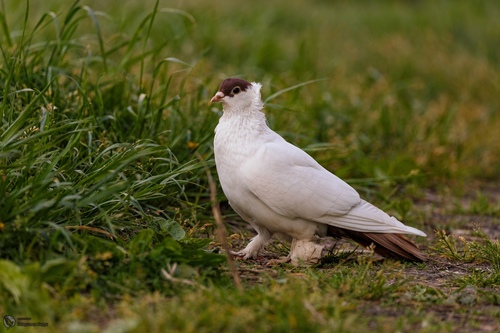 Rock Dove
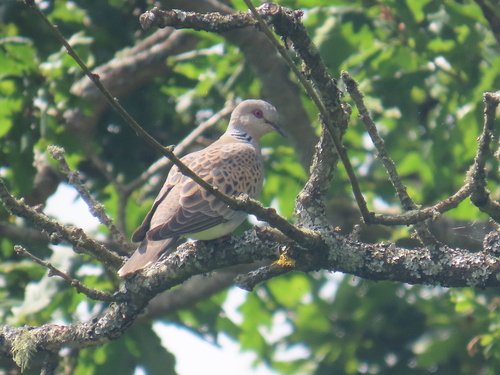 European Turtle Dove
In short
The single most reliable field mark between Rock Dove and European Turtle Dove is the wing and tail pattern in flight: Rock Doves (wild type) show broad pale grey wings with two bold black bars and a solid dark tail band, while European Turtle Doves have warm cinnamon-brown, black-mottled wings and a distinctive wedge-shaped tail with white edges and tip. Juvenile Turtle Doves lack the adult's neck patch but still show the unique tail pattern. Rock Doves are much bulkier, with a uniform grey look and iridescent neck, whereas Turtle Doves are noticeably smaller, slimmer, and have a black-and-white striped neck patch (adult only). If you see a pigeon-like bird with a white lower back and two black wing bars, it's a Rock Dove; if you see a slender dove with a warm brown wing and a white-tipped tail, it's a Turtle Dove.
Identification tips
- Flight tail pattern (all ages): Turtle Dove shows a wedge-shaped tail with white edges and tip, forming a blackish chevron from below; Rock Dove has a square tail with a solid black terminal band and white lower back.
- Wing pattern (all ages): Rock Dove always shows two bold black wing bars on pale grey wings; Turtle Dove has warm cinnamon-brown wings with black mottling and no wing bars.
- Juvenile confusion: Juvenile Turtle Doves lack the adult neck patch but still show the distinctive tail pattern and warm brown wings; juvenile Rock Doves look like duller adults but always have two black wing bars and a white lower back.
- Neck patch (adults only): Adult Turtle Doves have a black-and-white striped patch on the side of the neck; Rock Doves never have this feature.
- Back color: Rock Dove shows a white lower back (conspicuous in flight); Turtle Dove's back is blue-grey to brownish, never white.
- Head and neck iridescence: Rock Doves have greenish to reddish-purple iridescence on the neck; Turtle Doves have a blue-grey head and neck with the striped patch (adults).
- Bill and legs: Both have red to pink legs, but Turtle Dove's legs and eye ring are more vivid red; bill is black in Turtle Dove, grey-black in Rock Dove.
- Size and structure: Rock Dove is much bulkier, with a broad chest and heavy jizz; Turtle Dove is noticeably smaller, slender, and more delicate.
- Tail shape: Turtle Dove's tail is long and wedge-shaped with white edges; Rock Dove's tail is shorter, squarer, with a black band.
- Flight style: Rock Doves often glide and circle, with noisy wing claps on takeoff; Turtle Doves fly directly and quietly, often low and arrow-like.
- Flock size: Rock Doves often in large, noisy flocks; Turtle Doves usually solitary or in pairs, rarely in groups.
- Habitat: Rock Doves (wild type) in remote rocky coasts, feral pigeons everywhere; Turtle Doves in open woodland, hedgerows, and large gardens, rarely urban.
- Voice: Rock Dove's coo is soft and wavering; Turtle Dove's song is a purring 'turrr-turrr', very different.
- Seasonality: Turtle Doves are present only in spring-summer (breeding/migration); Rock Doves and feral pigeons are resident year-round.
- Pitfalls: Feral pigeons (domestic Rock Doves) can show variable plumage but never the Turtle Dove's tail pattern or neck patch; always check tail and wing pattern in flight for a definitive ID.
Size
Rock Dove is much heavier and bulkier (body mass ~280.5g) than the European Turtle Dove (~136g). Rock Doves are 30–35 cm long with a 62–68 cm wingspan, while Turtle Doves are 26–28 cm long with a 47–53 cm wingspan. In the field, Rock Doves look chunky and broad-chested, while Turtle Doves are noticeably smaller, more slender, and delicate overall.
Plumage
-
Juvenile/immature birds: Juvenile European Turtle Doves are browner and duller than adults, lacking the black-and-white neck patch, but still show the distinctive wedge-shaped tail with white edges and tip in flight. Juvenile Rock Doves look like duller versions of adults, with less neck iridescence and a generally uniform grey appearance; they always show two black wing bars and a white lower back.
-
Adults: Adult Rock Doves have a pale grey body, two crisp black wing bars, a white lower back, and a black tail band. Their head, neck, and chest are dark bluish-grey with greenish-purple iridescence on the neck. Adult Turtle Doves have a blue-grey head and rump, cinnamon-brown wings with black mottling, a vinaceous breast, and a diagnostic black-and-white striped patch on the side of the neck. The tail is wedge-shaped with a dark center and broad white borders and tip, forming a blackish chevron from below. Underparts are white on the belly and undertail coverts. The bill is black, legs and eye ring are red.
-
In flight: Rock Doves show a broad, pale underwing with two black bars and a white lower back; the tail has a solid black terminal band. Turtle Doves show a warm brown, mottled upperwing and a white-tipped, wedge-shaped tail with white edges, very different from the Rock Dove's pattern.
Behaviour
Rock Doves are often seen in large, noisy flocks, especially in urban or coastal areas, and take off with loud wing claps. They frequently glide and circle overhead. Turtle Doves are much shyer, rarely forming large groups, and are typically seen singly or in pairs, feeding quietly on the ground or perching in open woodland edges. Their flight is described as arrow-like and direct, but not particularly fast. Turtle Doves are much less likely to be seen in urban settings and are more secretive overall.
Habitat
Rock Doves (wild type) are now mostly restricted to remote coastal cliffs and islands in northwestern Europe, but feral/domestic pigeons (derived from Rock Doves) are ubiquitous in cities, towns, and farmland. Turtle Doves prefer open woodlands, hedgerows, and large gardens, avoiding dense forests and urban centers. They are migratory, breeding in Europe and wintering in sub-Saharan Africa, and are rarely seen outside migration and breeding season. Turtle Doves are much less likely to be seen in urban or rocky coastal habitats.
Voice
Rock Doves give a soft, slightly wavering coo ('crruoo-u'), with variations for alarm and display. Their call is more of a classic pigeon coo. Turtle Doves have a distinct, purring, 'turrr-turrr' song, often described as mournful or purring, quite different from the Rock Dove's coo. Both species are generally quiet when feeding, but the Turtle Dove's song is a classic summer sound in suitable habitat.