

Robust Woodpecker vs Lineated Woodpecker
Campephilus robustus versus Dryocopus lineatus
Play a quiz with Robust Woodpecker and Lineated Woodpecker
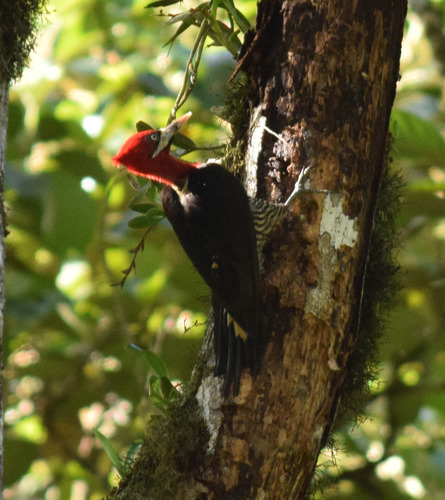 Robust Woodpecker
 Lineated Woodpecker
In short
The most reliable field mark between Robust Woodpecker and Lineated Woodpecker is the color and pattern of the upperparts and wing in all ages: Robust Woodpecker shows pale, whitish upperparts with a cinnamon tinge and black wings with small rusty-buff spots, while Lineated Woodpecker is mainly black above with prominent white lines on the face and (in many populations) down the neck and shoulders. In flight, Lineated Woodpecker shows distinct white in the wings, absent in Robust. Robust is bulkier and heavier, with a paler, longer bill, and both species have red crests but differ in facial striping and barring below. Immature birds are duller but follow the same basic pattern. Careful attention to the upperparts' color, wing pattern in flight, and facial stripes will separate even tricky individuals.
Identification tips
- Upperparts color (all ages): Robust Woodpecker has pale, whitish upperparts with a cinnamon or buff tinge; Lineated is mainly black above. This is often visible even at a distance or in flight.
- Wing pattern in flight (all ages): Lineated Woodpecker shows clear white patches in the wings when flying; Robust has blackish wings with small rusty-buff spots, lacking any bold white.
- Facial stripes (adults): Lineated has bold whitish lines from the bill down the neck and shoulders (though these may be reduced or absent in southern birds); Robust lacks these, but the female has a broad whitish stripe with black edges from bill to ear coverts.
- Head pattern (sexes): Adult male Robust has an all-red head and neck with a small black-and-white ear covert spot; adult female Robust has a wide whitish face stripe. Lineated male has a red malar stripe and forehead, female has these areas black.
- Underparts barring: Robust has buff to whitish underparts with narrow black bars, especially on the belly; Lineated is whitish below but heavily barred with black, giving a more contrasting appearance.
- Bill color and shape: Robust has a long, horn-colored (pale) chisel bill; Lineated's bill is usually black, but some populations have pale or bluish bills. Bill color is not always diagnostic, but Robust's is consistently paler and longer.
- Size and bulk: Robust is heavier and bulkier (262 g vs. 183.5 g), with a thicker neck and deeper body. This is most obvious when perched or seen side-by-side.
- Tail and wing shape: Both have strong, stiff tails, but Robust's tail appears proportionally longer and more wedge-shaped due to its larger size.
- Juvenile plumage: Juvenile Robust is duller and browner than adult, but still paler above and below than juvenile Lineated, which remains black above with white facial lines if present in its population.
- Habitat context: Robust prefers mature, undisturbed forest; Lineated is common in open woodland, edges, and disturbed areas. In overlap zones, habitat can help but is not definitive.
- Behavior: Robust is slower, more methodical, and often higher in the canopy; Lineated is more active, vocal, and likely to move between trees.
- Vocalization: Lineated gives a loud, ringing "wic-wic-wic"; Robust is quieter and less likely to call.
- Scapular/shoulder lines: Lineated typically shows white scapular lines (reduced or absent in southern populations); Robust lacks these.
- Sex differences: Female Robust has a broad whitish face stripe; female Lineated lacks red on the face and has black in these areas.
- Confusion risk: In southern populations of Lineated (where scapular lines are reduced), rely more on upperparts color, underparts barring, and bill color/size for separation.
Size
Robust Woodpecker is notably heavier and bulkier, averaging about 262 g compared to the Lineated Woodpecker's 183.5 g. Both are similar in length (about 32–37 cm), but Robust appears more massive and thick-necked, with a longer, paler bill. Lineated is slimmer, with a more typical woodpecker build. In the field, Robust often looks like a giant, especially when seen side-by-side or on the same tree. The difference is most obvious when perched, but can also be judged in flight by the deeper, slower wingbeats of Robust.
Plumage
For all ages, Robust Woodpecker has pale, whitish upperparts with a cinnamon or buff tinge, contrasting with black scapulars, coverts, and upperwing, which are marked with small rusty-buff spots on the inner webs of the flight feathers. Its underparts are buff to whitish with narrow black bars, especially on the belly. In contrast, Lineated Woodpecker is mainly black above, with a red crest and bold whitish lines running from the bill down the neck and shoulders (though these lines are reduced or absent in some southern populations). The underparts are whitish but heavily barred with black, creating a more contrasting look than Robust. In flight, Lineated shows clear white patches in the wings, which Robust lacks. Juveniles of both species are duller, but Robust juveniles remain paler above and below, with less contrast, while Lineated juveniles retain the black upperparts and white facial lines if present in their population. Adult males of both have red heads, but the facial pattern differs: Robust males have an all-red head with a small black-and-white ear covert spot, while Lineated males have a red malar stripe and forehead, with the rest of the face marked by white lines. Females of Robust have a broad whitish stripe edged in black from bill to ear coverts, while female Lineated have those areas black, lacking the red malar and forehead.
Behaviour
Both species drum and forage on large trunks, but Robust Woodpecker is more likely to be seen methodically working high up in mature forest, often in pairs. Its movements are slower and more deliberate, matching its heavier build. Lineated Woodpecker is more adaptable, often found at forest edges and open woodland, and is generally more active and conspicuous, with a tendency to call loudly and move between trees with strong, direct flights. Both excavate large nest holes, but Lineated is more likely to be seen in disturbed or secondary habitats.
Habitat
Robust Woodpecker is restricted to mature forests in Argentina, Brazil, and Paraguay, favoring large tracts of undisturbed woodland. Lineated Woodpecker has a much broader range, from southern Mexico to northern Argentina and Trinidad, and is common in forest borders, open woodland, and even semi-open areas. In areas of overlap (e.g., southeastern Brazil, Paraguay, northern Argentina), Robust will be in older, denser forest, while Lineated is more likely at edges or in fragmented woodland. Habitat context can help, but is not definitive where both occur.
Voice
Lineated Woodpecker gives a loud, ringing "wic-wic-wic" call, often repeated, and both sexes drum. Robust Woodpecker is less vocal and more secretive; its calls are not described in detail in the notes, but it is generally quieter and less likely to betray its presence by voice. If you hear a loud, repeated call, especially in open woodland, Lineated is more likely.