
Motmot

Roadside Hawk vs Grey Hawk

Rupornis magnirostris versus Buteo plagiatus

Play a quiz with Roadside Hawk and Grey Hawk
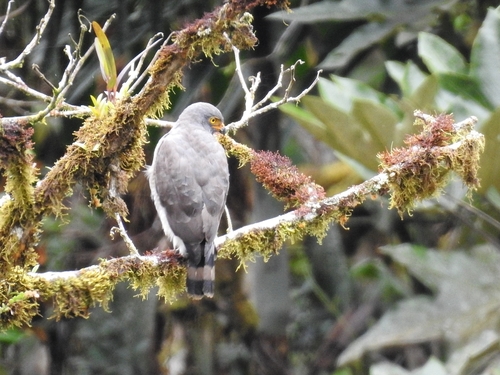
Roadside Hawk (Rupornis magnirostris) Roadside Hawk
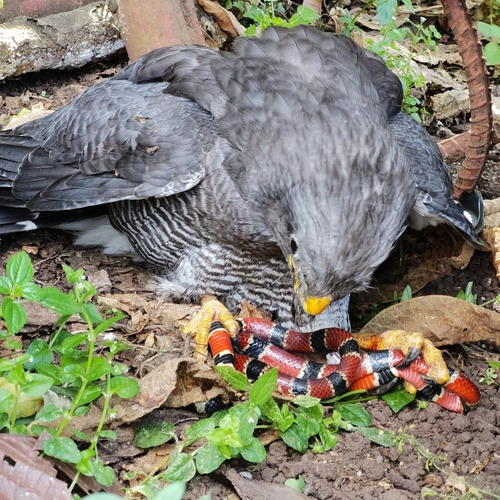
Grey Hawk (Buteo plagiatus) Grey Hawk

Media

Loading…

In short

The most reliable field mark to separate Roadside Hawk from Grey Hawk is the underpart pattern: adult Roadside Hawks show brown-and-white barring below, while adult Grey Hawks are smooth, pale gray with little or no barring. Juvenile Grey Hawks, however, are streaked or spotted on the underparts and have bold facial stripes and white upper tail coverts, unlike any Roadside Hawk. In flight, Roadside Hawks show a relatively long tail and short, rounded wings, often with a rufous tinge on the wings, while Grey Hawks are larger, longer-tailed, and adults appear more uniformly pale gray above and below. Both species have banded tails, but the pattern and number of bands differ. Structure and size also help: Grey Hawk is distinctly larger and bulkier, with orange legs and a solid gray upper side as an adult.

Identification tips

  1. Juvenile separation: Juvenile Grey Hawks have bold facial stripes and white upper tail coverts—features never shown by Roadside Hawk at any age. Their underparts are streaked or spotted, not barred. Juvenile Roadside Hawks lack these facial stripes and white tail coverts, and show brown-and-white barring below.
  2. Adult underparts: Adult Roadside Hawks always show brown-and-white barring on the lower breast and belly, while adult Grey Hawks are smooth, pale gray below with little or no barring.
  3. Tail pattern: Roadside Hawk's tail has four or five gray bars, while Grey Hawk's tail is black with three white bands (one wider than the other) and white tips. Juvenile Grey Hawks have more numerous dark bands on the tail.
  4. Upperparts: Adult Grey Hawks are solid, unpatterned gray above; Roadside Hawks are brown or grayish above, sometimes with a rufous tinge on the wings (especially in flight). Juvenile Grey Hawks are dark brown above, unlike any Roadside Hawk.
  5. Wing and tail structure: Roadside Hawk has a relatively long tail and short, rounded wings, giving it a compact, stubby-winged look in flight. Grey Hawk is larger, longer-tailed, and also short-winged for a Buteo, but appears bulkier and more substantial.
  6. Rufous on wings: A touch of rufous on the wings, especially visible in flight, is typical of Roadside Hawk and not shown by Grey Hawk.
  7. Leg color: Both species have yellow legs as adults, but Grey Hawk's can appear more orange.
  8. Beak size: Roadside Hawk has a relatively large beak for its size, which can be noticeable at close range.
  9. Eye color: Adult Roadside Hawks have whitish or yellow eyes; eye color is not specified for Grey Hawk, so not a primary field mark.
  10. Size: Grey Hawk is much larger and heavier than Roadside Hawk. If you see both together, the difference is obvious; otherwise, use structure and bulk as supporting clues.
  11. Vocalizations: Roadside Hawk gives a high-pitched, squeaky call; Grey Hawk gives a shrill, whistled 'kleee-ooo.' Listen for these if the bird is calling.
  12. Habitat and abundance: Roadside Hawk is often the default small raptor in much of its range, especially near roads and open areas. Grey Hawk is more restricted and less likely to be seen in urban or suburban settings.
  13. Flight style: Roadside Hawk soars frequently but does not hover; Grey Hawk is known for fast, agile flight and often perches high before swooping on prey.
  14. Pitfalls: Beware of the wide plumage variation in Roadside Hawk subspecies, which can sometimes approach the gray tones of Grey Hawk, but the underpart barring and lack of solid gray upperparts remain reliable. Juvenile Grey Hawks are the most likely to be confused with Roadside Hawk, but the facial stripes and white upper tail coverts are strong clues.
  15. Sex and season: Sexes are similar in both species; plumage differences are mainly age-related, not seasonal or sexual.

Size

Grey Hawk is significantly larger than Roadside Hawk: adult Grey Hawks measure 46–61 cm in length and weigh about 475 g, while Roadside Hawks are 31–41 cm and 250–300 g. This size difference is usually obvious in the field, with Grey Hawk appearing bulkier and longer-tailed. Both species are short-winged for Buteos, but Roadside Hawk is noticeably smaller and more compact, with a relatively large beak for its size. Sexes are similar in both, though female Roadside Hawks are about 20% larger than males.

Plumage

Juvenile Grey Hawks are the easiest to separate from Roadside Hawks: young Grey Hawks have a dark brown upper side, boldly streaked or spotted underparts, obvious facial stripes, and white upper tail coverts. Their tails show multiple dark bands. Juvenile Roadside Hawks, in contrast, do not have such bold facial stripes or white upper tail coverts, and their underparts are barred rather than streaked or spotted. Adult Roadside Hawks are variable (brownish or grayish above depending on subspecies), but always show brown-and-white barring on the lower breast and underparts, and a tail with four or five gray bars. Adult Grey Hawks are smooth, pale gray above and below, with a black tail featuring three white bands (one wider than the other), and white tips to the tail feathers. Roadside Hawks often show a touch of rufous on the wings, especially in flight, which is absent in Grey Hawk. Both species have yellow legs as adults, but Grey Hawk's can appear orange. Eye color is whitish or yellow in adult Roadside Hawk; not specified for Grey Hawk. The beak of Roadside Hawk is relatively large for its size.

Behaviour

Roadside Hawk is often the most common raptor in its range and is frequently seen soaring or perched conspicuously, especially near roads and open areas. It soars often but does not hover. Grey Hawk typically perches high in trees at forest edges or in open country, scanning for prey, and is known for its fast, agile flight. Both species hunt mainly small vertebrates, but Roadside Hawk is less likely to take birds and more likely to take insects and small mammals. Grey Hawk often swoops from a perch or glides low to catch prey, especially lizards and snakes.

Habitat

Both species are found in open country and at forest edges, but Roadside Hawk is often more abundant and widespread in its range, frequently seen near human habitation and along roads. Grey Hawk is found from Costa Rica north into the southwestern United States, favoring open country and forest edges but is generally less common and more localized than Roadside Hawk. Roadside Hawk is often the default small raptor in much of its range, while Grey Hawk is more restricted in distribution.

Voice

Roadside Hawk gives a very high-pitched, piercing squeak, while Grey Hawk's call is a shrill, whistled 'kleee-ooo.' Both are vocal, but the tone and structure of the calls are quite different; Roadside Hawk's is more squeaky and high-pitched, Grey Hawk's is more of a whistle.

Submit a better description

Use the same sections as the comparison. Your text is published immediately.

The most reliable field mark to separate Roadside Hawk from Grey Hawk is the underpart pattern: adult Roadside Hawks show brown-and-white barring below, while adult Grey Hawks are smooth, pale gray with little or no barring. Juvenile Grey Hawks, however, are streaked or spotted on the underparts and have bold facial stripes and white upper tail coverts, unlike any Roadside Hawk. In flight, Roadside Hawks show a relatively long tail and short, rounded wings, often with a rufous tinge on the wings, while Grey Hawks are larger, longer-tailed, and adults appear more uniformly pale gray above and below. Both species have banded tails, but the pattern and number of bands differ. Structure and size also help: Grey Hawk is distinctly larger and bulkier, with orange legs and a solid gray upper side as an adult.

  1. Juvenile separation: Juvenile Grey Hawks have bold facial stripes and white upper tail coverts—features never shown by Roadside Hawk at any age. Their underparts are streaked or spotted, not barred. Juvenile Roadside Hawks lack these facial stripes and white tail coverts, and show brown-and-white barring below.
  2. Adult underparts: Adult Roadside Hawks always show brown-and-white barring on the lower breast and belly, while adult Grey Hawks are smooth, pale gray below with little or no barring.
  3. Tail pattern: Roadside Hawk's tail has four or five gray bars, while Grey Hawk's tail is black with three white bands (one wider than the other) and white tips. Juvenile Grey Hawks have more numerous dark bands on the tail.
  4. Upperparts: Adult Grey Hawks are solid, unpatterned gray above; Roadside Hawks are brown or grayish above, sometimes with a rufous tinge on the wings (especially in flight). Juvenile Grey Hawks are dark brown above, unlike any Roadside Hawk.
  5. Wing and tail structure: Roadside Hawk has a relatively long tail and short, rounded wings, giving it a compact, stubby-winged look in flight. Grey Hawk is larger, longer-tailed, and also short-winged for a Buteo, but appears bulkier and more substantial.
  6. Rufous on wings: A touch of rufous on the wings, especially visible in flight, is typical of Roadside Hawk and not shown by Grey Hawk.
  7. Leg color: Both species have yellow legs as adults, but Grey Hawk's can appear more orange.
  8. Beak size: Roadside Hawk has a relatively large beak for its size, which can be noticeable at close range.
  9. Eye color: Adult Roadside Hawks have whitish or yellow eyes; eye color is not specified for Grey Hawk, so not a primary field mark.
  10. Size: Grey Hawk is much larger and heavier than Roadside Hawk. If you see both together, the difference is obvious; otherwise, use structure and bulk as supporting clues.
  11. Vocalizations: Roadside Hawk gives a high-pitched, squeaky call; Grey Hawk gives a shrill, whistled 'kleee-ooo.' Listen for these if the bird is calling.
  12. Habitat and abundance: Roadside Hawk is often the default small raptor in much of its range, especially near roads and open areas. Grey Hawk is more restricted and less likely to be seen in urban or suburban settings.
  13. Flight style: Roadside Hawk soars frequently but does not hover; Grey Hawk is known for fast, agile flight and often perches high before swooping on prey.
  14. Pitfalls: Beware of the wide plumage variation in Roadside Hawk subspecies, which can sometimes approach the gray tones of Grey Hawk, but the underpart barring and lack of solid gray upperparts remain reliable. Juvenile Grey Hawks are the most likely to be confused with Roadside Hawk, but the facial stripes and white upper tail coverts are strong clues.
  15. Sex and season: Sexes are similar in both species; plumage differences are mainly age-related, not seasonal or sexual.

Grey Hawk is significantly larger than Roadside Hawk: adult Grey Hawks measure 46–61 cm in length and weigh about 475 g, while Roadside Hawks are 31–41 cm and 250–300 g. This size difference is usually obvious in the field, with Grey Hawk appearing bulkier and longer-tailed. Both species are short-winged for Buteos, but Roadside Hawk is noticeably smaller and more compact, with a relatively large beak for its size. Sexes are similar in both, though female Roadside Hawks are about 20% larger than males.

Juvenile Grey Hawks are the easiest to separate from Roadside Hawks: young Grey Hawks have a dark brown upper side, boldly streaked or spotted underparts, obvious facial stripes, and white upper tail coverts. Their tails show multiple dark bands. Juvenile Roadside Hawks, in contrast, do not have such bold facial stripes or white upper tail coverts, and their underparts are barred rather than streaked or spotted. Adult Roadside Hawks are variable (brownish or grayish above depending on subspecies), but always show brown-and-white barring on the lower breast and underparts, and a tail with four or five gray bars. Adult Grey Hawks are smooth, pale gray above and below, with a black tail featuring three white bands (one wider than the other), and white tips to the tail feathers. Roadside Hawks often show a touch of rufous on the wings, especially in flight, which is absent in Grey Hawk. Both species have yellow legs as adults, but Grey Hawk's can appear orange. Eye color is whitish or yellow in adult Roadside Hawk; not specified for Grey Hawk. The beak of Roadside Hawk is relatively large for its size.

Roadside Hawk is often the most common raptor in its range and is frequently seen soaring or perched conspicuously, especially near roads and open areas. It soars often but does not hover. Grey Hawk typically perches high in trees at forest edges or in open country, scanning for prey, and is known for its fast, agile flight. Both species hunt mainly small vertebrates, but Roadside Hawk is less likely to take birds and more likely to take insects and small mammals. Grey Hawk often swoops from a perch or glides low to catch prey, especially lizards and snakes.

Both species are found in open country and at forest edges, but Roadside Hawk is often more abundant and widespread in its range, frequently seen near human habitation and along roads. Grey Hawk is found from Costa Rica north into the southwestern United States, favoring open country and forest edges but is generally less common and more localized than Roadside Hawk. Roadside Hawk is often the default small raptor in much of its range, while Grey Hawk is more restricted in distribution.

Roadside Hawk gives a very high-pitched, piercing squeak, while Grey Hawk's call is a shrill, whistled 'kleee-ooo.' Both are vocal, but the tone and structure of the calls are quite different; Roadside Hawk's is more squeaky and high-pitched, Grey Hawk's is more of a whistle.

Discard your changes?

You have unsaved edits. If you leave now, those changes will be lost.

Roadside Hawk · Grey Hawk · My Tricky Birds