

Roadside Hawk vs Gilded Barbet
Rupornis magnirostris versus Capito auratus
Play a quiz with Roadside Hawk and Gilded Barbet
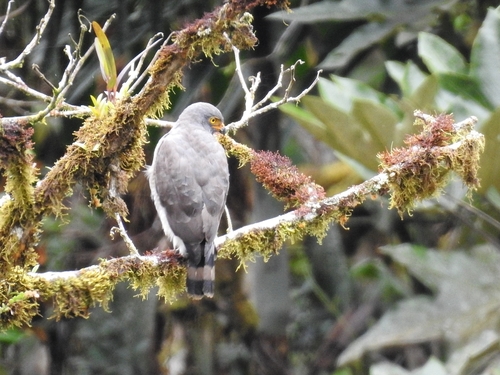 Roadside Hawk
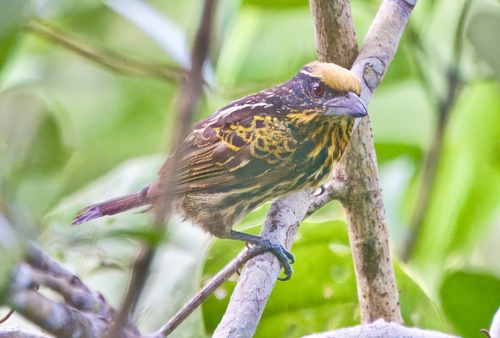 Gilded Barbet
In short
The most reliable field mark to separate Roadside Hawk from Gilded Barbet is overall structure and flight profile: Roadside Hawk is a slim, long-tailed raptor with short, broad wings, while Gilded Barbet is a chunky, big-headed songbird with a stubby bill and short tail. In flight, the hawk shows barred underparts and a long, banded tail, whereas the barbet is compact, with black upperparts and yellow highlights. If you see a raptor-like silhouette, it's Roadside Hawk; a thickset, stubby-billed bird with yellow and black plumage is Gilded Barbet. Habitat and behavior also help: hawks soar or perch openly, barbets stay in forest and move in short hops.
Identification tips
- Silhouette and structure: Roadside Hawk is slim, long-tailed, with short, broad wings and a hooked bill; Gilded Barbet is chunky, short-tailed, with a big head and stubby bill. This is the fastest way to separate them in flight or perched.
- Flight behavior: Roadside Hawk soars frequently and may be seen gliding or circling high; Gilded Barbet never soars and moves in short, direct flights within the canopy.
- Bill shape: The hawk has a large, hooked beak (adapted for predation), while the barbet's bill is thick, stubby, and straight, suited for fruit-eating.
- Tail pattern: Roadside Hawk shows a long tail with 4–5 distinct grey bars, visible in flight and when perched; Gilded Barbet's tail is short, black, and lacks barring.
- Underparts: Hawk has brown-and-white barring on the lower breast and belly; barbet has pale yellow underparts with black streaking on the flanks (and sometimes chest in females).
- Upperparts and wings: Hawk is brown or grey above, sometimes with rufous on the wings; barbet is black above, with yellow spotting and edging on the wings.
- Head and face: Hawk's head is plain brown or grey with yellow or whitish eyes; barbet has a black mask, yellow eyebrows (extending as lines over the mantle), and a brightly colored crown (yellow to orange or red).
- Sex differences: Female barbets have more orange-yellow on the wings and more streaking, especially in the westernmost subspecies; hawk sexes are similar except for size (females larger).
- Eye color: Hawk has whitish or yellow eyes; barbet has dark maroon irides.
- Leg color: Barbet has greyish legs; hawk's leg color not specified but usually yellowish in this group.
- Habitat: Hawk is common in open areas, roadsides, and forest edges; barbet is restricted to dense, moist lowland forests.
- Perching behavior: Hawk perches openly, often on wires or exposed branches; barbet stays within the canopy or subcanopy, rarely exposed.
- Vocalization: Hawk gives a high-pitched, piercing squeak; barbet's call is not specified, but expect a less raptor-like, more repetitive song.
- Feeding behavior: Hawk hunts small animals, sometimes seen swooping or pouncing; barbet feeds on fruit, often seen plucking berries or sitting quietly.
- Confusion risk: Immature hawks may appear streaked below, but never show the barbet's bright yellow and black pattern or thickset shape. Barbets never show raptor-like flight or structure.
Size
Roadside Hawk is significantly larger, measuring 31–41 cm (12–16 in) and weighing 250–300 g. Gilded Barbet is much smaller and more compact at about 20 cm (8 in) in length, with a thickset build but much lighter mass (not specified, but typical for barbets). The hawk's size is accentuated by its long tail and longer legs, while the barbet appears short-tailed and heavy-headed.
Plumage
No age-specific upperwing pattern is described for either species, but plumage is highly contrasting. Roadside Hawk (adult and immature) is mainly brown or grey above, with barred brown and white underparts and a tail with 4–5 grey bars; some rufous is visible on the wings in flight. The eyes are whitish or yellow, and the bill is relatively large and hooked. Gilded Barbet of both sexes is black above (including wings and tail), with yellow spotting on the greater coverts, yellow edges to remiges, and yellow tips to tertials. The underparts are pale yellow with black streaking on the flanks; the throat and crown are variably red, orange, or yellow depending on subspecies and sex. Females show more orange-yellow on the wings and additional streaking. Both sexes have a black-tipped grey bill and dark maroon eyes. In all ages, the barbet's plumage is much more colorful and patterned, while the hawk is more subdued and streaked/barred.
Behaviour
Roadside Hawk often perches conspicuously or soars, using its long tail and short wings for maneuvering. It hunts small animals and is often seen near roads or open areas. Gilded Barbet is a forest-dweller, moving in short hops or flights within the canopy, rarely soaring or perching in the open. It feeds mainly on fruit and is much less likely to be seen in open country or soaring.
Habitat
Roadside Hawk is common in open or semi-open habitats, often near roads, forest edges, and clearings throughout much of the Americas. It is often the most visible raptor in its range. Gilded Barbet is restricted to tropical moist lowland forests and woodlands, mainly in the western Amazon and Orinoco basins, and is rarely seen outside dense forest or woodland. If you are in open country, the hawk is far more likely; in deep forest, expect the barbet.
Voice
Roadside Hawk gives a very high-pitched, piercing squeak, often repeated and quite loud for its size. Gilded Barbet's voice is not described in the notes, but barbets generally have repetitive, sometimes mechanical-sounding calls. If you hear a piercing, raptor-like squeal, it's the hawk.