

Ridgway's Rail vs Virginia Rail
Rallus obsoletus versus Rallus limicola
Play a quiz with Ridgway's Rail and Virginia Rail
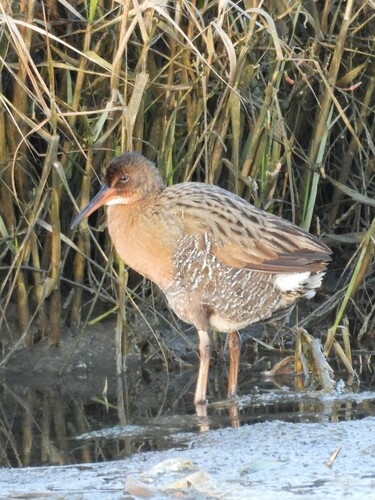 Ridgway's Rail
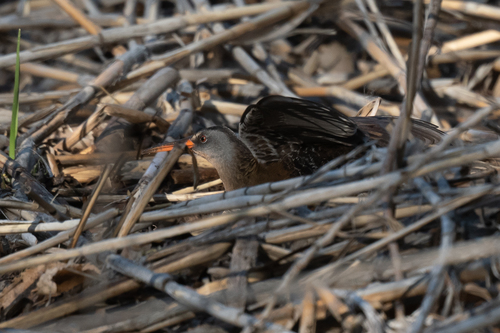 Virginia Rail
In short
The most reliable field mark to separate Ridgway's Rail from Virginia Rail is size: Ridgway's is much larger and bulkier, with a long, heavy, downward-curving bill, while Virginia Rail is distinctly smaller and more delicate with a slimmer, shorter reddish bill. Both species are secretive marsh birds with brownish plumage and similar rail-like structure, but Ridgway's Rail shows a more cinnamon-brown coloration overall and a conspicuous whitish rump patch, whereas Virginia Rail has gray cheeks, a whitish throat, and a bold pale supercilium. Juvenile and immature plumages are not described in detail for Ridgway's, but Virginia Rail juveniles are notably darker and blackish below. In flight, both species are reluctant to flush, but Ridgway's appears heavier and longer. Habitat overlap is possible, but Ridgway's is mostly restricted to brackish tidal marshes of the Pacific coast, while Virginia Rail is more widespread in freshwater marshes.
Identification tips
- Size is the most immediate clue: Ridgway's Rail is much larger and bulkier than Virginia Rail. If you see a rail that looks nearly chicken-sized, it is almost certainly Ridgway's; Virginia Rail is closer to a starling or small thrush in size.
- Bill structure: Ridgway's Rail has a long, heavy, and strongly downcurved bill, often appearing massive for the head. Virginia Rail's bill is long and slim, but shorter, more delicate, and reddish in color.
- Plumage tone: Ridgway's Rail is overall cinnamon-brown with a pale chestnut breast and a conspicuous whitish rump patch, especially visible when the bird is walking away or in flight. Virginia Rail is darker brown above, with gray cheeks, a bold pale supercilium, and a whitish throat. The overall effect is a more patterned, less uniform bird.
- Face pattern: Virginia Rail shows a distinct gray cheek and pale line over the eye (supercilium), which Ridgway's lacks. Ridgway's face is more uniformly brownish-gray.
- Rump patch: Ridgway's Rail has a conspicuous whitish rump patch, a useful mark if seen from behind or in flight. Virginia Rail lacks this feature.
- Leg color: Virginia Rail has orange-brown legs, which can be a supporting mark at close range. Ridgway's Rail's leg color is less distinctive in the notes.
- Tail: Virginia Rail's tail is short and often held cocked upward, sometimes exposing whitish undertail coverts. Ridgway's Rail's tail is also short but not as frequently cocked or as prominent.
- Juvenile plumage: Virginia Rail juveniles are blackish brown above with rufous feather edges and dark below; Ridgway's Rail juvenile plumage is not detailed, but expect a larger, paler, and less contrasting bird.
- Flight jizz: Both species are reluctant to fly, but when they do, Ridgway's Rail appears heavy, long-bodied, and slow, while Virginia Rail is more compact, quick, and direct.
- Habitat: Ridgway's Rail is almost always in brackish tidal marshes with pickleweed and cordgrass, especially on the Pacific coast. Virginia Rail is more likely in freshwater or mixed marshes with cattails and reeds, and is widespread across North America.
- Behavior: Virginia Rail may climb on vegetation while foraging and is more likely to dive or swim to escape danger. Ridgway's Rail is more likely to walk or run for cover.
- Seasonality: Ridgway's Rail is resident in its coastal range, while Virginia Rail may be migratory or present only in breeding season in some areas.
- Voice: Not described in the notes, so do not rely on vocalizations for separation here.
- Overlap: Where both species occur, use size, bill shape, and face pattern as your first checks. If you have a clear view of the rump, the whitish patch is diagnostic for Ridgway's.
- Pitfalls: Poor views in dense marsh can make even large rails look small. Always try to get a sense of scale, and check for the combination of bill size, face pattern, and rump color before making a call.
Size
Ridgway's Rail is substantially larger and heavier than Virginia Rail. While precise mass for Ridgway's is not provided, Virginia Rail averages about 89 g and measures 20–27 cm in length with a 32–38 cm wingspan. Ridgway's is described as a large rail, appearing much bulkier and longer-bodied in the field. This size difference is often obvious even at a distance or in flight, and is a primary field separation point.
Plumage
- Juvenile/immature plumage: Virginia Rail juveniles are blackish brown above with rufous feather edges, dark brown to black below, and a brownish bill and legs. Their face is grayish brown. Ridgway's Rail juvenile plumage is not detailed, but adults are described as cinnamon-brown with a pale chestnut breast and a conspicuous whitish rump patch.
- Adult plumage: Ridgway's Rail is overall grayish brown with a strong cinnamon wash, pale chestnut breast, and a distinctive whitish rump patch. Virginia Rail adults are mainly brown, darker on the back and crown, with gray cheeks, a bold pale stripe over the eye, and a whitish throat. Their legs are orange-brown and bill is reddish. Both have long toes and short tails, but Virginia Rail's tail is proportionally shorter and often cocked up.
- Flight views: No detailed wing pattern is given for either species, but Ridgway's Rail should appear larger and more cinnamon-toned, while Virginia Rail will show a smaller, darker, and more compact profile.
Behaviour
Both species are secretive and prefer to walk or run through dense marsh vegetation rather than fly. Ridgway's Rail is especially reluctant to fly and is most active at dawn, dusk, or night. Virginia Rail is also shy and more often heard than seen, but is capable of climbing through vegetation and occasionally dives or swims to escape danger. Virginia Rail may be seen climbing on plants while foraging, a behavior less often noted in Ridgway's. Both species probe mud or shallow water for invertebrates, but Ridgway's Rail is more likely to be seen in brackish tidal sloughs, while Virginia Rail is more flexible in habitat use.
Habitat
Ridgway's Rail is almost entirely restricted to brackish tidal marshes along the Pacific coast, especially in areas dominated by pickleweed and cordgrass, occasionally with bulrush. It is most often found in tidal sloughs and at the ecotone between mudflat and vegetated marsh. Virginia Rail, while also a marsh specialist, is more widespread and common in freshwater and brackish marshes across North America. It nests in dense emergent vegetation such as cattails, reeds, and grasses, and is less tied to tidal habitats. Overlap is possible in some brackish marshes, but Ridgway's is the expected species in tidal saltmarshes of the West Coast.