

Red Shoveler vs Australasian Shoveler
Spatula platalea versus Spatula rhynchotis
Play a quiz with Red Shoveler and Australasian Shoveler
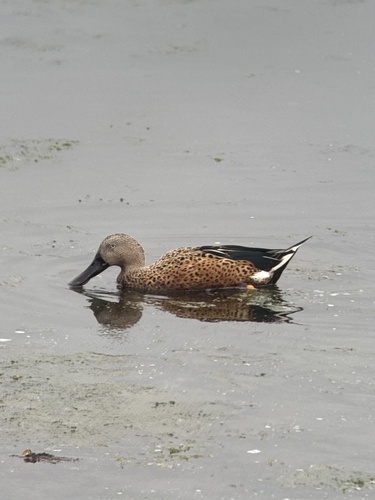 Red Shoveler
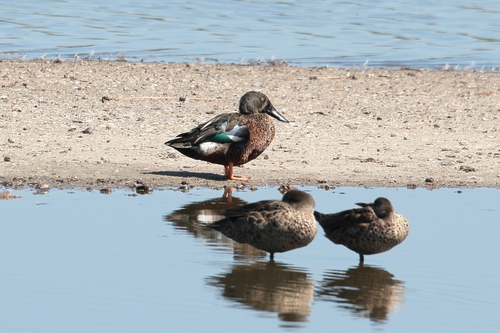 Australasian Shoveler
In short
The most reliable field mark between Red Shoveler and Australasian Shoveler is the overall body and wing coloration, especially in adult males: Red Shoveler males show a distinct reddish or pinkish body with a green speculum and pale blue upperwing coverts, while Australasian Shoveler males never appear red-toned. Both species have a large spatula-shaped bill, but Red Shoveler females have especially large, dark bills. In flight or at rest, the Red Shoveler’s combination of green speculum and pale blue upperwing coverts is distinctive. Size and structure are broadly similar, so focus on plumage and bill color for separation.
Identification tips
- Male body color: Adult male Red Shovelers are distinctly reddish or pinkish overall, a unique feature among shovelers. Australasian Shoveler males never show this coloration; they are more muted and lack any red or pink on the body.
- Upperwing pattern: Both species have a green speculum and pale blue upperwing coverts, visible in flight or when perched with wings spread. In Red Shoveler, the blue is often more obvious and contrasts with the reddish body in males.
- Bill shape and color: Both have a large, spatulate bill, but female Red Shovelers have especially large, dark bills, which can help separate them from Australasian Shoveler females if seen well.
- Female and immature plumage: Female Red Shovelers are less colorful but still show the green speculum and blue coverts. Australasian Shoveler females are similar but lack the reddish tinge anywhere on the body.
- Juvenile/immature birds: Upperwing pattern (green speculum, blue coverts) is likely present in both, so rely on bill size and body color for separation. If the bird is not red-toned and the bill is not especially large and dark, Australasian is more likely.
- Size: Both species are very similar in length and mass, so do not use size as a primary field mark.
- Flight views: In flight, look for the combination of green speculum and blue coverts, but remember this is shared. Focus on body color (red vs. brownish) and bill size for a confident ID.
- Perched views: When perched, Red Shoveler males are noticeably red or pink, while Australasian males are not. Females are trickier, but bill color and size may help.
- Geographic range: If you are in southern South America, Red Shoveler is expected; in Australia, Tasmania, or New Zealand, Australasian Shoveler is expected. Vagrancy is rare, so range is a strong context clue.
- Habitat: Both species use similar wetland habitats, so habitat alone is not diagnostic.
- Voice: No vocal differences are described in the available notes; do not rely on calls for separation.
- Seasonal variation: Males may appear paler or less red outside breeding season, but Red Shoveler should always show some reddish or pinkish tones if adult male.
- Courtship and behavior: Both species form pairs on the wintering grounds and have similar dabbling and filtering feeding behaviors, so do not use behavior for separation.
- Pitfalls: Immature or eclipse males may lack strong red color, so always check bill size and upperwing pattern in addition to body color.
- Summary tip: If you see a shoveler with a red or pinkish body and blue upperwing coverts, it is a Red Shoveler. If the bird lacks any red and is in Australasia, it is an Australasian Shoveler.
Size
Both species are very close in size, with Red Shoveler at 45–56 cm in length and Australasian Shoveler at 46–53 cm. Their wingspans and body mass are also similar, so size alone is not a reliable field mark. Expect both to look like medium-sized dabbling ducks with a noticeably long, broad bill.
Plumage
Adult male Red Shovelers are unique among shovelers for their reddish or pinkish body plumage, which is never shown by Australasian Shoveler. Both species have a green speculum and pale blue upperwing coverts, but the Red Shoveler’s blue is often more prominent and contrasts with the red body. Female Red Shovelers are less colorful but have a large, dark bill and still show the green speculum and blue upperwing. Australasian Shoveler males have a more muted body color, lacking any red tones, and their upperwing pattern is similar but typically less contrasting. Juvenile and immature plumages are not described in detail, but the upperwing pattern (green speculum, blue coverts) is likely present in both, so focus on body color and bill size for young birds.
Behaviour
Both species are dabbling ducks with similar feeding behavior, using their wide, spatulate bills to filter food from the water. No behavioral differences are noted that would reliably separate them in the field.
Habitat
Red Shoveler is native to southern South America, while Australasian Shoveler is found in Australia, Tasmania, and New Zealand. Both prefer wetlands and heavily vegetated swamps, so habitat is not a strong separator unless you are outside their native ranges.