

Red-ruffed Fruitcrow vs Bare-throated Bellbird
Pyroderus scutatus versus Procnias nudicollis
Play a quiz with Red-ruffed Fruitcrow and Bare-throated Bellbird
 Red-ruffed Fruitcrow
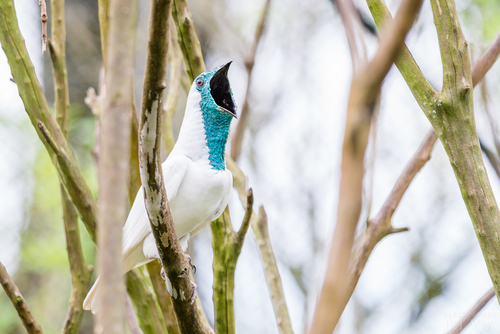 Bare-throated Bellbird
In short
The most reliable field mark to separate Red-ruffed Fruitcrow from Bare-throated Bellbird is overall plumage: adult male fruitcrows are large, mostly black birds with a striking crimson or chestnut throat patch, while adult male bellbirds are entirely white with a conspicuous bluish-black bare patch of skin on the throat, face, and around the bill. Females are also distinct: fruitcrow females resemble duller males, while female bellbirds are olive-brown above with yellowish, streaked underparts. No age-specific wing or flight pattern marks are described for either species, so focus on body color, throat, and bare skin. Structure and size also help: fruitcrows are much larger and heavier-bodied, with a heavier pale bill, compared to the more compact, short-billed bellbird.
Identification tips
- Adult male plumage: If you see a large, mostly black bird with a vivid crimson or chestnut throat patch, it's a Red-ruffed Fruitcrow. If the bird is entirely white with a bare bluish-black patch of skin on the throat and face, it's a male Bare-throated Bellbird.
- Adult female plumage: Female fruitcrows look like duller, slightly smaller versions of the male—still blackish with a colored throat. Female bellbirds are olive-brown above, yellowish and streaked below, with a blackish crown—never black or red-throated.
- Bare skin: Only the bellbird (male) has extensive bare, bluish-black skin on the throat, face, and around the bill. Fruitcrows always have feathered throats, even when red or chestnut.
- Bill color and shape: Fruitcrow has a heavy, pale bluish bill; bellbird has a short, wide-gaped bill, not as robust, and usually dark.
- Size and bulk: Fruitcrow is much larger and bulkier than bellbird. If the bird appears crow-sized or larger, it's almost certainly a fruitcrow.
- Subspecies variation: Some fruitcrow subspecies have more chestnut or brown underparts, but always retain a blackish upper body and colored throat. Bellbird males are always white; females always olive/yellow.
- Flight and jizz: Fruitcrows fly with heavy, direct wingbeats and appear large and slow. Bellbirds are more compact and may seem less ponderous in flight.
- Voice: If you hear a loud, metallic, anvil-like call, look for a bellbird. Fruitcrow calls are not as loud or distinctive.
- Habitat context: In southeastern Brazil, Paraguay, or Argentina, especially in more open or disturbed forests, bellbird is more likely. In Andean or dense, steep-forested areas, fruitcrow is more likely.
- Lekking behavior: If you see several large black birds with red throats calling together, it's a fruitcrow lek. Bellbirds do not display in groups.
- Juvenile/immature confusion: No distinctive juvenile wing or flight marks are described for either species, so rely on overall color and throat/face pattern at all ages.
- Perched vs. flying: Both species are most easily identified when perched; in flight, size and body color (blackish vs. white) are still diagnostic.
- Pitfalls: Do not confuse the bellbird's bare black throat for a colored patch; the fruitcrow's throat is always feathered and red/chestnut, never bare.
- Sex differences: Only bellbird shows strong sexual dimorphism (white male, olive/yellow female). Fruitcrow sexes are similar, with females slightly duller.
- Urban context: Bellbirds may turn up in urban parks during migration; fruitcrows are rarely found outside dense forest.
Size
Red-ruffed Fruitcrow is one of the largest passerines in South America, with some subspecies reaching up to 14 inches (36 cm) in length (e.g., P. s. granadensis: 14 in/36 cm). Bare-throated Bellbird is significantly smaller, around 27 cm (11 in) in length. The fruitcrow is notably bulkier and heavier-bodied, with a more robust, pale bluish bill, while the bellbird is more compact with a short bill and wide gape. Even the smallest fruitcrow subspecies (granadensis) is larger than the bellbird.
Plumage
-
Juvenile/immature plumage and wing pattern: No distinctive juvenile or immature upperwing or flight pattern marks are described for either species, so separation relies on body and head plumage at all ages.
-
Adult males: Red-ruffed Fruitcrow males are glossy black with a bright to dull crimson or chestnut throat patch (varying by subspecies), sometimes with brown underparts. Bare-throated Bellbird males are entirely white with a striking bluish-black bare patch of skin around the eye, bill, and throat—no red or chestnut anywhere.
-
Adult females: Female fruitcrows are similar to males but slightly smaller and with a duller ruff; still mostly blackish with a colored throat. Female bellbirds are olive-brown above, with yellowish underparts streaked with olive green, and a blackish crown—completely different from any fruitcrow.
-
Subspecies variation: Fruitcrow subspecies show some variation in the extent and brightness of the throat and underparts, but always retain the blackish body and colored throat. Bellbird males are always white with bare skin; females always olive/yellowish and streaked.
Behaviour
Red-ruffed Fruitcrows may gather in loose leks where males call to attract females, often seen perched in the canopy or flying with heavy, direct flight. They are omnivorous, feeding on fruit, insects, and lizards. Bare-throated Bellbirds are more strictly frugivorous and are often detected by the male's extremely loud, metallic call given from high perches. Both species may be seen high in the forest, but bellbirds are more likely to be heard before seen due to their voice.
Habitat
Both species inhabit subtropical and tropical moist forests, but their ranges only partially overlap. Red-ruffed Fruitcrow is found in Andean and adjacent forests, while Bare-throated Bellbird is restricted to southeastern South America (Brazil, Paraguay, Argentina), favoring primary and some secondary forests. Bellbirds may appear in more disturbed or urban forest patches, especially during migration, while fruitcrows are more associated with dense, less disturbed forest and steep drainages.
Voice
Bare-throated Bellbird males produce one of the loudest bird calls, a metallic, anvil-like sound that carries over long distances. This is a key field clue—if you hear a piercing metallic call, suspect bellbird. Red-ruffed Fruitcrow males also call, especially in leks, but their vocalizations are not described as especially loud or metallic and are not as distinctive as the bellbird's.
Red-ruffed Fruitcrow · Bare-throated Bellbird · My Tricky Birds