

Red-naped Sapsucker vs Lewis's Woodpecker
Sphyrapicus nuchalis versus Melanerpes lewis
Play a quiz with Red-naped Sapsucker and Lewis's Woodpecker
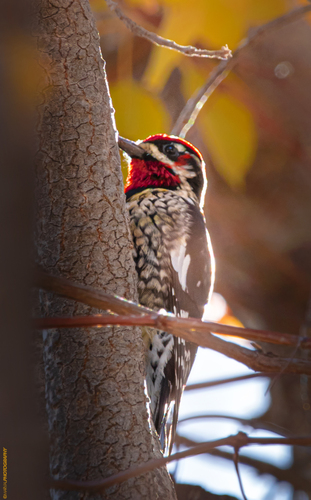 Red-naped Sapsucker
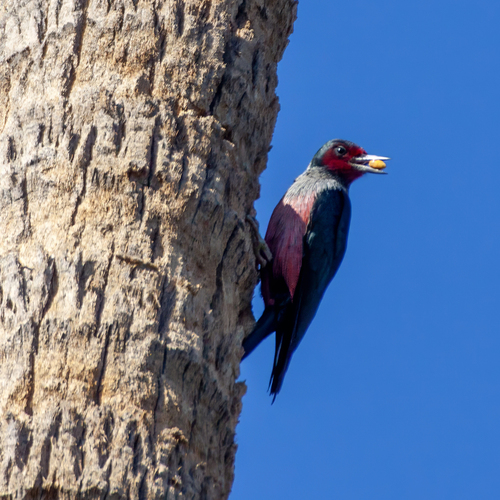 Lewis's Woodpecker
In short
The most reliable field mark to separate Red-naped Sapsucker from Lewis's Woodpecker is overall coloration and structure: Red-naped Sapsucker is a medium-sized, compact woodpecker with bold black, white, and red head pattern and a yellowish belly, while Lewis's Woodpecker is much larger, with a unique combination of dark greenish-black upperparts, a gray collar, pinkish belly, and red face. In flight, Lewis's Woodpecker shows broader wings and a slower, crow-like flight style, unlike the more typical woodpecker flight of the Red-naped Sapsucker. The sapsucker has a distinctive white wing patch and red nape spot, while Lewis's lacks these and instead has a gray collar and pinkish underparts. If you see a large, dark woodpecker with a gray collar and pink belly, it's Lewis's; a smaller, crisply patterned bird with a red nape and white wing patch is Red-naped Sapsucker.
Identification tips
- Size is a strong clue: Lewis's Woodpecker is much larger and bulkier than Red-naped Sapsucker; if the bird looks crow-sized or nearly so, it's Lewis's.
- Overall color and pattern: Red-naped Sapsucker is crisply patterned with black, white, and red, including a red nape spot and a large white wing patch. Lewis's is dark, with a greenish-black back, gray collar, pinkish belly, and red face, lacking any white wing patch.
- Head pattern: Red-naped Sapsucker has a black head with white stripes and a red forehead; Lewis's has a red face but a gray collar and lacks the sapsucker's white facial stripes.
- Nape and collar: Red-naped Sapsucker shows a distinct red spot on the nape; Lewis's has a gray collar wrapping around the neck, which is unique among North American woodpeckers.
- Underparts: Red-naped Sapsucker has a yellowish breast and upper belly, fading to white lower belly and rump. Lewis's has a pinkish belly and a gray upper breast, with no yellow tones.
- Wing pattern: In all ages, Red-naped Sapsucker shows a prominent white wing patch; Lewis's has broad, dark wings with no white patch.
- Flight style: Lewis's Woodpecker flies with slow, even wingbeats and often glides, resembling a crow in flight. Red-naped Sapsucker has a more typical woodpecker undulating flight.
- Perching behavior: Lewis's often sits in the open, sometimes on wires or exposed branches. Red-naped Sapsucker is more likely to be seen clinging to trunks or branches.
- Bill and structure: Lewis's has a proportionally longer, heavier bill and a more elongated body; Red-naped Sapsucker is compact with a shorter bill.
- Sex differences: In Red-naped Sapsucker, males have a fully red throat, females have a red lower throat and white upper throat; Lewis's sexes are similar in plumage.
- Habitat context: Open pine woods and scattered snags favor Lewis's; denser forests or aspen groves are more likely to hold Red-naped Sapsucker.
- Face color: Lewis's has an extensive red face, while in Red-naped Sapsucker, red is mostly limited to the forehead and nape (and throat in males).
- White markings: Red-naped Sapsucker shows more white overall, especially on the wing and face; Lewis's is much darker and lacks bold white areas.
- Voice (limited): If you hear a harsh, varied call, it may point to Lewis's, but this is not a reliable separation based on current notes.
- Seasonal context: Both species are western, but Lewis's is more nomadic and may show up in unexpected open habitats, especially outside the breeding season.
Size
Lewis's Woodpecker is substantially larger than Red-naped Sapsucker. Lewis's measures 26–28 cm (10.2–11.0 in) in length and weighs 88–139 g, while Red-naped Sapsucker is 19–21 cm (7.5–8.3 in) and weighs about 49 g. In the field, Lewis's appears bulkier, with a longer wingspan (49–52 cm) and a heavier, more elongated body. Red-naped Sapsucker is more compact and noticeably smaller when seen side by side or with a clear size reference.
Plumage
No age-specific juvenile or immature upperwing patterns are described for either species in the sources, so adult plumage is most diagnostic. Red-naped Sapsucker adults have a black head with a red forehead, a red spot on the nape, white stripes on the face, and a large white wing patch. The underparts are yellowish on the breast and upper belly, with a white lower belly and rump. Males have a fully red throat, while females have a red lower throat and white upper throat. In contrast, Lewis's Woodpecker is much darker overall: it has a blackish-green back and wings, a black rump, a gray collar and upper breast, a pinkish belly, and a red face. The wings are broad and lack the sapsucker's white patch. The combination of a gray collar and pink belly is unique to Lewis's. Red-naped Sapsucker's crisp black-and-white patterning and red nape spot are absent in Lewis's, which is more uniform and lacks bold white markings.
Behaviour
Lewis's Woodpecker often perches openly and flies with slow, steady wingbeats reminiscent of a crow, using broad wings and gliding more than typical woodpeckers. It also engages in aerial insect catching (hawking), which is unusual for woodpeckers. Red-naped Sapsucker behaves more like a typical sapsucker: it clings to tree trunks, drills sap wells, and has a more bounding, undulating woodpecker flight. Sapsuckers are less likely to be seen sallying for insects in the air or perching in the open for extended periods.
Habitat
Lewis's Woodpecker is found in open pine woodlands and areas with scattered trees and snags, often sitting in the open. Its range is mostly in the western and central US, with some nomadic movements. Red-naped Sapsucker is also a western species but is more closely tied to forests, especially with aspens or mixed conifers, and is less likely to be seen in open, park-like settings. If you see a woodpecker in a very open pine woodland or on exposed perches, consider Lewis's first.
Voice
Lewis's Woodpecker has a harsher call than most woodpeckers and uses a variety of phrases, but specific vocalizations are not detailed in the sources. Red-naped Sapsucker's voice is not described in the provided notes, so vocal cues are not reliably diagnostic here.