
Red-naped Fruit-Dove vs Pink-headed Fruit-Dove
Ptilinopus dohertyi versus Ptilinopus porphyreus
Play a quiz with Red-naped Fruit-Dove and Pink-headed Fruit-Dove
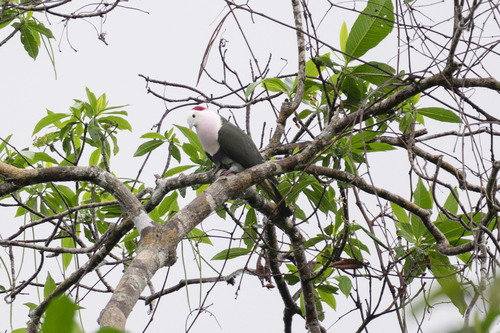 Red-naped Fruit-Dove
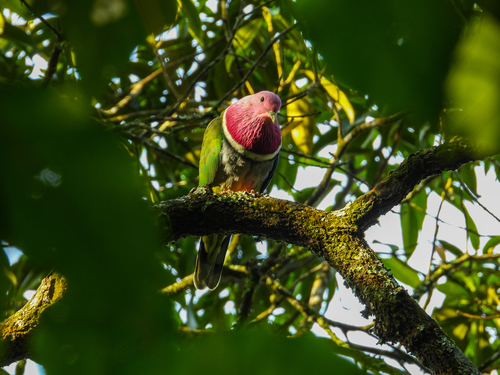 Pink-headed Fruit-Dove
In short
The most reliable field mark is the head and neck coloration: Red-naped Fruit-Dove shows a creamy white head and upper neck with a distinctive red nape patch, while Pink-headed Fruit-Dove males have a striking purple-pink head, neck, and throat. Both species are green-bodied fruit doves of Indonesian montane forests, but Red-naped is larger and endemic to Sumba, whereas Pink-headed is smaller and found on Sumatra, Java, and Bali. Juvenile Red-naped Fruit-Doves are much greener than adults, which can cause confusion with the duller female and juvenile Pink-headed Fruit-Doves. Careful attention to the head pattern, breast band, and undertail coloration is essential for separation, especially in poor light or with immature birds.
Identification tips
- Head and Neck Coloration (Adults): Red-naped Fruit-Dove has a creamy white head and upper neck, sharply separated from the pale pink lower neck by a narrow yellowish-white band, and a distinctive red nape patch. Pink-headed Fruit-Dove males have a purple-pink head, neck, and throat, bordered below by a white band outlined in greenish-black. Females and juveniles are duller but never show the creamy white head or red nape.
- Breast Band: Red-naped Fruit-Dove shows a dark purple breast band separating the pinkish breast from the greyish-green belly. Pink-headed Fruit-Dove has a weaker or absent breast band, especially in females and juveniles.
- Upperparts: Red-naped has dark metallic to purplish-blue upperparts with greenish feather edges, while Pink-headed is more uniformly green above.
- Undertail Coverts: Red-naped shows green and yellow streaked undertail coverts; Pink-headed has yellow undertail coverts without streaking.
- Bill and Leg Color: Red-naped has a yellow-tipped grey bill and purplish-grey legs. Pink-headed has a greenish bill and pink feet. These are subtle but useful at close range.
- Size and Structure: Red-naped is much larger and bulkier (35 cm) than the small, compact Pink-headed. If seen together or with other pigeons, size is a strong clue.
- Juvenile Confusion: Juvenile Red-naped are much greener and can resemble dull female or juvenile Pink-headed, but will still be larger and lack the purple-pink head. Breast band and undertail pattern may help separate.
- Sex Differences (Pink-headed): Only males have the full purple-pink head and clear breast band; females and juveniles are duller, with a weak or absent breast band and a less vivid head.
- Flight and Perched Jizz: Both species are canopy dwellers, but Red-naped's larger size may make it appear slower and more ponderous in flight or when perched.
- Habitat and Range: Red-naped is only on Sumba; Pink-headed is on Sumatra, Java, and Bali. Elevation is also a clue: Pink-headed prefers higher elevations (often above 2000 m), Red-naped is usually above 500 m.
- Voice: Only Pink-headed is known to give a soft 'hoo'; absence of vocalization is not diagnostic for Red-naped.
- Iris Color: Pink-headed has an orange iris; iris color is not described for Red-naped but may help if visible.
- Contextual Clues: If seen in a bird market or on social media from outside Sumba, it is almost certainly Pink-headed, as Red-naped is not widely traded.
- Seasonal Variation: No strong seasonal plumage change is noted for either species, but juvenile and female Pink-headed are always duller than males, and juvenile Red-naped are much greener than adults.
- Pitfalls: Beware of confusing juvenile Red-naped with dull Pink-headed, especially in poor light or partial views. Focus on size, head pattern, and undertail coverts for the best separation.
Size
Red-naped Fruit-Dove is a noticeably larger species, averaging 35 cm in length, and is described as a large fruit pigeon. Pink-headed Fruit-Dove is smaller and more compact, with no exact length given but consistently referred to as small and colorful. In direct comparison, Red-naped will appear bulkier and longer, especially when perched or seen alongside other pigeons. Size alone is not always diagnostic at a distance, but the difference is significant if both are known from the observer's region.
Plumage
-
Juveniles/Immatures: Juvenile Red-naped Fruit-Doves are much greener overall than adults, lacking the creamy white head and red nape, which can make them resemble the duller, greenish juvenile or female Pink-headed Fruit-Dove. However, even young Red-naped should show a more robust size and a less distinctly pink or purple head compared to Pink-headed. Juvenile Pink-headed Fruit-Doves are drabber versions of the female, with a weak or absent breast band and a generally greenish appearance.
-
Adults: Red-naped Fruit-Dove adults have a creamy white head and upper neck, a narrow yellowish-white band separating the head from the pale pink lower neck and breast, and a unique red patch on the nape. The breast is divided from the greyish-green belly by a dark purple band. The upperparts are dark metallic to purplish blue with greenish feather edges, and the undertail coverts are streaked green and yellow. Pink-headed Fruit-Dove males have a purple-pink head, neck, and throat, bordered below by a white band outlined in greenish-black, green upperparts, grey underparts, and yellow undertail coverts. Females are duller, with a weaker breast band and less vivid head coloration. The iris, bill, and feet also differ: Pink-headed has an orange iris, greenish bill, and pink feet, while Red-naped has a yellow-tipped grey bill and purplish-grey legs.
Behaviour
Both species are canopy-dwelling fruit doves, typically feeding on fruit high in the forest. Pink-headed Fruit-Dove is noted for being very inconspicuous and well-camouflaged among foliage, and males are the sole nest builders. Red-naped Fruit-Dove behavior is less detailed in the notes, but as a large fruit pigeon, it is likely less agile and more deliberate in movement. Both are generally quiet and unobtrusive, but the larger size of Red-naped may make it more conspicuous in flight or when perched in open branches.
Habitat
Red-naped Fruit-Dove is strictly endemic to Sumba, inhabiting subtropical or tropical moist montane forests, usually above 500 m but sometimes as low as 160 m. Pink-headed Fruit-Dove is endemic to mountain forests of Sumatra, Java, and Bali, typically at higher elevations (1000–2200 m, often above 2000 m). Thus, location is a strong clue: any sighting outside Sumba is Pink-headed, and within Sumba, only Red-naped is expected. Both prefer dense, forested mountain habitats, but Pink-headed is more restricted to higher elevations and a broader island range.
Voice
Only Pink-headed Fruit-Dove has a described vocalization: a soft 'hoo.' No vocal description is available for Red-naped Fruit-Dove, so voice is not a reliable separator unless the call is heard and confidently matched to Pink-headed.
Red-naped Fruit-Dove · Pink-headed Fruit-Dove · My Tricky Birds