

Motmot

Red-legged Partridge vs Rock Partridge

Alectoris rufa versus Alectoris graeca

Play a quiz with Red-legged Partridge and Rock Partridge
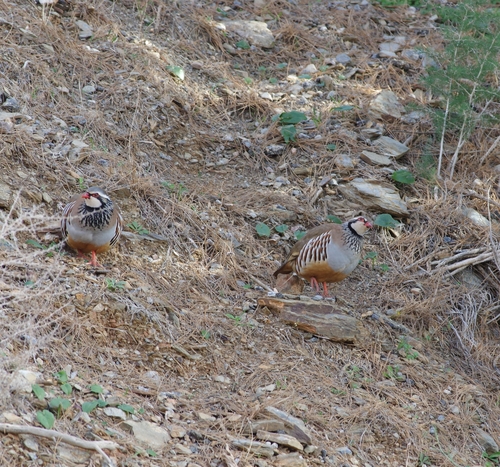
Red-legged Partridge (Alectoris rufa) Red-legged Partridge
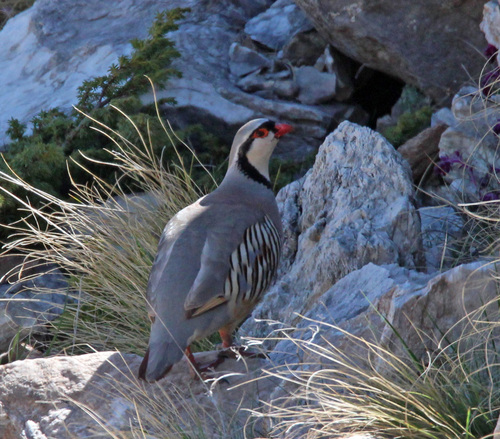
Rock Partridge (Alectoris graeca) Rock Partridge

Media

Loading…

In short

The most reliable way to separate Red-legged Partridge from Rock Partridge is by focusing on the face and throat: Red-legged has a creamy-white throat bordered by a bold black gorget with black streaking below, while Rock Partridge shows a white face and foreneck with a sharply defined black gorget. Both have rufous-barred flanks and red legs, but the Red-legged Partridge’s flanks are more boldly and cleanly marked. Back color and breast tone also differ subtly, with Red-legged Partridge being sandy-brown above and pinkish-buff below, versus the Rock Partridge’s light brown back and greyer breast. In the field, these differences are most visible on perched birds at moderate range.

Identification tips

  1. Face and Throat Pattern: Red-legged Partridge has a creamy-white throat bordered by a bold, solid black gorget, with broad triangular black streaks extending onto the lower throat and upper breast. Rock Partridge has a white face and foreneck with a sharply defined black gorget, but lacks the streaked lower throat—this is the single most reliable mark at all ages.
  2. Flank Markings: Red-legged Partridge shows bold, clean rufous-brown bars on the flanks, each with a narrow black leading edge and crisp pale backgrounds. Rock Partridge’s flanks are rufous-streaked rather than cleanly barred, so look for the clarity and regularity of the flank pattern.
  3. Back and Breast Color: Red-legged Partridge is sandy-brown above with a pinkish-buff belly and pale blue-grey breast. Rock Partridge is greyer on the back and has a grey breast with a buff belly. Subtle, but can help in good light.
  4. Supercilium and Lores: Red-legged Partridge has a narrow off-white supercilium and black lores above a reddish patch, with a bright red eye-ring. Rock Partridge’s face is plainer white, lacking the same supercilium and complex lore pattern.
  5. Gorget Shape and Definition: The black gorget on Rock Partridge is sharply defined and contrasts strongly with the white face and foreneck. On Red-legged Partridge, the gorget is broader, more streaked below, and merges with the black-streaked lower throat.
  6. Leg and Bill Color: Both species have red legs and bills, so this is not a separator.
  7. Flight and Jizz: Both species are rotund, short-tailed, and fly on rounded wings for short distances. No difference in flight jizz is described.
  8. Age and Sex: No age- or sex-specific field marks are described for either species in the provided notes, so all tips apply to adults and immatures alike.
  9. Voice: If you hear a noisy, repetitive 'ga-ga-ga-ga-chakera-chakera-chakera,' you are likely hearing Rock Partridge. Red-legged Partridge’s call is not described here.
  10. Habitat Context: If in rocky, mountainous terrain in southern Europe, Rock Partridge is more likely; in farmland or lowland open country, Red-legged Partridge is more typical. However, do not rely on habitat alone where ranges overlap or introductions have occurred.
  11. Pitfalls: Both species are similar to Chukar Partridge, but Chukar has a yellowish foreneck and different back color. Be careful not to confuse all three, especially where hybridization or introductions have occurred.
  12. Captive vs Wild: In New Zealand and other introduced areas, Red-legged Partridge is more likely in captivity or game farms, while Rock Partridge is not commonly kept. This may help in context, but not in field marks.
  13. Lighting and Distance: At long range or in poor light, the face/throat pattern and flank barring may be hard to see. Try to get a side-on view of the head and flanks for best separation.
  14. No Reliable Size Difference: Both are similar in size and structure; do not use bulk or length as a separator.
  15. Summary: Always prioritize the face/throat pattern and flank barring for the most confident identification.

Size

Both species are robust, rotund partridges with similar overall structure. The only available measurement is for Rock Partridge, with an average adult body mass of 632.5 g [wikidata]. No direct measurement is given for Red-legged Partridge, but both are in the same genus and are similar in size and build. Size alone is not a reliable field mark between these two.

Plumage

There are no detailed age-specific flight or wing pattern marks described for either species, so focus is on adult and general plumage. Red-legged Partridge adults show a sandy-brown upperpart, pinkish-buff belly, and pale blue-grey breast, with a prominent black-streaked gorget below a creamy-white throat. The face has a narrow off-white supercilium, black lores above a reddish patch, and a bright red eye-ring. The flanks are boldly barred with rufous and black, with each bar having a narrow black leading edge and contrasting pale backgrounds. Rock Partridge adults have a light brown back, grey breast, and buff belly, with a white face and foreneck, and a sharply defined black gorget (not streaked below as in Red-legged). The flanks are rufous-streaked (not as cleanly barred), and the legs are red. The back is greyer than in Red-legged Partridge, and the foreneck is white, not yellowish. Both species have red legs and a generally similar jizz, but the facial and throat pattern is the key separator.

Behaviour

Both species are ground-dwelling gamebirds that prefer to run rather than fly when disturbed. If flushed, they fly short distances on rounded wings. There is no behavioral difference highlighted in the sources that reliably separates them in the field.

Habitat

Red-legged Partridge is native to southwestern Europe and has been introduced elsewhere, often found in farmland, open country, and lowland habitats. Rock Partridge is native to southern Europe, typically favoring more mountainous or rocky terrain. However, habitat overlap can occur, especially in areas where both are introduced or managed as gamebirds, so habitat alone is not diagnostic.

Voice

Only the Rock Partridge’s song is described: a noisy, repetitive 'ga-ga-ga-ga-chakera-chakera-chakera.' No vocal description is given for Red-legged Partridge in the provided notes. Voice is not a reliable separator here unless the Rock Partridge’s distinctive call is heard.

Submit a better description

Use the same sections as the comparison. Your text is published immediately.

The most reliable way to separate Red-legged Partridge from Rock Partridge is by focusing on the face and throat: Red-legged has a creamy-white throat bordered by a bold black gorget with black streaking below, while Rock Partridge shows a white face and foreneck with a sharply defined black gorget. Both have rufous-barred flanks and red legs, but the Red-legged Partridge’s flanks are more boldly and cleanly marked. Back color and breast tone also differ subtly, with Red-legged Partridge being sandy-brown above and pinkish-buff below, versus the Rock Partridge’s light brown back and greyer breast. In the field, these differences are most visible on perched birds at moderate range.

  1. Face and Throat Pattern: Red-legged Partridge has a creamy-white throat bordered by a bold, solid black gorget, with broad triangular black streaks extending onto the lower throat and upper breast. Rock Partridge has a white face and foreneck with a sharply defined black gorget, but lacks the streaked lower throat—this is the single most reliable mark at all ages.
  2. Flank Markings: Red-legged Partridge shows bold, clean rufous-brown bars on the flanks, each with a narrow black leading edge and crisp pale backgrounds. Rock Partridge’s flanks are rufous-streaked rather than cleanly barred, so look for the clarity and regularity of the flank pattern.
  3. Back and Breast Color: Red-legged Partridge is sandy-brown above with a pinkish-buff belly and pale blue-grey breast. Rock Partridge is greyer on the back and has a grey breast with a buff belly. Subtle, but can help in good light.
  4. Supercilium and Lores: Red-legged Partridge has a narrow off-white supercilium and black lores above a reddish patch, with a bright red eye-ring. Rock Partridge’s face is plainer white, lacking the same supercilium and complex lore pattern.
  5. Gorget Shape and Definition: The black gorget on Rock Partridge is sharply defined and contrasts strongly with the white face and foreneck. On Red-legged Partridge, the gorget is broader, more streaked below, and merges with the black-streaked lower throat.
  6. Leg and Bill Color: Both species have red legs and bills, so this is not a separator.
  7. Flight and Jizz: Both species are rotund, short-tailed, and fly on rounded wings for short distances. No difference in flight jizz is described.
  8. Age and Sex: No age- or sex-specific field marks are described for either species in the provided notes, so all tips apply to adults and immatures alike.
  9. Voice: If you hear a noisy, repetitive 'ga-ga-ga-ga-chakera-chakera-chakera,' you are likely hearing Rock Partridge. Red-legged Partridge’s call is not described here.
  10. Habitat Context: If in rocky, mountainous terrain in southern Europe, Rock Partridge is more likely; in farmland or lowland open country, Red-legged Partridge is more typical. However, do not rely on habitat alone where ranges overlap or introductions have occurred.
  11. Pitfalls: Both species are similar to Chukar Partridge, but Chukar has a yellowish foreneck and different back color. Be careful not to confuse all three, especially where hybridization or introductions have occurred.
  12. Captive vs Wild: In New Zealand and other introduced areas, Red-legged Partridge is more likely in captivity or game farms, while Rock Partridge is not commonly kept. This may help in context, but not in field marks.
  13. Lighting and Distance: At long range or in poor light, the face/throat pattern and flank barring may be hard to see. Try to get a side-on view of the head and flanks for best separation.
  14. No Reliable Size Difference: Both are similar in size and structure; do not use bulk or length as a separator.
  15. Summary: Always prioritize the face/throat pattern and flank barring for the most confident identification.

Both species are robust, rotund partridges with similar overall structure. The only available measurement is for Rock Partridge, with an average adult body mass of 632.5 g [wikidata]. No direct measurement is given for Red-legged Partridge, but both are in the same genus and are similar in size and build. Size alone is not a reliable field mark between these two.

There are no detailed age-specific flight or wing pattern marks described for either species, so focus is on adult and general plumage. Red-legged Partridge adults show a sandy-brown upperpart, pinkish-buff belly, and pale blue-grey breast, with a prominent black-streaked gorget below a creamy-white throat. The face has a narrow off-white supercilium, black lores above a reddish patch, and a bright red eye-ring. The flanks are boldly barred with rufous and black, with each bar having a narrow black leading edge and contrasting pale backgrounds. Rock Partridge adults have a light brown back, grey breast, and buff belly, with a white face and foreneck, and a sharply defined black gorget (not streaked below as in Red-legged). The flanks are rufous-streaked (not as cleanly barred), and the legs are red. The back is greyer than in Red-legged Partridge, and the foreneck is white, not yellowish. Both species have red legs and a generally similar jizz, but the facial and throat pattern is the key separator.

Both species are ground-dwelling gamebirds that prefer to run rather than fly when disturbed. If flushed, they fly short distances on rounded wings. There is no behavioral difference highlighted in the sources that reliably separates them in the field.

Red-legged Partridge is native to southwestern Europe and has been introduced elsewhere, often found in farmland, open country, and lowland habitats. Rock Partridge is native to southern Europe, typically favoring more mountainous or rocky terrain. However, habitat overlap can occur, especially in areas where both are introduced or managed as gamebirds, so habitat alone is not diagnostic.

Only the Rock Partridge’s song is described: a noisy, repetitive 'ga-ga-ga-ga-chakera-chakera-chakera.' No vocal description is given for Red-legged Partridge in the provided notes. Voice is not a reliable separator here unless the Rock Partridge’s distinctive call is heard.

Discard your changes?

You have unsaved edits. If you leave now, those changes will be lost.

Red-legged Partridge · Rock Partridge · My Tricky Birds