

Red-legged Crake vs Black-headed Ibis
Rallina fasciata versus Threskiornis melanocephalus
Play a quiz with Red-legged Crake and Black-headed Ibis
 Red-legged Crake
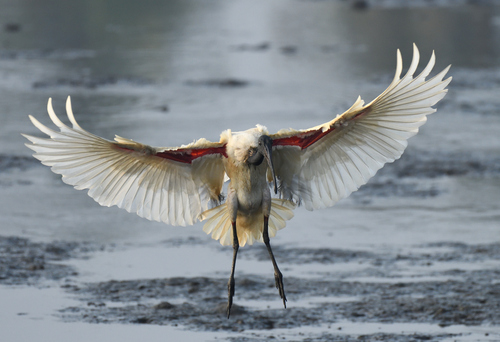 Black-headed Ibis
In short
The most reliable field mark to separate Red-legged Crake from Black-headed Ibis is overall size and structure: the ibis is a much larger, long-legged, long-necked wader with a strikingly white body and naked black head and neck, while the crake is a small, compact rail with rich chestnut underparts and barred flanks. In flight or at rest, the crake’s barred black-and-white underparts and red legs are diagnostic, while the ibis always shows a white body with black head, neck, and bill. Juvenile ibis have some greyish feathering but never show the crake’s rich rufous or barring. Even at a distance, the ibis’s long, decurved bill and upright stance contrast sharply with the crake’s short bill and crouched, rail-like posture.
Identification tips
- Size and structure: Black-headed Ibis is enormous compared to Red-legged Crake; if the bird is goose-sized or larger than a duck, it is an ibis, not a crake. Crake is pigeon-sized, compact, and short-legged.
- Bill shape: Ibis has a long, down-curved black bill, very obvious at any distance. Crake has a short, straight, greenish bill. This is a key mark even in poor light.
- Leg color: Crake has bright red legs, often visible when walking or in flight. Ibis has black legs.
- Head and neck: Ibis has a naked black head and neck; crake’s head and neck are feathered, rich red-brown. No crake ever shows a naked black head.
- Underparts: Crake shows bold black-and-white barring on the flanks and underwings, visible when walking or flying. Ibis is white below, sometimes with a hint of yellow or grey in breeding adults, but never barred.
- Upperparts: Crake’s upperparts are grey-brown; ibis is white with some grey on the tail (breeding) or brown-grey speckling in juveniles, but never overall brown.
- Flight silhouette: Ibis flies with neck and legs outstretched, large wings, and slow, steady wingbeats. Crake flies low and fast, with neck retracted and legs trailing.
- Habitat: Crake stays in dense cover near water, rarely in the open. Ibis is usually in open wetlands, fields, or even urban areas, often in groups.
- Juvenile confusion: Juvenile ibis have greyish or brown-grey feathering but never show the crake’s barring or rufous tones. If you see barring or rich chestnut, it is a crake.
- Group size: Ibis often seen in groups or flocks; crake is solitary or in pairs.
- Behavior: Crake is secretive and skulking; ibis is bold, upright, and conspicuous.
- Bare skin patches (ibis): Only breeding ibis may show red or blueish bare patches under the wing or behind the neck, never seen in crake.
- Tail: Ibis tail is short with ornamental feathers; crake’s tail is not distinctive.
- Vocalization: Ibis is silent except for rare grunts at nest; crake may call but is not described here.
- Context: If seen in a heronry or nesting in a large tree, it is an ibis. Crake nests in dense ground cover.
Size
Red-legged Crake is a medium-large crake, about 24 cm in length [wikipedia], with a compact, short-necked, short-legged rail shape. Black-headed Ibis is much larger, at 65–76 cm in length [wikipedia], with a long neck, long legs, and a long, down-curved bill. The size difference is dramatic: the ibis is nearly three times as long as the crake and much bulkier, towering over the crake in any direct comparison.
Plumage
Juvenile and adult Red-legged Crakes have a rich red-brown head, neck, and breast, paler on the throat, with grey-brown upperparts and distinctive black-and-white barring on the underparts and underwings [wikipedia]. Their bill is green and legs are red. In contrast, adult Black-headed Ibis are white overall with a naked black head and neck, black down-curved bill, and black legs. The tail has light grey ornamental feathers, turning jet black in breeding season. Breeding adults may show red or blueish bare skin patches and sometimes yellowish tinges on the breast and back. Juvenile ibis have greyish feathering on the neck and brown-grey speckling on the wings and back, but never show barring or rufous tones. The ibis’s underwing may show red bare patches in breeding season, but never the crisp barring of the crake. No age or season of ibis resembles the crake’s underpart pattern.
Behaviour
Red-legged Crake is typically secretive, skulking in dense wet vegetation, moving with short, rapid dashes and rarely venturing into open water. It often forages close to cover and may freeze when disturbed. Black-headed Ibis is a conspicuous, gregarious wader, often seen walking in open wetlands, rice fields, or even urban areas, feeding by probing with its long bill. The ibis stands upright, often in groups, and is much more likely to be seen in flight over open country. Flight style differs: ibis flies with neck and legs outstretched, while crake flies low and fast, with legs trailing and neck retracted.
Habitat
Red-legged Crake prefers dense, wet undergrowth near forest streams, marshes, or thickly vegetated wetlands, rarely venturing far from cover [wikipedia]. Black-headed Ibis is highly adaptable, using a wide range of open wetland habitats, including marshes, lakes, rice fields, sewage ponds, and even urban dumps [wikipedia]. The ibis is often seen in open country, while the crake is almost always in or near dense cover. If you see a bird in open water or feeding in a large group, it is almost certainly an ibis, not a crake.
Voice
Black-headed Ibis is essentially silent, lacking a true voice-producing mechanism, and only utters ventriloquistic grunts at the nest [wikipedia]. Red-legged Crake is not described here, but rails in general may give sharp, repeated calls, especially when flushed. Vocalizations are not a reliable field mark for separating these two, but the silence of the ibis is notable.