

Red Junglefowl vs Barbary Partridge
Gallus gallus versus Alectoris barbara
Play a quiz with Red Junglefowl and Barbary Partridge
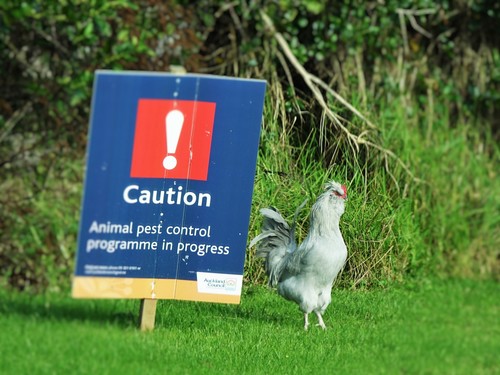 Red Junglefowl
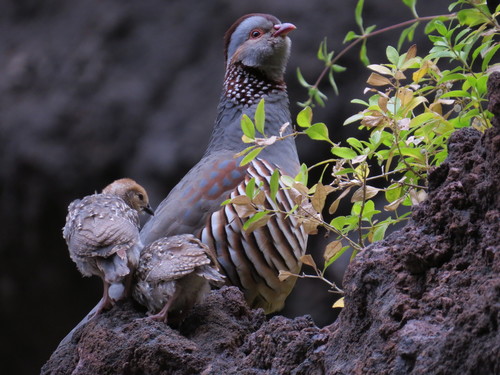 Barbary Partridge
In short
The most reliable field mark between Red Junglefowl and Barbary Partridge is overall shape and tail: Red Junglefowl, especially males, have long, iridescent, and often dramatically curved tail feathers, while Barbary Partridge is compact and short-tailed with a rotund body. In flight, Barbary Partridge shows rounded wings and prefers running to flying, whereas Red Junglefowl rarely flies except to roost, but when it does, the long tail and larger size are obvious. Plumage is also a strong separator: male Red Junglefowl are vividly colored with golden hackles and a large comb, while Barbary Partridge is much more subdued with a grey-brown back, buff belly, and a distinct reddish-brown gorget. Females and immature Red Junglefowl are drabber but still lack the partridge's face pattern. Use structure and tail length first, then check for head pattern and leg color.
Identification tips
- Tail length and shape: Red Junglefowl (especially males) have very long, often curved, iridescent tail feathers; Barbary Partridge has a short, stubby tail. This is visible in both perched and flying birds, and is reliable for all ages and sexes.
- Overall shape: Junglefowl is lanky and elongated, especially when walking or running; Barbary Partridge is round-bodied and compact, with a low center of gravity.
- Head and face pattern: Barbary Partridge shows a pale grey face with a broad reddish-brown gorget (neck band), unique among these two. Junglefowl of all ages and sexes have plain faces, with males showing a large red comb and wattle, and females lacking strong face markings.
- Plumage color (males): Male Red Junglefowl are brightly colored with golden hackles, iridescent tails, and a large red comb. Barbary Partridge is much duller, with no iridescence or bright hackles.
- Plumage color (females/immatures): Female and immature junglefowl are drab brown, lacking the partridge's face pattern and gorget. Barbary Partridge is always more patterned on the face and flanks.
- Legs and spurs: Both species have red legs, but only male junglefowl have prominent spurs above the foot. If you see a spur, it's a male junglefowl.
- Flight style: Barbary Partridge flies only when flushed, with short, rounded wings and a quick, direct flight. Junglefowl flies rarely, usually to roost, and when it does, the long tail is obvious.
- Behavior on the ground: Barbary Partridge prefers to run when disturbed, often in a group. Junglefowl may also run, but males can be seen alone and may display or crow from a perch.
- Vocalizations: A classic rooster crow is junglefowl; a rapid, chattering call is Barbary Partridge.
- Habitat: In native ranges, junglefowl are in dense, tropical forests; Barbary Partridge is in open, rocky, or scrubby areas. In introduced or overlapping areas, check for habitat preference.
- Eclipse plumage: Male junglefowl in eclipse (post-breeding) plumage have more black on the back and scattered red-orange plumes, but still lack any face pattern or gorget.
- Group structure: Barbary Partridge is often seen in pairs or family groups, while junglefowl flocks have a few males and more females, with males sometimes alone.
- Comb and wattle: Junglefowl males have a large, obvious red comb and wattle; Barbary Partridge lacks these features entirely.
- Roosting behavior: Junglefowl roost in trees at night, so birds seen flying up to high perches at dusk are likely junglefowl.
- Pitfall: Female and immature junglefowl can be confused with Barbary Partridge at a distance due to drab color, but always lack the partridge's strong face pattern and gorget.
Size
Red Junglefowl is significantly larger and longer than Barbary Partridge. Adult Red Junglefowl (especially males) can reach up to 70 cm in length and have a body mass around 672 g [wikidata], with males sometimes even heavier. Barbary Partridge is much more compact and rotund, with a shorter body and tail, and a noticeably smaller mass (precise mass not given, but always less than junglefowl). In the field, the junglefowl's size and long tail make it appear lankier and more elongated, while Barbary Partridge is squat and rounded.
Plumage
There are no distinctive juvenile or immature wing patterns described for either species, so focus is on adult and general plumage. Male Red Junglefowl are striking: long golden hackles on the neck, iridescent blue/green/purple tail feathers (some extremely long and curved), and a large red comb and wattle. Females are drab brown for camouflage, lacking the ornate male features, but still have a plain face and no strong head pattern. Barbary Partridge is overall grey-brown above, with a light grey face, a broad reddish-brown gorget, and rufous-streaked white flanks. Its breast is grey and belly buff. The partridge's face pattern (grey with a reddish gorget) is unique and not matched by junglefowl of any age or sex. Both species have red legs, but only junglefowl males have prominent spurs. In eclipse (post-breeding) plumage, male junglefowl show more black on the back and scattered red-orange plumes, but still lack the partridge's face and gorget. Female junglefowl do not change much seasonally.
Behaviour
Red Junglefowl is shy and spends most of its time on the ground, foraging in flocks with a few males and several females. Males are often seen alone. They fly only to escape danger or to reach roosts in trees at dusk, and their flight is strong but brief. Barbary Partridge also prefers running to flying, but when flushed, it flies short distances on rounded wings. Junglefowl males are territorial and may be seen crowing from prominent spots. Barbary Partridge is more likely to be seen in pairs or family groups, moving quickly on the ground.
Habitat
Red Junglefowl is found in tropical forests and dense undergrowth across Southeast and South Asia. Barbary Partridge is native to North Africa and prefers open, dry, and rocky habitats, often with scattered bushes or scrub. In areas of overlap (such as introduced populations), habitat can help: junglefowl stick to denser cover, while partridges are more open-country birds.
Voice
Red Junglefowl males give the classic 'cock-a-doodle-doo' crow, which is loud, clear, and far-carrying, used to announce territory and attract mates. Barbary Partridge has a noisy, chattering call: 'tre-tre-tre-tre-tre-cheeche-tre-tre-tre', which is more rapid and less musical than the junglefowl's crow. If you hear a true rooster crow, it's junglefowl; if you hear a rapid, chattering series, it's Barbary Partridge.