
Red-headed Quelea vs Red-billed Quelea
Quelea erythrops versus Quelea quelea
Play a quiz with Red-headed Quelea and Red-billed Quelea
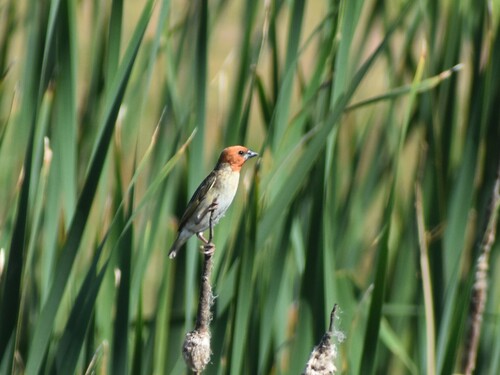 Red-headed Quelea
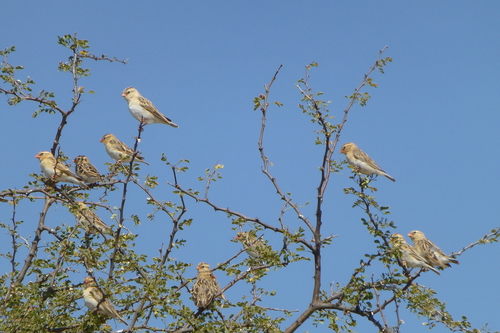 Red-billed Quelea
In short
The most reliable field mark between Red-headed Quelea and Red-billed Quelea is the color and pattern of the head in breeding plumage: Red-headed Quelea males show a distinct red or rufous face and head, while Red-billed Quelea males typically have a black facial mask surrounded by yellow, rusty, or pink, or sometimes a white mask. Outside the breeding season, both species become much duller, but the bill color and facial pattern remain helpful. Juveniles and non-breeding birds are more challenging, as both are sparrow-like with conical bills, but subtle differences in bill and face color can help. Structure and size are nearly identical, so focus on head and bill details, especially in adult males during the breeding season.
Identification tips
- Breeding male head color: Red-headed Quelea males have a bright red or rufous face and head; Red-billed Quelea males have a black (or rarely white) facial mask surrounded by yellow, rusty, pink, or purple. This is the single most reliable mark in the field during the breeding season.
- Non-breeding and female bill color: In Red-billed Quelea, females and non-breeding males have a pink or dull red bill, but females show a yellow or orange bill and eye-ring during the breeding season. Red-headed Quelea is less variable but generally keeps a reddish bill; look for any hint of red on the face.
- Facial pattern in non-breeding plumage: Red-billed Quelea loses the mask and becomes plain grey-brown with a faint pale stripe above the eye, whitish chin, and throat. Red-headed Quelea is less well described but should retain some reddish tones on the face, lacking the pale supercilium of Red-billed Quelea.
- Juvenile bill color: Juvenile Red-billed Quelea have a horn-colored bill with a lavender tinge, turning orange-purple before their first molt. Juvenile Red-headed Quelea are not well described, but any early reddish tinge to the face or bill may be suggestive.
- Upperparts and underparts: Both are streaked brown above and pale below, but Red-billed Quelea males in breeding plumage may show buff or white underparts depending on subspecies, sometimes with a pink wash. These differences are subtle and not reliable at a distance.
- Subspecies variation: Red-billed Quelea shows subspecies differences in the extent and color of the mask and underparts, but all have the mask (black or white) as a feature. Red-headed Quelea does not show this mask.
- Bill shape and color: Both have heavy, conical bills, usually bright red in breeding males. Bill color is less helpful outside the breeding season but can support other marks.
- Leg color: Red-billed Quelea has orangey legs; Red-headed Quelea is not described in detail but is likely similar.
- Eye-ring: Red-billed Quelea has a narrow naked red eye-ring and brown iris; Red-headed Quelea's eye details are not specified.
- Flock composition: If you see both species together, look for the red-faced males among the masked ones; mixed flocks are possible in overlapping ranges.
- Habitat and range: Both occur in similar open habitats across much of sub-Saharan Africa; do not rely on habitat for separation.
- Flight views: In flight, both appear as small, brownish weavers with little to separate them; head color in males may be visible in good light.
- Pitfalls: Non-breeding and juvenile birds are the hardest to separate; focus on subtle facial and bill color differences, and beware of overlap with other sparrow-like weavers.
- Voice: Not described in the sources; do not use for separation.
- Seasonal context: If you know the breeding season, expect brighter, more distinctive males; outside this period, be cautious and rely on subtle marks.
Size
Both species are very similar in size and structure. Red-headed Quelea averages 19.4 g, while Red-billed Quelea averages 18.8 g [wikidata]. Both are small, sparrow-like weavers with heavy, conical bills and similar overall proportions. Length is about 12 cm for Red-billed Quelea; Red-headed Quelea is comparable. In the field, size alone is not a reliable separator.
Plumage
-
Juveniles and immatures: Both species resemble sparrows, with greyish or brownish heads and conical bills. Juvenile Red-billed Quelea have a horn-colored bill with a lavender tinge, turning orange-purple before their first full molt. After the post-juvenile molt (2–3 months old), young Red-billed Quelea look like non-breeding adults: grey head, whitish cheeks, and buff-edged wing coverts and flight feathers. There is no detailed juvenile description for Red-headed Quelea, but expect similar sparrow-like tones; focus on bill color if visible.
-
Adult breeding males: Red-headed Quelea males have a striking red or rufous face and head, which is diagnostic. Red-billed Quelea males usually have a black facial mask (forehead, cheeks, lores, upper throat), sometimes white, surrounded by yellow, rusty, pink, or purple, with the rest of the underparts buff or white depending on subspecies. Bill is bright red in both, but the facial pattern is key.
-
Adult non-breeding and females: Both become much duller. Red-billed Quelea males lose the mask and become grey-brown with streaks, a whitish chin and throat, and a faint pale supercilium; bill turns pink or dull red. Females resemble non-breeding males but have a yellow or orange bill and eye-ring in the breeding season, pinkish or dull red otherwise. Red-headed Quelea females and non-breeding males are less well described but lack the black mask and should retain some reddish or rufous on the face, especially compared to the plain-faced Red-billed Quelea.
Behaviour
Both species are gregarious, often seen in large flocks, and have similar weaver-like habits. They are active, social, and feed on seeds in open habitats. Flight is fast and direct, with flocks wheeling in unison. Behavior is not a reliable separator in the field.
Habitat
Both species overlap widely in sub-Saharan Africa and are found in open grasslands, savannas, and agricultural areas. Red-billed Quelea is especially common in semi-arid thornbush and grassland, avoiding dense forests. Red-headed Quelea shares much of this range and habitat, so location and habitat alone are not diagnostic.