

Red-footed Falcon vs Amur Falcon
Falco vespertinus versus Falco amurensis
Play a quiz with Red-footed Falcon and Amur Falcon
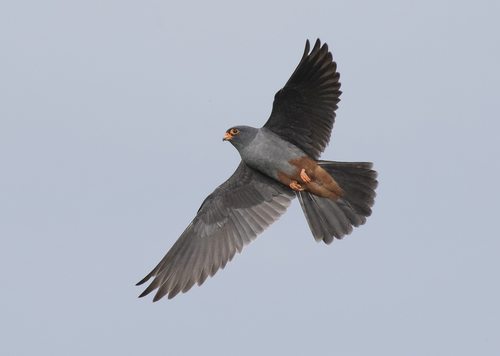 Red-footed Falcon
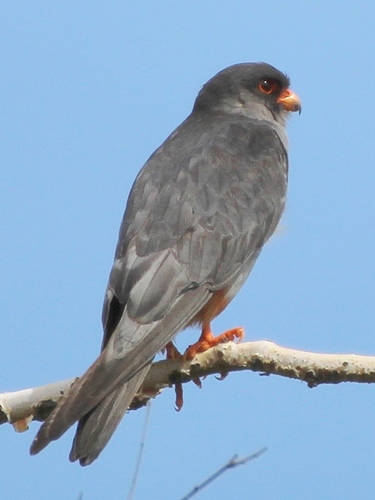 Amur Falcon
In short
The most reliable way to separate Red-footed Falcon from Amur Falcon in the field is by the color of the underwing coverts in adult males: Red-footed Falcon males show uniformly dark grey underwings, while Amur Falcon males have strikingly white underwing linings that contrast with the dark flight feathers. For juveniles and females, separation is more subtle, but Amur Falcon juveniles lack the buffy underwing coverts seen in Red-footed Falcon. Both species are slim, long-winged falcons with similar jizz, but careful attention to underwing pattern, leg and cere color, and facial markings is essential. Structural differences are minimal, so focus on age- and sex-specific plumage, especially in flight.
Identification tips
- Adult male underwing pattern: In flight, check the underwing coverts. Red-footed Falcon males have uniformly dark grey underwings, while Amur Falcon males have white underwing linings contrasting with dark flight feathers. This is the single most reliable field mark for adult males.
- Juvenile underwing coverts: Juvenile Red-footed Falcons show buffy underwing coverts, giving a warmer underwing tone. Juvenile Amur Falcons lack this, so their underwing appears paler and less buffy. Use this mark for immatures in flight.
- Adult female facial pattern: Both species have white faces with dark markings, but Red-footed Falcon females show a distinct black eye-stripe and moustache. Amur Falcon females have a more orange eye-ring and a red cere.
- Leg and cere color (females): Amur Falcon females have reddish-orange feet and a red cere, while Red-footed Falcon females have red legs but a less brightly colored cere. This is subtle and best used at close range.
- Rufous/orange on thighs and vent (males): Both species show rufous on the vent and thighs, but this is more extensive and brighter in Amur Falcon males. However, this mark is less reliable than underwing pattern.
- Overall coloration (males): Red-footed Falcon males are more uniformly blue-grey, while Amur Falcon males are sooty grey with a slightly darker tone and more contrast with the rufous vent.
- Size and structure: Both species are similar in size and shape, with long wings and slim bodies. Do not rely on size for separation in the field.
- Perched jizz: Both species show long wings that reach or slightly extend beyond the tail when perched. This is not a separator.
- Habitat and range: If observed in Europe in breeding season, Red-footed Falcon is more likely. In migration across India or wintering in Africa, Amur Falcon is expected. However, vagrancy does occur.
- Flock behavior: Amur Falcons are more likely to be seen in large migratory flocks, especially during migration. Red-footed Falcons may breed in loose colonies but are less likely to form large flocks outside migration.
- Voice: No diagnostic vocal differences are described in the sources provided.
- Pitfalls: Females and juveniles of both species are very similar, and separation may be impossible without a good view of the underwing in flight or close inspection of bare part colors.
- Seasonal context: During migration in central Asia, both species may occur together. Use underwing and bare part details for separation, especially in mixed flocks.
- Artificial nest boxes: Red-footed Falcons may be found near artificial nest colonies in Europe, a context less likely for Amur Falcon.
- When in doubt: For birds that cannot be safely aged or sexed, and where underwing or bare part color is not visible, identification may remain uncertain. Prioritize underwing pattern for males and juveniles in flight.
Size
Red-footed Falcon is slightly heavier on average (158.5g) than Amur Falcon (137.5g), but both are medium-small, long-winged falcons with overlapping wingspans (Red-footed: 65–75 cm; Amur: 63–71 cm) and similar lengths. In the field, size alone is not a reliable separator, as both appear slim and agile.
Plumage
- Adult males: Red-footed Falcon males are all blue-grey with a red undertail and legs, and have uniformly dark grey underwings. Amur Falcon males are sooty grey above with rufous thighs and vent, but the key mark is their white underwing linings, which contrast sharply with the dark flight feathers.
- Adult females: Both species have grey backs and wings, orange or rufous heads and underparts, and a white face with dark markings. Amur Falcon females can be told by their orange eye-ring, red cere, and reddish-orange feet, while Red-footed Falcon females have a black eye-stripe and moustache.
- Juveniles/immatures: Both are brown above and buff below with streaks and a female-like face pattern. However, juvenile Amur Falcons lack the buffy underwing coverts present in juvenile Red-footed Falcons, making the underwing paler and less warm-toned in Amur. This is the most useful mark for separating young birds in flight.
Behaviour
Both species are agile, aerial hunters, often seen hawking for insects in open country. Red-footed Falcons may breed in colonies or solitary pairs, sometimes using artificial nest boxes, while Amur Falcons are known for migrating in large flocks. In perched birds, both species show long wings extending to or beyond the tail, and both may be seen perched on wires or exposed branches.
Habitat
Red-footed Falcon breeds in eastern Europe and western Asia, favoring open grasslands and steppe with scattered trees, and is now often found near human settlements due to habitat loss. Amur Falcon breeds in southeastern Siberia and northern China, migrating across India and the Arabian Sea to winter in southern and eastern Africa. During migration, Amur Falcons may be seen in large flocks in a variety of open habitats. Range overlap is limited to migration periods in central Asia.