

Red-breasted Flycatcher vs Blackstart
Ficedula parva versus Oenanthe melanura
Play a quiz with Red-breasted Flycatcher and Blackstart
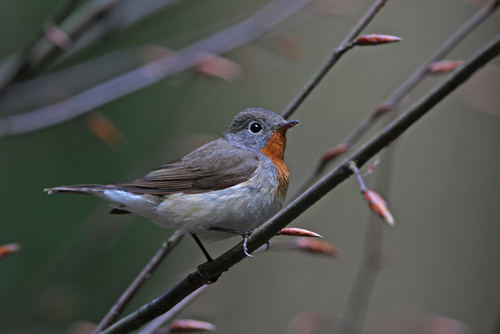 Red-breasted Flycatcher
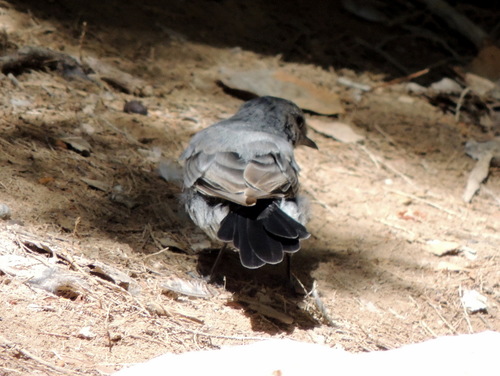 Blackstart
In short
The most reliable field mark to separate Red-breasted Flycatcher from Blackstart is the presence of a bold white eyering and the distinctive tail pattern: Red-breasted Flycatcher (all ages) shows a black tail with white bases to the outer tail feathers, while Blackstart has a wholly black tail and rump, frequently fanned, with no white. In breeding males, the Red-breasted Flycatcher’s orange throat patch is unique, but females and immatures lack this and can be confused with Blackstart. However, Blackstart is larger, with a longer, more upright stance, and has uniform bluish-grey or grey-brown plumage with no eyering. Habitat and behavior also help: Blackstart is a desert chat, often seen on rocks in arid landscapes, while Red-breasted Flycatcher is a woodland migrant. If you see a small flycatcher with a white eyering and a two-toned tail in a leafy setting, it’s the Red-breasted Flycatcher; a larger, upright bird with a solid black tail in rocky desert is the Blackstart.
Identification tips
- Tail pattern (all ages): Red-breasted Flycatcher always shows a black tail with white bases to the outer tail feathers, visible when the tail is spread or flicked. Blackstart’s tail and rump are wholly black, with no white, and the tail is often fanned.
- Eyering: Red-breasted Flycatcher has a prominent white eyering in all plumages; Blackstart never shows an eyering.
- Throat color (breeding males): Only Red-breasted Flycatcher males have a bright orange throat patch. Blackstart never shows orange or warm tones on the throat.
- Overall coloration: Red-breasted Flycatcher is brown above and white below, with a grey head in males. Blackstart is uniform bluish-grey or grey-brown, with little contrast between upperparts and underparts.
- Bill color: Red-breasted Flycatcher’s bill is black with a pale pinkish base (especially obvious in good light); Blackstart’s bill is entirely black.
- Leg color: Both have dark legs, not a useful separator.
- Size and structure: Blackstart is larger and bulkier, with a longer tail and a more upright, chat-like stance. Red-breasted Flycatcher is smaller, more delicate, and perches more horizontally.
- Behavior: Red-breasted Flycatcher flicks its tail upwards and often holds its wingtips down; it forages by sallying from perches in trees or shrubs. Blackstart is more likely to be seen on rocks or the ground, fanning its tail and making short, direct flights.
- Habitat: Red-breasted Flycatcher is found in wooded or shrubby areas, especially during migration; Blackstart is strictly a bird of rocky deserts and arid slopes.
- Voice: Red-breasted Flycatcher’s song is a sweet, descending whistle, often with a rattling call; Blackstart’s song is a clear, melancholy whistle with repeated phrases. Calls are less likely to be heard from flycatcher in winter.
- Sex differences: Both species are sexually monomorphic outside of breeding male flycatchers, so do not rely on sex for separation except for the orange throat in male Red-breasted Flycatcher.
- Flight pattern: Red-breasted Flycatcher’s white tail bases may flash in flight; Blackstart’s tail remains solid black even when fanned.
- Jizz: Red-breasted Flycatcher is restless, often moving through foliage; Blackstart is more deliberate, upright, and often perches in the open.
- Season/context: Red-breasted Flycatcher is migratory and may be seen outside of breeding season in passage; Blackstart is resident year-round in its range.
- Pitfalls: Female and immature Red-breasted Flycatchers lack orange throat and can appear plain, but the eyering and tail pattern remain reliable. Blackstart may appear browner in North African races but never shows the flycatcher’s white eyering or tail pattern.
Size
Red-breasted Flycatcher is smaller, at 11–12 cm in length [wikipedia], only slightly larger than a Eurasian Wren, and noticeably more petite than Blackstart. Blackstart measures about 14 cm in length with a wingspan of 23–27 cm and weighs around 15 g [wikipedia]. The difference is subtle at a distance but becomes apparent if both are seen side by side or with familiar species for scale: Blackstart has a bulkier, longer-bodied appearance and a proportionally longer tail.
Plumage
-
Juvenile/immature/first-winter (all ages): Red-breasted Flycatcher of all ages shows a black tail with white bases to the outer tail feathers, giving a two-toned effect when fanned or flicked. This is visible both perched and in flight and is a key mark. Blackstart, regardless of age or sex, has a wholly black tail and rump, with no white, and often fans its tail, emphasizing the solid black color.
-
Adult breeding males: Red-breasted Flycatcher males have a muted brown back, grey head, white underparts, and a conspicuous orange throat patch. Blackstart males (and females) are uniform bluish-grey (or grey-brown in North African races), with no orange or warm tones, and lack any eyering.
-
Females and immatures: Red-breasted Flycatcher females and immatures are brown above and white below, with a clear white eyering and no orange throat. Blackstart of all ages and sexes is more uniform in color, with a bluish-grey or brownish-grey tone, and never shows a white eyering or orange on the throat.
-
Bill and legs: Red-breasted Flycatcher has a black bill with a pale pinkish base, more extensive than in similar flycatchers. Blackstart’s bill and legs are entirely black.
Behaviour
Red-breasted Flycatcher is an active, restless bird, often seen flicking its tail upward and sallying out from perches to catch insects in mid-air or gleaning from leaves and trunks, usually in wooded or shrubby areas. It often holds its wingtips down while flicking the tail. Blackstart is more confident and upright, frequently found on rocks or in open desert terrain, often fanning its tail and making short flights to the ground to catch insects. It is less arboreal and more terrestrial than the flycatcher, and is notably unafraid of people.
Habitat
Red-breasted Flycatcher breeds in eastern European and Central Asian woodlands and migrates through or winters in South Asia, favoring leafy, wooded, or shrubby habitats. It is a regular passage migrant in western Europe. Blackstart is a resident of rocky deserts and mountain slopes in North Africa, the Middle East, and the Arabian Peninsula. It is rarely found away from arid, stony habitats and is absent from woodland. Thus, habitat is a strong clue: wooded or leafy areas favor flycatcher; rocky, barren, or desert terrain points to Blackstart.
Voice
Red-breasted Flycatcher’s song is a short, sweet, far-carrying whistle, often with a descending sequence, and its call is a soft chip-chip-chr-rrr or a short, rattling zrrrt. It is mostly silent in winter. Blackstart’s song is a clear, melancholy whistle with repeated phrases (CHURlee...TRUloo...), and its calls are derived from short phrases of the song. Blackstart’s song is more mournful and less varied than the flycatcher’s, and is often delivered from exposed rocks in open country.