

Red-billed Pigeon vs Short-billed Pigeon
Patagioenas flavirostris versus Patagioenas nigrirostris
Play a quiz with Red-billed Pigeon and Short-billed Pigeon
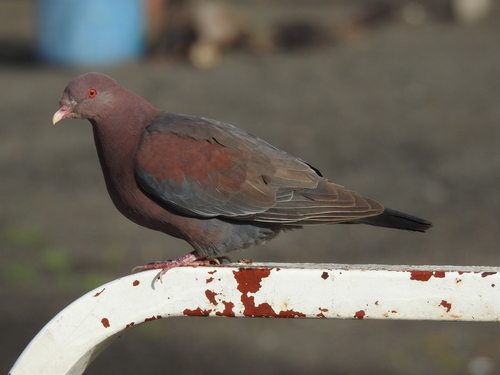 Red-billed Pigeon
 Short-billed Pigeon
In short
The most reliable field mark to separate Red-billed Pigeon from Short-billed Pigeon is the bill color: Red-billed Pigeon shows a distinctive red bill with a yellow tip, while Short-billed Pigeon has a black bill. In adults, Red-billed Pigeon is larger, with a more robust build and a slate-gray body contrasting with a maroon or purple head and neck, whereas Short-billed Pigeon is smaller, overall more uniformly wine-purple with browner underparts and olive-brown back. Juvenile plumages are duller in both, but Red-billed Pigeon juveniles have dusky shoulders and a browner mantle, while Short-billed juveniles show cinnamon scaling on the head and upperparts. Eye color and orbital ring also differ: Red-billed has pale red eyes with an orange ring, Short-billed shows purple-red eyes. Both can overlap in range in southern Mexico and Central America, so careful attention to these features is essential.
Identification tips
- Bill color (all ages): Red-billed Pigeon always shows a red bill with a yellow tip; Short-billed Pigeon has a black bill. This is the most consistent and visible difference, especially at close range or in good light.
- Size and build (adults): Red-billed Pigeon is larger and bulkier (30–37 cm, 230–425 g) than Short-billed Pigeon (26.5 cm, 150 g). Use this when birds are side by side or with familiar species for scale.
- Head and neck color (adults): Red-billed Pigeon has a maroon to purple head and neck, sharply contrasting with the slate-gray body. Short-billed Pigeon is more uniformly wine-purple, with less contrast between head and body.
- Back and underparts (adults): Red-billed Pigeon has a blue-gray belly and tail coverts, and a less brown back. Short-billed Pigeon is browner on the belly and has an olive-brown back. Look for the blue-gray tones in Red-billed, especially when perched or in good light.
- Juvenile plumage: Red-billed Pigeon juveniles are duller, with dusky shoulders and a browner mantle and wings. Short-billed juveniles show cinnamon scaling on the head and upperparts and a greyish-brown head/neck/breast. These marks are best seen at close range or in good light.
- Eye color and orbital ring: Red-billed Pigeon has pale red eyes with an orange orbital ring; Short-billed Pigeon has purple-red eyes. This can be subtle but is useful at close range.
- Wing and tail color (adults): Short-billed Pigeon has blackish tail and primaries, while Red-billed's tail is blue-gray. In flight, this may be hard to see unless lighting is excellent.
- Sex differences: Females of both species are duller, but the difference is not strong enough for reliable field separation; focus on other marks.
- Iridescence: Neither species has strong iridescent collar plumage, so this is not a useful mark for separation.
- Vocalizations: Red-billed Pigeon gives a long, ascending 'coooo' plus three 'cuk-c'-c'-coo' notes; Short-billed Pigeon has a slower, more complex 'coo... cu-COO k’CO coohoo.' If you hear a drawn-out, ascending call, lean toward Red-billed; if the call is more complex and spaced out, consider Short-billed.
- Wing clapping: Red-billed Pigeon often produces a wing clapping sound on takeoff, which is rarely noted in Short-billed.
- Habitat context: In dry, open woods or riversides, especially in coastal Mexico or southern Texas, Red-billed Pigeon is more likely. In humid lowland forests or forest edges, especially south of Mexico, Short-billed Pigeon is more likely.
- Range overlap: Both species can occur in southern Mexico and Central America. Do not rely on range alone for separation in these areas.
- Foraging behavior: Short-billed Pigeon is more often seen in the canopy and sometimes on roadsides for grit; Red-billed Pigeon may perch more openly in dry woods.
- Pitfalls: Both species can appear dull and brownish when young or in poor light. Always check bill color first, then look for body size and head-to-body color contrast.
Size
Red-billed Pigeon is noticeably larger and heavier, measuring 30–37 cm in length and weighing 230–425 g [wikipedia]. Short-billed Pigeon is smaller at about 26.5 cm and 150 g [wikipedia]. In the field, Red-billed Pigeon often appears bulkier and more robust, while Short-billed Pigeon seems more compact and less hefty. This size difference is most apparent when both species are seen together, but may be subtle if seen singly or at a distance.
Plumage
-
Juvenile/immature birds: Red-billed Pigeon juveniles are duller overall, with dark and dusky shoulders and a browner mantle and wings. Short-billed Pigeon juveniles have a greyish-brown head, neck, and breast, with cinnamon scaling on the head and upperparts. These juvenile features are most useful in the non-breeding season or when birds are not yet fully adult.
-
Adults: Red-billed Pigeon adults have a slate-gray body with a maroon to purple head, neck, and wing coverts, blue-gray belly and tail coverts, and a less brown back. Short-billed Pigeon adults are more uniformly wine-purple, becoming browner on the belly and olive-brown on the back, with blackish tail and primaries. Red-billed lacks iridescent collar plumage, which is not a factor in Short-billed either. Females of both species are duller than males, but the difference is subtle.
-
Bill and eye: Red-billed Pigeon has a red bill with a yellow tip and pale red eyes with an orange orbital ring. Short-billed Pigeon has a black bill and purple-red eyes.
Behaviour
Both species are typically seen singly or in pairs, foraging in trees for fruit. Short-billed Pigeon is often found in the canopy and may also come to roadsides for grit or invertebrates. Red-billed Pigeon is more likely to be seen in dry woods or along riversides, sometimes perching conspicuously. In flight, Red-billed Pigeon produces a noticeable wing clapping sound when taking off, which is less often noted in Short-billed.
Habitat
Red-billed Pigeon prefers dry forests and riverside woodlands, especially in coastal and lowland areas from southern Texas to Costa Rica. It is most common in Mexico and rare in southern Texas, especially in winter. Short-billed Pigeon occupies lowland forest canopy and semi-open woodland from southern Mexico to northwestern Colombia. Both can overlap in southern Mexico and Central America, but Red-billed is more associated with drier, open habitats, while Short-billed is more typical of humid forests and edges.
Voice
Red-billed Pigeon gives a long, high-pitched call: a drawn-out 'coooo' followed by three 'cuk-c'-c'-coo' notes, with an ascending pitch. Short-billed Pigeon has a complex, loud, and high-pitched call: 'coo... cu-COO k’CO coohoo,' usually delivered singly or with long pauses. The Short-billed's call is slower and more complex than Red-billed's, but both are high-pitched and can be confusing if not well known. Red-billed's wing clapping on takeoff is also a useful auditory clue.