

Red-billed Pigeon vs Band-tailed Pigeon
Patagioenas flavirostris versus Patagioenas fasciata
Play a quiz with Red-billed Pigeon and Band-tailed Pigeon
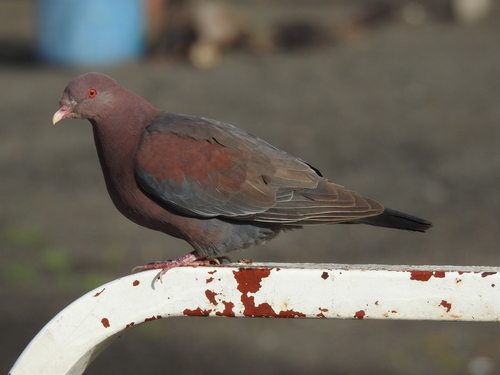 Red-billed Pigeon
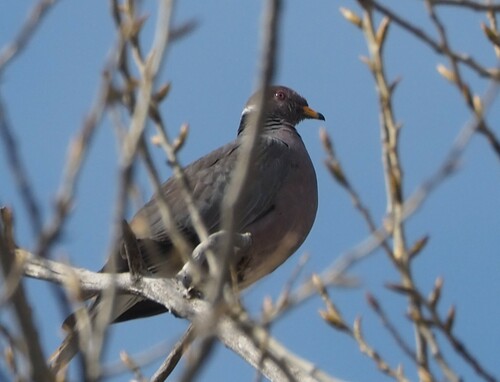 Band-tailed Pigeon
In short
The most reliable field mark to separate Red-billed Pigeon from Band-tailed Pigeon is the presence of a thin white nape collar and green neck iridescence on adult Band-tailed Pigeon, which Red-billed Pigeon always lacks. Juvenile Band-tailed Pigeons also show a scaly appearance above and lack the collar, but Red-billed juveniles are duller overall with browner upperparts and lack any scaly effect. Bill color is another key: Red-billed Pigeon has a red bill with a yellow tip, while Band-tailed Pigeon shows a yellow bill (sometimes with a black tip in northern subspecies). In flight, Band-tailed Pigeon shows a broad pale tail band, while Red-billed Pigeon’s tail is more uniformly colored. Both are large, robust pigeons of similar size, but their structure and habitat preferences can help in context.
Identification tips
- White nape collar (adult Band-tailed only): Look for a thin white collar on the nape and green neck iridescence in Band-tailed Pigeon adults; Red-billed Pigeon never shows this feature at any age.
- Tail pattern in flight: Band-tailed Pigeon shows a broad pale terminal tail band with a darker subterminal band; Red-billed Pigeon’s tail is more uniformly colored and lacks a contrasting band.
- Bill color: Red-billed Pigeon has a red bill with a yellow tip (all ages); Band-tailed Pigeon has a yellow bill, sometimes with a black tip (northern subspecies), but never red.
- Juvenile upperparts: Juvenile Band-tailed Pigeon has pale-edged, scaly-looking upperparts and lacks the white collar; juvenile Red-billed Pigeon is duller overall, with brownish wings and mantle, but not scaly.
- Head and neck color: Red-billed Pigeon adults have a maroon to purple head and neck; Band-tailed Pigeon is gray with a faint pinkish or purple-gray cast, never rich maroon.
- Belly color: Band-tailed Pigeon has a nearly white belly; Red-billed Pigeon’s belly is blue-gray, not white.
- Eye and orbital ring: Red-billed Pigeon has pale red eyes with an orange orbital ring; this is less distinctive in Band-tailed Pigeon.
- Sex differences: Female Red-billed Pigeons are duller on the head and neck than males, but this is subtle; Band-tailed Pigeon males may be slightly larger and pinker, but sexes are similar.
- Wing structure: Band-tailed Pigeon has thick-based, pointed wings; Red-billed Pigeon is also robust but does not show this feature as strongly.
- Habitat context: In lowland dry forests or riverside woods, suspect Red-billed Pigeon; in montane or oak forests, Band-tailed is more likely.
- Flight sound: Red-billed Pigeon may produce a wing-clap on takeoff, which can be a clue if heard.
- Vocalization: If you hear a long, high-pitched 'coooo' followed by three quick notes, it is Red-billed Pigeon.
- Group behavior: Band-tailed Pigeon may nest in loose colonies; Red-billed Pigeon is more often solitary or in pairs.
- Seasonal presence: Red-billed Pigeon is rare in winter in most of its range; Band-tailed Pigeon’s seasonal movements depend on region, but both can be absent in winter in some areas.
- Size: Both are similarly large and robust; do not rely on size alone for separation.
Size
Both species are among the largest New World pigeons, with substantial overlap in size. Red-billed Pigeon measures 30–37 cm in length and weighs 230–425 g; Band-tailed Pigeon is 33–40 cm long and weighs 226–460 g. Band-tailed may average slightly larger, but size alone is not a reliable field mark between them. Both appear large and robust in the field.
Plumage
- Juveniles: Juvenile Band-tailed Pigeons have pale feather edges above, giving a scaly or mottled look, and lack both the white nape collar and neck iridescence. Juvenile Red-billed Pigeons are duller overall, with dark, dusky shoulders and a browner mantle and wings, but do not show a scaly effect.
- Adults: Adult Band-tailed Pigeons have a thin white collar on the nape and green iridescence on the neck, plus a broad pale tail band with a darker subterminal band. Their overall color is gray with a faint pinkish cast on the head and breast, and a nearly white belly. Adult Red-billed Pigeons are darker slate-gray with a maroon to purple head, neck, and wing coverts, a blue-gray belly and tail coverts, and lack any iridescent collar or nape mark. Their bill is red with a yellow tip, while Band-tailed's is yellow (sometimes with a black tip).
Behaviour
Both species are robust pigeons with strong, direct flight. Band-tailed Pigeon has thick-based, pointed wings and a broad tail, often showing the pale tail band in flight. Red-billed Pigeon also has strong flight and can produce a wing-clap sound on takeoff. Both perch in trees, but Band-tailed Pigeons may form small colonies when nesting, while Red-billed Pigeons are often seen singly or in pairs. No major behavioral differences are diagnostic in brief field views.
Habitat
Red-billed Pigeon is most often found in dry forests, riverside woodlands, and lowland areas from southern Texas through Mexico and Central America. Band-tailed Pigeon prefers montane forests, oak woodlands, and higher elevation habitats, especially in western North America and Central America. Overlap is possible in some regions, but context can help: Band-tailed is more likely in upland or montane forests, Red-billed in lowland dry woods or riparian zones.
Voice
Red-billed Pigeon gives a distinctive, long, high-pitched call: a drawn-out 'coooo' followed by three quick 'cuk-c'-c'-coo' notes, with an ascending pattern. Band-tailed Pigeon's vocalizations are not described in the provided notes, so voice is only diagnostic if Red-billed's unique call is heard.