

Motmot

Purple Sandpiper vs Little Stint

Calidris maritima versus Calidris minuta

Play a quiz with Purple Sandpiper and Little Stint
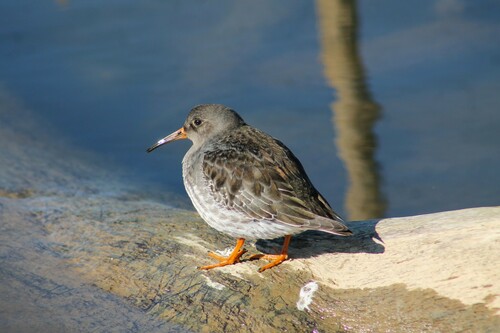
Purple Sandpiper (Calidris maritima) Purple Sandpiper
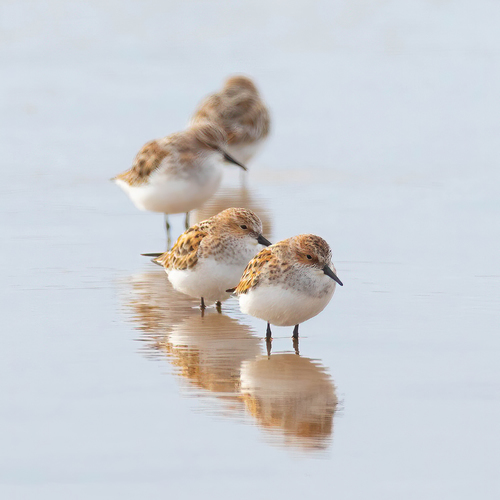
Little Stint (Calidris minuta) Little Stint

Media

Loading…

In short

The most reliable way to separate Purple Sandpiper from Little Stint is by size and structure: Purple Sandpiper is much bulkier, with a heavier body and thicker, slightly downcurved bill, while Little Stint is tiny, delicate, and fine-billed. In flight or at rest, Little Stint shows a long primary projection and dark legs, whereas Purple Sandpiper has short yellow legs and a stubbier look. Juvenile Little Stints show pale crown stripes and a pinkish breast, while Purple Sandpipers are always darker and more uniform above. Habitat is also a strong clue: Purple Sandpiper prefers rocky coasts, while Little Stint is found on muddy or sandy flats.

Identification tips

  1. Size and bulk: Purple Sandpiper is much larger and heavier than Little Stint; use nearby waders for scale.
  2. Bill structure: Purple Sandpiper has a thicker, medium-length, slightly downcurved bill with a yellow base; Little Stint's bill is fine, straight, and all dark.
  3. Leg color: Purple Sandpiper always has short yellow legs, while Little Stint has long, dark legs. This is visible even at a distance.
  4. Primary projection: Little Stint shows a long primary projection beyond the tail, especially obvious when perched or in flight; Purple Sandpiper's wings are shorter and broader.
  5. Juvenile plumage: Juvenile Little Stint has pale crown stripes and a pinkish breast, plus a strong white 'V' on the back. Purple Sandpiper juveniles are darker and lack these pale markings.
  6. Breast and underparts: Purple Sandpiper has a grey-smeared breast and mainly white underparts, but the upperparts are always dark and uniform. Little Stint in breeding plumage has an orange wash to the breast and white throat; in winter, it is plainer but still paler than Purple Sandpiper.
  7. Upperpart gloss: Purple Sandpiper may show a slight purplish gloss above, especially in good light; Little Stint is never glossy.
  8. Rump and tail: Purple Sandpiper has a black rump, which may be visible in flight; Little Stint's rump is not described as contrasting.
  9. Behavior: Purple Sandpiper is slow, tame, and forages among rocks; Little Stint is quick, active, and feeds on open mud or sand.
  10. Habitat: Purple Sandpiper is almost always on rocky coasts in winter; Little Stint is on mudflats, sandy shores, or inland pools.
  11. Flock composition: Little Stint often occurs in large flocks with other small waders; Purple Sandpiper is usually in small groups, sometimes with turnstones.
  12. Voice: If you hear a sharp 'stit' call, it's Little Stint. Purple Sandpiper's call is not a useful field mark in this context.
  13. Pitfalls: In dull winter light, Little Stint can appear greyer and less distinctive, but will still be much smaller, finer-billed, and dark-legged compared to Purple Sandpiper. Juvenile Little Stints are especially distinctive with their pale crown and pinkish tones.
  14. Context: If you find a small wader on a rocky Atlantic shore in winter, it is almost certainly Purple Sandpiper; on a muddy estuary, Little Stint is much more likely.
  15. Direct comparison: If both species are present, the size, structure, and leg color differences are immediately obvious.

Size

Purple Sandpiper is significantly larger and heavier (about 72 g vs. 26 g for Little Stint) and measures 20–22 cm in length, compared to the much smaller Little Stint. The difference is obvious in direct comparison or when seen with other waders: Purple Sandpiper appears chunky and robust, while Little Stint is tiny, slim, and delicate. The bill of Purple Sandpiper is thicker and slightly downcurved, with a yellow base; Little Stint has a fine, straight, all-dark bill. Leg color is also a strong size-related cue: Purple Sandpiper has short yellow legs, Little Stint has dark, fine legs.

Plumage

Juvenile Little Stints are distinctive with pale crown stripes and a pinkish breast, and in fresh juvenile plumage show a strong white 'V' on the back. Adults in breeding plumage have an orange wash to the breast and a white throat. In non-breeding (winter) plumage, Little Stints become plainer and greyer, making separation trickier, but they still retain a fine bill and dark legs. Purple Sandpiper is always darker above, with a slight purplish gloss, and has a grey-smeared breast and black rump. Its underparts are mainly white, but the overall impression is much darker and more uniform than Little Stint. The yellow base to the bill and yellow legs are consistent in all ages and seasons for Purple Sandpiper. In flight, Little Stint shows a long primary projection beyond the tail, while Purple Sandpiper's wings appear shorter and broader.

Behaviour

Purple Sandpiper is typically tame and slow-moving, often foraging among rocks and seaweed on wave-washed shorelines. It is gregarious but usually in small flocks, sometimes with turnstones. Little Stint is much more active and quick, feeding rapidly on open mud or sand, often in large flocks with other small waders. Its movements are more frenetic and it is less approachable than Purple Sandpiper.

Habitat

Habitat is a strong separator: Purple Sandpiper winters almost exclusively on rocky, often wave-battered Atlantic coasts, rarely venturing onto mud or sand. Little Stint is found on muddy or sandy coastal flats, estuaries, and the edges of inland pools, rarely if ever on rocky shores. If you see a small wader on a rocky coast in winter, it is far more likely to be Purple Sandpiper; on mudflats, especially in large flocks, Little Stint is the default.

Voice

Little Stint gives a sharp 'stit' call, which is distinctive among small waders. Purple Sandpiper's call is not described in the notes, so voice is only diagnostic if you hear the Little Stint's sharp note.

Submit a better description

Use the same sections as the comparison. Your text is published immediately.

The most reliable way to separate Purple Sandpiper from Little Stint is by size and structure: Purple Sandpiper is much bulkier, with a heavier body and thicker, slightly downcurved bill, while Little Stint is tiny, delicate, and fine-billed. In flight or at rest, Little Stint shows a long primary projection and dark legs, whereas Purple Sandpiper has short yellow legs and a stubbier look. Juvenile Little Stints show pale crown stripes and a pinkish breast, while Purple Sandpipers are always darker and more uniform above. Habitat is also a strong clue: Purple Sandpiper prefers rocky coasts, while Little Stint is found on muddy or sandy flats.

  1. Size and bulk: Purple Sandpiper is much larger and heavier than Little Stint; use nearby waders for scale.
  2. Bill structure: Purple Sandpiper has a thicker, medium-length, slightly downcurved bill with a yellow base; Little Stint's bill is fine, straight, and all dark.
  3. Leg color: Purple Sandpiper always has short yellow legs, while Little Stint has long, dark legs. This is visible even at a distance.
  4. Primary projection: Little Stint shows a long primary projection beyond the tail, especially obvious when perched or in flight; Purple Sandpiper's wings are shorter and broader.
  5. Juvenile plumage: Juvenile Little Stint has pale crown stripes and a pinkish breast, plus a strong white 'V' on the back. Purple Sandpiper juveniles are darker and lack these pale markings.
  6. Breast and underparts: Purple Sandpiper has a grey-smeared breast and mainly white underparts, but the upperparts are always dark and uniform. Little Stint in breeding plumage has an orange wash to the breast and white throat; in winter, it is plainer but still paler than Purple Sandpiper.
  7. Upperpart gloss: Purple Sandpiper may show a slight purplish gloss above, especially in good light; Little Stint is never glossy.
  8. Rump and tail: Purple Sandpiper has a black rump, which may be visible in flight; Little Stint's rump is not described as contrasting.
  9. Behavior: Purple Sandpiper is slow, tame, and forages among rocks; Little Stint is quick, active, and feeds on open mud or sand.
  10. Habitat: Purple Sandpiper is almost always on rocky coasts in winter; Little Stint is on mudflats, sandy shores, or inland pools.
  11. Flock composition: Little Stint often occurs in large flocks with other small waders; Purple Sandpiper is usually in small groups, sometimes with turnstones.
  12. Voice: If you hear a sharp 'stit' call, it's Little Stint. Purple Sandpiper's call is not a useful field mark in this context.
  13. Pitfalls: In dull winter light, Little Stint can appear greyer and less distinctive, but will still be much smaller, finer-billed, and dark-legged compared to Purple Sandpiper. Juvenile Little Stints are especially distinctive with their pale crown and pinkish tones.
  14. Context: If you find a small wader on a rocky Atlantic shore in winter, it is almost certainly Purple Sandpiper; on a muddy estuary, Little Stint is much more likely.
  15. Direct comparison: If both species are present, the size, structure, and leg color differences are immediately obvious.

Purple Sandpiper is significantly larger and heavier (about 72 g vs. 26 g for Little Stint) and measures 20–22 cm in length, compared to the much smaller Little Stint. The difference is obvious in direct comparison or when seen with other waders: Purple Sandpiper appears chunky and robust, while Little Stint is tiny, slim, and delicate. The bill of Purple Sandpiper is thicker and slightly downcurved, with a yellow base; Little Stint has a fine, straight, all-dark bill. Leg color is also a strong size-related cue: Purple Sandpiper has short yellow legs, Little Stint has dark, fine legs.

Juvenile Little Stints are distinctive with pale crown stripes and a pinkish breast, and in fresh juvenile plumage show a strong white 'V' on the back. Adults in breeding plumage have an orange wash to the breast and a white throat. In non-breeding (winter) plumage, Little Stints become plainer and greyer, making separation trickier, but they still retain a fine bill and dark legs. Purple Sandpiper is always darker above, with a slight purplish gloss, and has a grey-smeared breast and black rump. Its underparts are mainly white, but the overall impression is much darker and more uniform than Little Stint. The yellow base to the bill and yellow legs are consistent in all ages and seasons for Purple Sandpiper. In flight, Little Stint shows a long primary projection beyond the tail, while Purple Sandpiper's wings appear shorter and broader.

Purple Sandpiper is typically tame and slow-moving, often foraging among rocks and seaweed on wave-washed shorelines. It is gregarious but usually in small flocks, sometimes with turnstones. Little Stint is much more active and quick, feeding rapidly on open mud or sand, often in large flocks with other small waders. Its movements are more frenetic and it is less approachable than Purple Sandpiper.

Habitat is a strong separator: Purple Sandpiper winters almost exclusively on rocky, often wave-battered Atlantic coasts, rarely venturing onto mud or sand. Little Stint is found on muddy or sandy coastal flats, estuaries, and the edges of inland pools, rarely if ever on rocky shores. If you see a small wader on a rocky coast in winter, it is far more likely to be Purple Sandpiper; on mudflats, especially in large flocks, Little Stint is the default.

Little Stint gives a sharp 'stit' call, which is distinctive among small waders. Purple Sandpiper's call is not described in the notes, so voice is only diagnostic if you hear the Little Stint's sharp note.

Discard your changes?

You have unsaved edits. If you leave now, those changes will be lost.

Purple Sandpiper · Little Stint · My Tricky Birds