

Purple-crowned Fairy vs Veraguan Mango
Heliothryx barroti versus Anthracothorax veraguensis
Play a quiz with Purple-crowned Fairy and Veraguan Mango
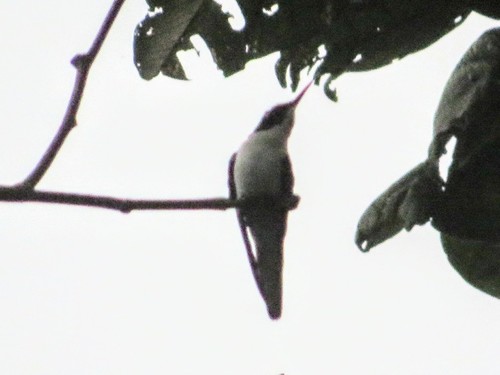 Purple-crowned Fairy
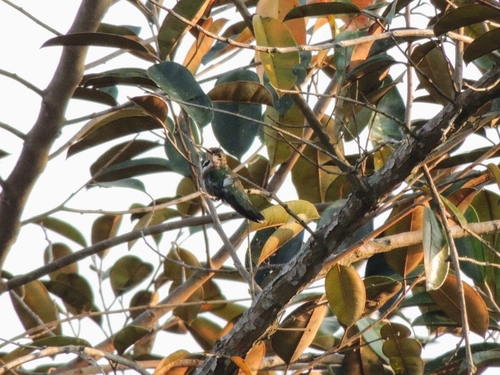 Veraguan Mango
In short
The most reliable way to separate Purple-crowned Fairy from Veraguan Mango is by overall shape and plumage: the Fairy is a slender, small hummingbird with a strikingly white belly and long, pointed tail with white outer feathers, while the Mango is bulkier, with a metallic green body, dark tail with red-centered feathers, and a distinctive ventral stripe (teal in females, blueish underparts in males). Immature Purple-crowned Fairies show cinnamon-edged upperparts and sparse dusky spots below, unlike any Veraguan Mango. The Fairy's short, straight bill and pure white underparts contrast with the Mango's decurved bill and colored belly. Both species occur in Central America, but the Mango is more localized to Panama and Costa Rica. Focus on underpart color, tail pattern, and bill shape for quick separation.
Identification tips
- Underpart color: Purple-crowned Fairy of all ages and sexes shows pure white underparts; Veraguan Mango always has colored underparts (blueish in males, white-cream with a dark teal ventral stripe in females).
- Tail pattern: Fairy has a long, pointed tail with white outer feathers and blue-black central feathers. Mango has a black tail with red-centered feathers and no white.
- Bill shape: Fairy's bill is short, straight, and black; Mango's is longer, slightly decurved, and dark grey. This is often visible even at a distance.
- Crown and face: Male Fairy has a metallic violet forecrown and a black eye patch with a violet spot behind it; female has a green crown and less black on the face. Mango lacks these crown and face features.
- Ventral stripe: Female Mango always shows a dark teal stripe down the white-cream belly, never present in Fairy. Male Mango has a blueish belly, not white.
- Immature Fairy: Cinnamon fringes on upperparts and dusky spots on throat/breast are unique to immature Fairy and not seen in Mango.
- Overall shape: Fairy is slender and delicate, with a long, pointed tail. Mango is bulkier and more robust, with a broader tail.
- Size: Fairy is smaller (9–13 cm, 5.5 g) than Mango (11–12 cm, heavier build). If seen together, size difference is clear.
- Tail in flight: The Fairy's white outer tail feathers are visible in flight and when perched, a quick separation from the all-dark Mango tail.
- Habitat and range: Mango is only in Panama and Costa Rica; Fairy is more widespread. If seen outside Panama/Costa Rica, default to Fairy.
- Feeding behavior: Fairy often forages higher in the canopy and is less likely at feeders; Mango may be more visible at feeders or in open gardens.
- Face pattern: Fairy has a black eye patch (with violet spot in males); Mango's face is plain metallic green without such markings.
- Plumage gloss: Both are metallic green above, but only the Fairy shows a violet crown (male) and white below.
- Sexual dimorphism: Both species show sexual dimorphism, but the Mango's ventral stripe (female) and blueish underparts (male) are unique and diagnostic.
- Pitfall: Do not rely on overall green upperparts alone; focus on underparts, tail, and bill for reliable separation.
Size
Purple-crowned Fairy is smaller and more slender, measuring 9–13 cm in length and weighing about 5.5 g. Veraguan Mango is noticeably larger and heavier, at 11–12 cm long, with a more robust build. The difference in body mass and overall bulk is often apparent in the field, especially when both species are seen at feeders or in the same area. The Fairy's long, pointed tail also contributes to its more delicate appearance compared to the Mango's broader, squared tail.
Plumage
- Immature/juvenile birds: Purple-crowned Fairy immatures have cinnamon fringes on the upperparts and sparse dusky spots on the throat and breast, which are not seen in Veraguan Mango of any age. This is a strong mark for young birds.
- Adult males: Purple-crowned Fairy males have a metallic violet forecrown, emerald green upperparts, pure white underparts, and a long tail with blue-black central and white outer feathers. Veraguan Mango males are metallic green overall, with a blueish breast and belly, and a black tail with a red circle in the center of each feather.
- Adult females: Female Purple-crowned Fairy has a green crown, less black on the face, and pure white underparts. Female Veraguan Mango has a white-cream belly with a dark teal stripe running down the breast, and the tail is black with red-centered feathers. The Mango lacks the Fairy's white outer tail feathers and has a distinct ventral stripe.
- Tail pattern: Purple-crowned Fairy has white outer tail feathers, while Veraguan Mango's tail is black with red-centered feathers and lacks white.
- Bill: Fairy's bill is short, straight, and black; Mango's is slightly decurved and dark grey.
Behaviour
Purple-crowned Fairy forages mostly in the mid-story and canopy, sometimes lower at forest edges, and is not particularly territorial but can be aggressive toward other hummingbirds. It feeds by inserting its bill into flowers or robbing nectar by piercing the base, and gleans small arthropods (especially spiders) from foliage, rarely catching insects in flight. Veraguan Mango behavior is not described in detail here, but as a typical mango, it is likely to be more territorial and may visit feeders or open areas more readily. The Fairy's preference for higher, more shaded foraging sites may contrast with the Mango's use of more open or edge habitats.
Habitat
Purple-crowned Fairy ranges from southeastern Mexico to northern Peru, occupying a variety of forested habitats, often in the mid-story and canopy. Veraguan Mango is much more restricted, found mainly in Panama and recently in Costa Rica, and is likely to be encountered in more open or edge habitats, gardens, or near feeders. If you are outside Panama or Costa Rica, the Mango is unlikely; within those countries, check habitat context and range overlap.