

Purple-banded Sunbird vs White-bellied Sunbird
Cinnyris bifasciatus versus Cinnyris talatala
Play a quiz with Purple-banded Sunbird and White-bellied Sunbird
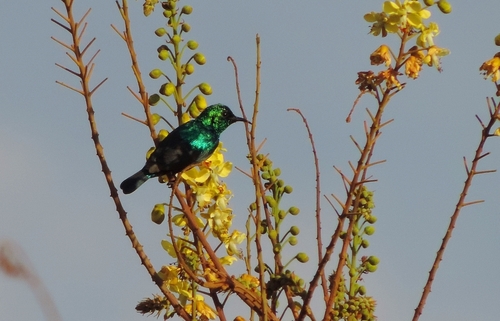 Purple-banded Sunbird
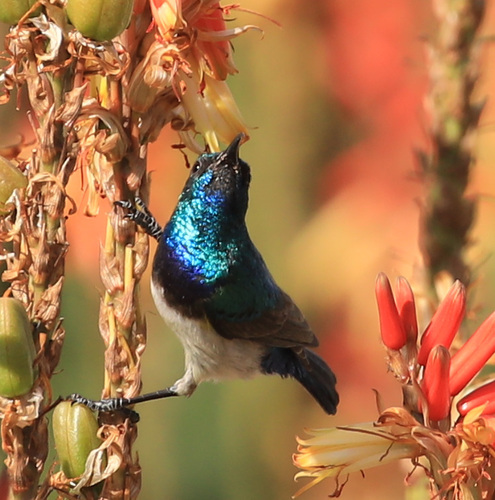 White-bellied Sunbird
In short
The most reliable way to separate Purple-banded Sunbird from White-bellied Sunbird is by focusing on the underpart coloration in adult males: Purple-banded shows a distinct purplish breast band on otherwise white underparts, while White-bellied lacks this band and has a clean white belly and breast. Both species overlap widely in range and habitat, and their size and structure are very similar, so plumage details—especially on the underparts—are key. Immature and female birds are much trickier, as both are small, slender sunbirds with similar proportions and subtle differences. In the field, always try to get a clear view of the breast and belly, and be cautious with non-adult males.
Identification tips
- Adult male underpart pattern is the best field mark: Look for the distinct, narrow purplish band across the upper breast of Purple-banded Sunbird males. If the breast is clean white without a band, you are likely seeing a White-bellied Sunbird male.
- Females and immatures are very similar: Both show pale underparts and lack the adult male's breast band. In these plumages, separation is extremely difficult and not reliably possible in the field with the information available.
- No distinctive juvenile or immature wing patterns: Neither species is described as having unique upperwing or flight marks in non-adult plumages, so do not rely on wing pattern for separation.
- Bill and structure are not reliable: Both species have slender, decurved bills and similar proportions. Bill length, tail shape, and wing formula are not diagnostic.
- Plumage pitfalls: Beware that lighting can obscure or exaggerate the purplish breast band of Purple-banded Sunbird males. In poor light, the band may appear faint or absent; always try to confirm with a direct, well-lit view.
- White-bellied Sunbird males may show a faint greenish or bluish wash on the upper breast, but never a distinct band: If you see any suggestion of a band, favor Purple-banded, but check carefully for lighting artifacts.
- Habitat and range are not helpful within the overlap zone: Both species can be found in the same habitats and regions in southern and central Africa.
- Behavior is not diagnostic: Both species forage similarly and join mixed flocks; do not use behavior for separation.
- Voice is not described as a separator: No distinctive vocal differences are noted in the sources.
- If in East Africa (e.g., Kenya, Ethiopia, Somalia), Purple-banded is more likely, but White-bellied is absent there: Use range only as a last resort, and always confirm with plumage.
- In mixed-species sunbird flocks, focus on underpart pattern: With several Cinnyris species present, the breast band (or lack thereof) is the most reliable mark for these two.
- Do not rely on size or jizz: Both are equally small and active, and neither stands out structurally.
- If uncertain and not seeing an adult male, consider leaving the bird unidentified: Female and immature sunbirds are notoriously tricky, and these two are no exception.
- Photograph for later review: If possible, get photos of the underparts, as subtle differences may be easier to assess after the fact.
- Consult local birders for recent splits or taxonomic changes: The Tsavo Sunbird is sometimes lumped with Purple-banded; check local checklists if in East Africa.
Size
Both species are small, slender sunbirds typical of the genus Cinnyris. No reliable size difference is noted in the sources; both are similar in overall length and mass [wikipedia][avonet]. Bill length and shape are also similar, so size is not a useful field mark for separation.
Plumage
Adult males are most easily separated: Purple-banded Sunbird males have a clear, narrow purplish band across the upper breast, sharply set off against a white belly. White-bellied Sunbird males lack this breast band and instead show a uniform white breast and belly, sometimes with a faint greenish or bluish wash on the upper breast, but never a distinct band. Females and immatures of both species are drab, with pale underparts and duller upperparts, making field separation very difficult without the adult male's breast band. No distinctive juvenile or immature upperwing or flight pattern differences are described in the sources for either species.
Behaviour
Both species behave similarly: they are active, often joining mixed-species flocks and foraging for nectar and insects. Both can be seen hawking insects in the late afternoon and gleaning from foliage. No behavioral differences are reliably described that would help separate them in the field.
Habitat
Habitat overlap is extensive. Both species occur in a wide range of wooded and bushy habitats across southern and central Africa, including Angola, Botswana, DRC, Eswatini, Malawi, Mozambique, Namibia, South Africa, Tanzania, Zambia, and Zimbabwe [wikipedia]. Purple-banded Sunbird also extends into East Africa (e.g., Kenya, Ethiopia, Uganda, Somalia, Gabon, Congo, Rwanda), but within the shared range, habitat is not a useful separator.
Purple-banded Sunbird · White-bellied Sunbird · My Tricky Birds