

Puff-throated Babbler vs Short-tailed Babbler
Pellorneum ruficeps versus Pellorneum malaccense
Play a quiz with Puff-throated Babbler and Short-tailed Babbler
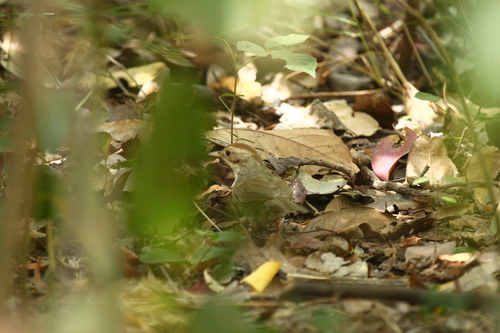 Puff-throated Babbler
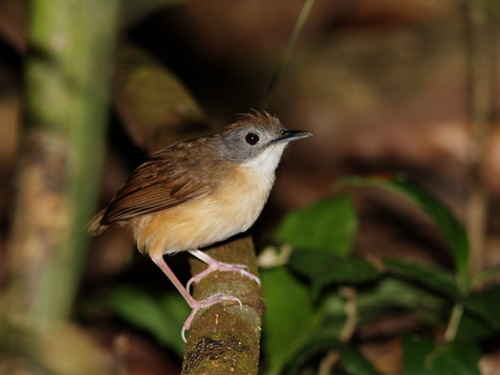 Short-tailed Babbler
In short
The most reliable field mark to separate Puff-throated Babbler from Short-tailed Babbler is the strong, contrasting facial pattern of Puff-throated: a bold buff supercilium, chestnut crown, and white, often 'puffed' throat, compared to the more uniform and less contrasting head of Short-tailed. Puff-throated is larger and streaked below, while Short-tailed is smaller, more compact, and lacks the heavy streaking. Both species skulk in the undergrowth, but Puff-throated is more likely to be seen in small groups and in hilly or bamboo-rich habitats, whereas Short-tailed is solitary or in pairs and restricted to lowland forests. If you see a babbler with a clearly streaked breast and a strong supercilium, it's almost certainly Puff-throated.
Identification tips
- Facial pattern is key: Puff-throated Babbler has a bold buff supercilium, chestnut crown, dusky cheeks, and a white throat (often puffed out), making the face strikingly patterned. Short-tailed Babbler has a more uniform, less contrasting face and lacks the puffed white throat.
- Underpart streaking: Puff-throated shows heavy brown streaks on the white breast and belly; Short-tailed is plain below, with no strong streaking.
- Size and structure: Puff-throated is larger and bulkier, with longer legs and a longer tail; Short-tailed is smaller, more compact, and has a noticeably shorter tail.
- Group vs solitary: Puff-throated is often seen in small, active groups; Short-tailed is usually alone or in pairs.
- Habitat context: Puff-throated is found in hilly or bamboo-rich forests, often at higher elevations; Short-tailed is restricted to lowland tropical forests in the Malay Peninsula and nearby islands.
- Vocalization: Persistent, ascending whistled calls point to Puff-throated; Short-tailed is less vocal and not known for such calls.
- Behavior: Both species forage on the ground, but Puff-throated may be more conspicuous due to group activity and vocalizing. Short-tailed is more secretive and solitary.
- Subspecies variation: Some Puff-throated subspecies are streaked on the back and nape, especially in eastern populations; Short-tailed does not show this variation.
- No flight/wing pattern cues: Neither species has distinctive upperwing or flight marks described, so rely on body and head pattern.
- Juvenile/immature birds: No detailed descriptions, but the strong facial contrast and streaking of Puff-throated should be visible in all ages; Short-tailed remains plain.
- Tail length: If the tail appears short and the bird is compact, suspect Short-tailed, especially in lowland forest; a longer-tailed, bulkier bird in hills is more likely Puff-throated.
- Legs: Puff-throated has strong, long legs, often visible as it runs or creeps through leaf litter.
- Foraging style: Both turn over leaf litter, but Puff-throated may appear more thrush-like in movement; Short-tailed sometimes uses its foot to grasp prey, an unusual behavior for passerines.
- Range: If you are outside the Malay Peninsula and nearby islands, Short-tailed is highly unlikely; in the Himalayas or peninsular India, it's Puff-throated.
- When in doubt: Focus on the combination of facial pattern, underpart streaking, and habitat/elevation to separate these two.
Size
Puff-throated Babbler is noticeably heavier (26g vs 21g) and generally appears bulkier and longer-legged than Short-tailed Babbler, which is more compact and true to its name, with a shorter tail. This difference is subtle in the field but can be apparent if both species are seen side by side or with experience. Both are small, ground-dwelling babblers, but Puff-throated gives a slightly larger, more elongated impression.
Plumage
No distinctive age-specific upperwing or flight marks are described for either species, so focus on body and head pattern. Adult Puff-throated Babblers show a brown upperbody, white underparts with heavy brown streaking on the breast and belly, a chestnut crown, long buff supercilium, dusky cheeks, and a white throat that is sometimes puffed out. Some subspecies have streaking on the mantle and back, especially in the east, while others are plainer above. Short-tailed Babbler, in contrast, lacks the bold head pattern and heavy underpart streaking; it is more uniformly brownish above and below, with a less contrasting face and no puffed white throat. Juvenile/immature plumages are not described in detail for either species, but the strong facial contrast and streaked underparts of Puff-throated are expected to be present in all ages, while Short-tailed remains plainer.
Behaviour
Puff-throated Babblers are often seen foraging in small groups, actively turning over leaf litter and creeping through the undergrowth, sometimes running in a rodent-like manner. They spend a lot of time on the ground and are quite vocal. Short-tailed Babblers are more solitary or found in pairs, rarely joining mixed flocks, and also forage on the ground for insects, sometimes using their foot to grasp prey. Both species are secretive and prefer dense cover, but Puff-throated may be more conspicuous due to group foraging and vocal activity.
Habitat
Puff-throated Babbler is found in a variety of scrub and moist forest habitats, especially in hilly regions and bamboo thickets across a wide range in Asia, including the Himalayas and peninsular India. Short-tailed Babbler is restricted to tropical moist lowland forests of the Malay Peninsula and surrounding islands. Thus, elevation and forest type are strong clues: Puff-throated prefers hills and bamboo, Short-tailed is a lowland forest specialist.
Voice
Puff-throated Babbler is notably vocal, with a series of ascending whistling notes, sometimes described as 'he'll beat you' or 'pret-ty-sweet,' and calls can be persistent. No detailed vocal description is given for Short-tailed Babbler, but it is not noted for persistent vocalizing. If you hear a series of whistled, ascending notes, Puff-throated is much more likely.
Puff-throated Babbler · Short-tailed Babbler · My Tricky Birds