

Plumed Whistling-Duck vs White-faced Whistling-Duck
Dendrocygna eytoni versus Dendrocygna viduata
Play a quiz with Plumed Whistling-Duck and White-faced Whistling-Duck
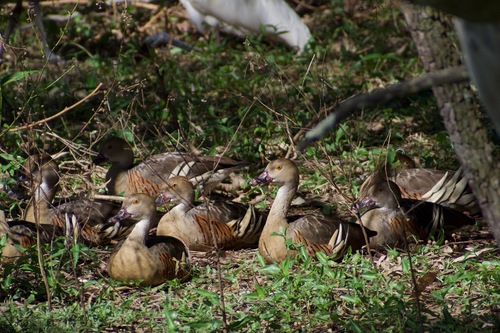 Plumed Whistling-Duck
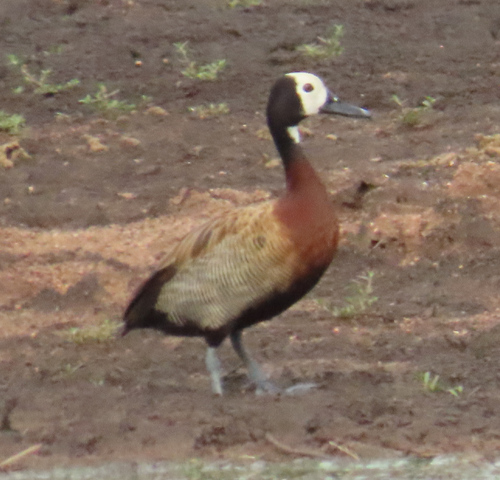 White-faced Whistling-Duck
In short
The most reliable field mark to separate Plumed Whistling-Duck from White-faced Whistling-Duck is the presence of long, black-edged buff plumes on the flanks of the Plumed Whistling-Duck—these are always absent on White-faced. In contrast, White-faced Whistling-Duck shows a striking white face and black head, which is never matched by Plumed Whistling-Duck. Both species are long-necked, brownish whistling ducks, but their head and flank patterns are diagnostic at all ages. In flight or at rest, focus on the flank plumes versus the white face for a quick separation. Juvenile White-faced Whistling-Ducks can have less contrast on the head, but never show the distinctive plumes of Plumed.
Identification tips
- Flank plumes: Plumed Whistling-Duck always shows long, buff plumes edged with black projecting from the flanks—this is the single best field mark and is visible at all ages and in all postures. White-faced Whistling-Duck never shows these plumes.
- Head pattern: White-faced Whistling-Duck has a bold white face and black head/neck in adults, which is never matched by Plumed Whistling-Duck. Juveniles may have a duller face but still lack flank plumes.
- Chest and neck color: Plumed Whistling-Duck has a chestnut chest with fine black barring and a plain brown head/neck. White-faced has a rich chestnut neck but a black head and white face.
- Bill and leg color: Plumed Whistling-Duck has pinkish-red bill and legs; White-faced has a grey bill and legs. This can help at close range.
- Upperparts and underparts: Plumed is brown above with paler underparts and a white rump; White-faced is darker above and has black underparts with fine white barring on the flanks.
- Iris color: Plumed Whistling-Duck has a yellow iris, which can be visible at close range; iris color is not distinctive in White-faced.
- Flight silhouette: Plumed often flies with a lowered neck and short, rounded wings; White-faced has a more typical whistling duck flight with a straighter neck.
- Juvenile confusion: Juvenile White-faced Whistling-Ducks have less contrast on the head, but still never show flank plumes. Juvenile Plumed Whistling-Ducks already show the distinctive plumes.
- Sex differences: Both species are sexually monomorphic—do not rely on sex for separation.
- Habitat and range: If seen in Australia, especially in the north or east, Plumed is expected. In Africa or South America, White-faced is the default. Vagrancy is rare.
- Group size: Massive flocks (thousands) are more typical of White-faced Whistling-Duck, but flock size is not diagnostic.
- Vocalizations: Both species whistle, but White-faced gives a clear three-note call. Use voice only as supporting evidence.
- Perched vs. in flight: Flank plumes of Plumed are visible both perched and flying; White-faced never shows them in any posture.
- Pitfalls: Do not rely on overall brown coloration or size, as both are similar. Always check head and flank pattern first.
- Season and molt: No significant seasonal or molt differences affect the main field marks in either species.
Size
Plumed Whistling-Duck is slightly heavier (average 790 g) than White-faced Whistling-Duck (average 674 g), but this difference is subtle in the field and not a reliable separator. Both are medium-sized, long-necked ducks with similar overall proportions. Length overlaps considerably, so size alone should not be used for identification.
Plumage
Juvenile and adult Plumed Whistling-Ducks always show long, pale buff plumes with black edges projecting from the flanks—this is unique among whistling ducks and visible at all ages, both perched and in flight. Their chest is chestnut with fine black barring, and the underparts are pale. The head and neck are plain brown, lacking any bold facial pattern. In contrast, adult White-faced Whistling-Ducks have a sharply defined white face and black head/neck, with a rich chestnut neck and dark brown to black upperparts. The flanks are black with fine white barring. Juvenile White-faced Whistling-Ducks resemble adults but have a duller, less contrasting head pattern, yet still never show flank plumes. Bill and leg color also differ: Plumed has pinkish-red bill and legs, while White-faced has a grey bill and legs. Sexes are similar in both species.
Behaviour
Both species are gregarious and often found in large flocks, but White-faced Whistling-Duck is especially known for forming massive groups, sometimes numbering over a thousand. Plumed Whistling-Ducks are also social, but their flocks are generally smaller. In flight, Plumed Whistling-Ducks often show a lowered neck and short, rounded wings, while White-faced Whistling-Ducks have a more typical whistling duck flight silhouette. Both species feed in open wetlands and grasslands, but Plumed is more likely to be seen grazing in tall grass.
Habitat
Plumed Whistling-Duck is resident in Australia, especially in the northern and eastern regions, with occasional records in New Zealand and nearby islands. White-faced Whistling-Duck is found in sub-Saharan Africa and much of South America. Their ranges do not overlap in the wild, so location is a strong clue. Both species prefer wetlands, lakes, and grassy areas, but Plumed is more tied to grassy floodplains.
Voice
Both species are noisy and produce whistling calls. Plumed Whistling-Duck has a characteristic whistle, while White-faced Whistling-Duck gives a clear, three-note whistling call. The difference is subtle and not always reliable for separation, especially at a distance or in mixed flocks.
Plumed Whistling-Duck · White-faced Whistling-Duck · My Tricky Birds