

Plain Tyrannulet vs Euler's Flycatcher
Inezia inornata versus Lathrotriccus euleri
Play a quiz with Plain Tyrannulet and Euler's Flycatcher
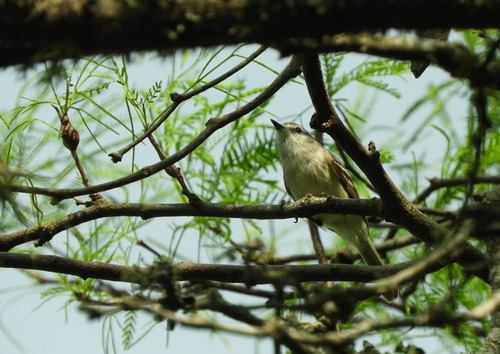 Plain Tyrannulet
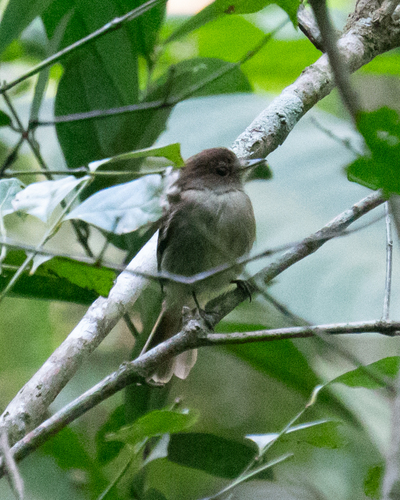 Euler's Flycatcher
In short
The most reliable field mark to separate Plain Tyrannulet from Euler's Flycatcher is overall size and structure: Plain Tyrannulet is distinctly smaller and more delicate, with a shorter bill and finer build, while Euler's Flycatcher is noticeably larger and bulkier. In plumage, both show two pale wing bars and a pale eye-ring, but Plain Tyrannulet has a grayish-olive crown and face with a thin white supercilium, whereas Euler's Flycatcher has a warmer olive-brown crown and a faint pale stripe above the lores. Bill color and structure also help: Plain Tyrannulet has a thin, mostly black bill, while Euler's Flycatcher has a stouter bill with a pinkish or orangish lower mandible. Both can occur in similar habitats, so careful attention to these structural and plumage details is essential.
Identification tips
- Size is a primary clue: Plain Tyrannulet is much smaller and lighter than Euler's Flycatcher. If the bird appears dainty and compact, suspect Tyrannulet; if it seems robust and heavy-billed, consider Euler's.
- Bill structure and color: Plain Tyrannulet has a thin, mostly black bill (sometimes with a paler base), while Euler's Flycatcher has a stouter bill with a black upper mandible and a pinkish or orangish lower mandible. Bill color is best seen in good light.
- Crown color: Tyrannulet shows a grayish to olive-gray crown, while Euler's Flycatcher has a warmer olive-brown crown and nape.
- Facial pattern: Plain Tyrannulet has a whitish face with a thin white supercilium and a thin white eye-ring, giving a more contrasting, 'open-faced' look. Euler's Flycatcher has a whitish eye-ring and a faint pale stripe above the lores, but the face is more uniformly olive-brown and less contrasting.
- Wing bars: Both species have two pale wing bars, but Tyrannulet's are dull white, while Euler's are pale buff. This is subtle and may be hard to judge without direct comparison.
- Underparts: Plain Tyrannulet has dingy gray underparts with a pale yellow tinge on the lower belly and undertail. Euler's Flycatcher has a grayish white throat, brownish olive breast, and a pale yellow to white belly. Subspecies of Euler's may show more or less yellow, but never the Tyrannulet's grayish-olive face and supercilium.
- Upperparts: Tyrannulet's back and rump are grayish to olive-gray; Euler's Flycatcher is olive-brown above with a brown rump.
- Tail: Both have dusky tails, but no strong difference is described in shape or length.
- Iris color: Both have dark irises; not useful for separation.
- Leg color: Both have gray to blackish brown legs and feet; not diagnostic.
- Behavior: Tyrannulet is more restless, often flicking wings and tail, while Euler's is steadier.
- Habitat: Both can occur in similar habitats, but Tyrannulet is more likely in drier, open woodland; Euler's is widespread in humid forests and edges. Use with caution.
- Sex and age: Both sexes look alike in both species. No strong age-specific field marks are described for separation.
- Flight vs perched: Size and structure are often easiest to judge in flight. Perched birds require close attention to facial pattern and bill.
- Voice: No diagnostic vocal differences are provided in the sources; do not rely on song or call for separation with the information given.
Size
Plain Tyrannulet is much smaller, measuring about 9 cm in length and weighing 5.5–6 g. Euler's Flycatcher is significantly larger at 12.7–13.5 cm and 9–13.8 g. This size difference is usually obvious in the field, especially when seen side by side or compared to known species. The Tyrannulet appears dainty and compact, while Euler's Flycatcher is more robust and heavy-billed.
Plumage
- Juvenile/immature wing pattern: No age-specific upperwing marks are described for either species; both show two pale wing bars in all plumages, but the color differs: Plain Tyrannulet's wing bars are dull white, while Euler's Flycatcher's are pale buff.
- Adults: Plain Tyrannulet has a grayish to olive-gray crown, whitish face with a thin white supercilium and eye-ring, grayish-olive back, and dingy gray underparts with a pale yellow tinge on the lower belly and undertail. Euler's Flycatcher has a warm olive-brown crown and nape, olive-brown upperparts, a whitish eye-ring, and a faint pale stripe above the lores. Its underparts are grayish white on the throat, brownish olive on the breast, and pale yellow to white on the belly. The bill of Plain Tyrannulet is thin and black (sometimes with a paler base), while Euler's Flycatcher has a black maxilla and a dull pinkish or orangish pink mandible. Subspecies of Euler's Flycatcher vary slightly in underpart color but always lack the Tyrannulet's grayish-olive face and supercilium.
Behaviour
Both species are active and often forage in the midstory or canopy, but Plain Tyrannulet tends to be more restless and flicks its wings and tail frequently. Euler's Flycatcher may appear more deliberate and less nervy. In flight, the Tyrannulet's smaller size and quicker movements can be noticeable compared to the more robust, steady-flying Euler's.
Habitat
There is considerable overlap in habitat: both species can be found in a range of wooded and edge habitats, including forest edges, secondary growth, and scrub. However, Plain Tyrannulet is more likely in drier or more open woodland, while Euler's Flycatcher is widespread in humid forests and edges. Habitat alone is not diagnostic where ranges overlap.