

Plain Prinia vs Orange-bellied Flowerpecker
Prinia inornata versus Dicaeum trigonostigma
Play a quiz with Plain Prinia and Orange-bellied Flowerpecker
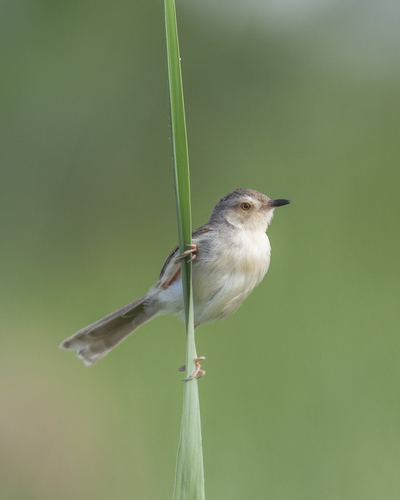 Plain Prinia
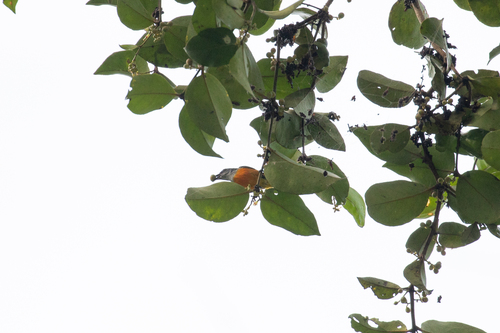 Orange-bellied Flowerpecker
In short
The most reliable field mark to separate Plain Prinia from Orange-bellied Flowerpecker is overall coloration and structure: Plain Prinia is a slender, long-tailed, brownish warbler with a pale supercilium and plain underparts, while Orange-bellied Flowerpecker is a compact, short-tailed bird with a small, slightly curved bill and, in males, striking blue and orange coloration. Females flowerpeckers are duller but still show a yellow belly and orange rump, never the uniform buffy underparts of prinia. In flight or perched, the prinia’s long tail and upright stance contrast sharply with the flowerpecker’s stubby, rounded profile. Both species can be found in overlapping regions of Southeast Asia, but their structure and plumage are distinct at all ages and seasons.
Identification tips
- Tail length and shape: Plain Prinia has a long, graduated tail often held cocked or fanned; Orange-bellied Flowerpecker has a very short, stubby tail. This is the fastest structural check, especially in flight or when perched upright.
- Overall build: Prinia is slender and elongated, with strong legs and a thin, straight bill. Flowerpecker is compact, rounded, with a short, slightly downcurved bill.
- Bill shape: Prinia’s bill is straight, thin, and black; flowerpecker’s is shorter, thicker at the base, and slightly curved at the tip—useful even at a distance.
- Supercilium: Plain Prinia shows a distinct short white supercilium above the eye; flowerpecker lacks any pale eyebrow.
- Male flowerpecker coloration: Males are unmistakable—slaty-blue above, with a large orange mantle patch and fiery orange to yellow underparts. No prinia ever shows blue or orange.
- Female flowerpecker: Females are olive-brown above, yellow below, with a pale orange rump. They lack the prinia’s white supercilium and never show uniform buffy underparts.
- Prinia underparts: Always whitish-buff to buff, never bright yellow or orange. Underparts are plain, with no color patches.
- Wing and back color: Prinia is grey-brown above with rufous edges to the closed wings (in breeding plumage). Flowerpecker males are blue above; females are olive-brown.
- Seasonal change in prinia: In winter, prinia becomes warmer brown above and buffier below, with a longer tail. This may make it look even less like a flowerpecker.
- Sex differences: Flowerpecker shows strong sexual dimorphism; prinia sexes are identical.
- Behavior: Prinia is often seen in open, grassy areas, perching upright and flicking its tail. Flowerpecker is more likely to be in trees, moving quickly, sometimes hovering at flowers.
- Habitat context: Prinia in open country, flowerpecker in forest or gardens—use habitat as a supporting clue.
- Perched posture: Prinia perches upright, often on exposed stems; flowerpecker is more horizontal, clinging to branches or flowers.
- Flight style: Prinia’s flight is weak and undulating, with the long tail obvious; flowerpecker’s flight is bounding and direct, with a stubby-tailed, compact look.
- No orange or blue in prinia: Any hint of blue or orange on the bird rules out prinia immediately.
Size
Plain Prinia is slightly larger and more elongated, measuring about 13–14 cm in length, with a noticeably long tail and slim build [wikipedia]. Orange-bellied Flowerpecker is smaller and much more compact, with a body mass of about 7 g [wikidata], and a short, stubby tail. The flowerpecker’s overall proportions are more rounded and chunky, while the prinia appears slender and elongated, especially when the tail is cocked or fanned.
Plumage
- Juvenile/immature/first-winter: No specific juvenile wing pattern is described for either species, but age-related differences are more subtle in flowerpecker females (duller, olive-brown with yellow belly and orange rump) and in non-breeding prinias (warmer brown above, buffier below, longer tail).
- Adult breeding plumage: Plain Prinia is grey-brown above with a white supercilium, rufous wing edges, and whitish-buff underparts; sexes are identical. Orange-bellied Flowerpecker males are unmistakable: slaty-blue upperparts, large orange mantle patch, fiery orange to yellow underparts, and a pale blue-grey throat and upper breast. Females are olive-brown above, yellow below, with a pale orange rump—never showing the plain buffy underparts or white supercilium of prinia.
- Seasonal change: Plain Prinia becomes warmer brown above and buffier below in winter, with a longer tail. The Sri Lankan race keeps summer plumage year-round. Flowerpecker shows little seasonal change, but sex differences are strong.
Behaviour
Plain Prinia is often seen perched upright on grass stems or low shrubs, frequently flicking or fanning its long tail. It moves actively through open country, often in pairs or small groups. Orange-bellied Flowerpecker is more arboreal, typically foraging in the canopy or mid-levels of trees, moving quickly and often hovering briefly at flowers or fruit. Its movements are more bounding and less tail-active than the prinia. The flowerpecker’s feeding is more specialized on nectar and fruit, while the prinia gleans insects from foliage and grass.
Habitat
Both species occur in Southeast Asia, but Plain Prinia favors open country, grasslands, scrub, and edges of wetlands—rarely venturing into dense forest. Orange-bellied Flowerpecker is more closely tied to forested habitats, gardens, and plantations, especially where flowering or fruiting trees are present. Seeing a bird in tall grass or open scrub strongly favors prinia; in the canopy or at flowering trees, flowerpecker is more likely.
Plain Prinia · Orange-bellied Flowerpecker · My Tricky Birds