

Plain-breasted Ground Dove vs Ruddy Ground Dove
Columbina minuta versus Columbina talpacoti
Play a quiz with Plain-breasted Ground Dove and Ruddy Ground Dove
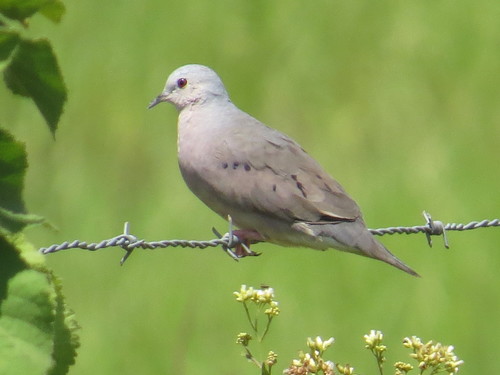 Plain-breasted Ground Dove
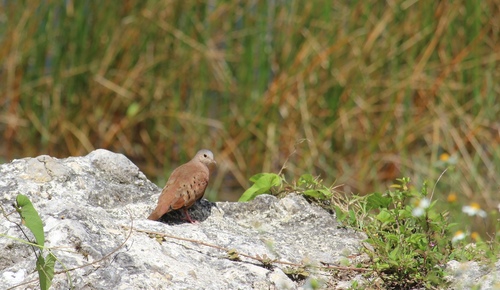 Ruddy Ground Dove
In short
The most reliable field mark between Plain-breasted Ground Dove and Ruddy Ground Dove is the presence or absence of black spots on the wing coverts: Ruddy Ground Dove always shows distinct black spots on the wings (all ages and sexes), while Plain-breasted Ground Dove lacks these spots and has a more uniform, plainer wing. In addition, Plain-breasted is smaller and darker overall, with a less reddish tone than Ruddy. Sex differences are subtle in Plain-breasted but obvious in Ruddy, with males showing a rufous body and gray head, and females being all brown. Both species can appear together in open country, so careful attention to wing pattern and overall size is essential.
Identification tips
- Check for black spots on the wing coverts: Ruddy Ground Dove always shows distinct black spots on the wings (perched and in flight, all ages and sexes). Plain-breasted Ground Dove never shows these spots; its wings are plain or subtly marked, but not boldly spotted.
- Assess overall size and structure: Plain-breasted Ground Dove is smaller and lighter, with a more delicate, compact appearance. Ruddy Ground Dove is noticeably bulkier and heavier.
- Look for reddish or rufous tones: Adult male Ruddy Ground Dove has rich rufous upperparts and a pale gray head, creating a strong contrast. Plain-breasted Ground Dove is darker gray-brown overall, lacking strong rufous or reddish tones.
- Check for scaling or speckling on the breast and head: Plain-breasted Ground Dove lacks any scaled or speckled pattern on the breast and head, appearing plain. Ruddy Ground Dove may show some contrast between head and body, especially in males, but not a scaled pattern (that is a feature of Common Ground Dove, not Ruddy).
- Note underwing color in flight: Both species show rufous or cinnamon underwings, but this is not a reliable separator between them.
- Sex differences: In Ruddy Ground Dove, males are rufous with a gray head, females are all brown. Plain-breasted Ground Dove shows only subtle sex differences, with both sexes appearing similarly dark and plain.
- Tail pattern: Ruddy Ground Dove has a black-edged tail, visible when the bird is fanned or in flight. Plain-breasted Ground Dove's tail is less distinctly marked.
- Behavioral cues: Ruddy Ground Dove is often seen in groups, sometimes displaying aggression (wing-raising, striking). Plain-breasted is more solitary or in pairs and less aggressive.
- Habitat context: If seen in a city park, garden, or heavily cultivated field, Ruddy Ground Dove is much more likely. Plain-breasted prefers less disturbed open areas and is less common in urban settings.
- Relative abundance: In most areas where both occur, Ruddy Ground Dove is the more numerous and conspicuous species.
- Juvenile/immature birds: The black wing spots of Ruddy Ground Dove are present even in young birds, so this mark is reliable across all ages. Plain-breasted juveniles are plain-winged like adults.
- Bill and leg color: Plain-breasted Ground Dove has a gray bill and pink legs, with reddish eyes. Ruddy Ground Dove's bill and leg color are less distinctive for separation.
- Flight style: Both species fly with fast, direct wingbeats, but Ruddy Ground Dove may show more frequent sharp flicks in flight.
- Ignore voice for separation: No distinctive vocal differences are described in the sources for field separation.
- Do not confuse with Common Ground Dove: Both species lack the scaled appearance of Common Ground Dove, but only Ruddy Ground Dove has black wing spots.
Size
Plain-breasted Ground Dove is notably smaller and lighter than Ruddy Ground Dove. Plain-breasted averages 14.5–16 cm in length and 24–42 g in weight, possibly the smallest columbid by mass. Ruddy Ground Dove is larger and heavier, measuring 12–18 cm (but typically at the upper end of that range) and about 46.5 g on average. In the field, Plain-breasted often appears more delicate and compact, while Ruddy Ground Dove is bulkier and more robust.
Plumage
The key plumage difference at all ages is the wing pattern: Ruddy Ground Dove (both sexes, all ages) has a series of distinct black spots on the wing coverts, easily seen when perched or in flight. Plain-breasted Ground Dove lacks these black spots, showing instead a more uniform, plain wing with subtle dark violet spots and paler panels, but never bold black marks. Adult male Ruddy Ground Doves have a pale gray head and rich rufous upperparts, with paler brown underparts and a black-edged tail; females are overall gray-brown with less contrast. Plain-breasted Ground Dove is dark gray to brown overall, with a plain breast (no scaling or spots), paler wings, and rufous underwings. The lack of a scaled or speckled appearance on the head and breast is also a good mark for Plain-breasted, while Ruddy may show some contrast between head and body (especially in males). Juvenile and immature plumages in both species follow the same wing pattern rules: Ruddy always has black wing spots, Plain-breasted never does.
Behaviour
Both species forage on the ground in open areas, but Ruddy Ground Dove is often more aggressive and social, frequently seen in groups and showing territorial or competitive displays (such as wing-raising and striking). Plain-breasted Ground Dove is less conspicuous in behavior, often seen singly or in pairs and not noted for aggressive interactions. Ruddy Ground Dove's flight is fast and direct, with regular wingbeats and occasional sharp flicks typical of pigeons. Both species may be approachable, but Ruddy is especially tolerant of human presence.
Habitat
Both doves favor open country, but Ruddy Ground Dove is much more adaptable to human-altered environments, thriving in urban centers, cultivated fields, and even city parks and gardens. Plain-breasted Ground Dove is more likely to be found in less disturbed open areas, and is generally less abundant and less likely to be seen in heavily urbanized settings. Where their ranges overlap, Ruddy Ground Dove is typically the more common and conspicuous species.
Plain-breasted Ground Dove · Ruddy Ground Dove · My Tricky Birds