
Pied Wheatear vs White-crowned Wheatear
Oenanthe pleschanka versus Oenanthe leucopyga
Play a quiz with Pied Wheatear and White-crowned Wheatear
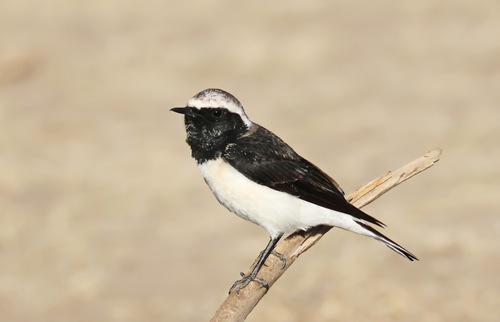 Pied Wheatear
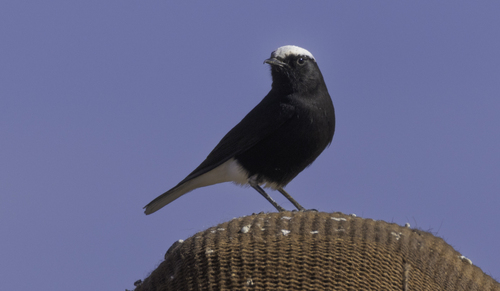 White-crowned Wheatear
In short
The most reliable field mark between Pied Wheatear and White-crowned Wheatear is the tail pattern: Pied Wheatear shows an inverted black 'T' on a white tail, while White-crowned Wheatear has only a black center to the tail, lacking the 'T'. Adult male Pied Wheatear has a contrasting pale crown and black face/throat, while adult White-crowned Wheatear is all black with a white crown and rump. Juvenile and female Pied Wheatear are browner and more patterned, whereas White-crowned Wheatear (except juveniles) is mostly black. Size is also a clue: White-crowned Wheatear is noticeably larger. Habitat and range overlap only rarely, but both can appear as vagrants in Europe. Focus on tail pattern and overall color for the quickest separation.
Identification tips
- Tail pattern is key: Look for the inverted black 'T' on a white tail in Pied Wheatear (all ages), versus only a black center to the tail in White-crowned Wheatear (no 'T'). This is most visible when the bird fans or flicks its tail.
- Crown color in adults: Adult male Pied Wheatear has a pale brown to white crown, contrasting with a black face and throat. Adult White-crowned Wheatear (both sexes) has a white crown, but otherwise is all black except rump/tail.
- Overall coloration: Pied Wheatear males are boldly patterned with black and white, while White-crowned Wheatear is almost entirely black with white rump, tail, and crown (in adults). Females and juveniles of Pied are browner and more patterned; White-crowned is always darker.
- Juvenile/female confusion: Juvenile Pied Wheatear is brown and speckled above, with pale centers to feathers, while juvenile White-crowned is dull blackish without a white crown. Female Pied is brown with buff tips, never all black.
- Size matters: White-crowned Wheatear is about 3–4 cm longer and noticeably bulkier than Pied Wheatear. If the bird appears large for a wheatear, consider White-crowned.
- Wing pattern: Pied Wheatear females and juveniles show brown wings with buff tips/edges; White-crowned is uniformly dark-winged in all plumages.
- Face pattern: Pied Wheatear males have a black mask and throat, with a pale supercilium (line above eye). White-crowned lacks a pale supercilium and is black-faced.
- Rump and back: Both have white rumps, but Pied Wheatear's back is creamy-white, while White-crowned's back is black.
- Habitat context: In true desert or rocky arid areas, White-crowned is more likely. In steppe or semi-desert, Pied is more likely. Both can appear as vagrants.
- Song: White-crowned's song is louder and more varied, often with mimicry. Pied's song is softer, more musical, and imitative but less forceful.
- Bill and legs: Both have black bills and legs; not a useful distinction.
- Seasonal wear: Pied Wheatear males become whiter-crowned and blacker-backed as feather edges wear off through the year; White-crowned's plumage is more stable.
- Perched vs. flight views: Tail pattern is best seen when the bird fans or flicks its tail, or in flight. In perched birds, look for crown and overall color.
- Pitfalls: Do not rely on presence of a white crown alone—juvenile White-crowned lacks it, and Pied Wheatear males can have a pale crown. Always check tail pattern for confirmation.
- Vagrancy: Both are rare in Western Europe; do not assume species based on location alone—use plumage and structure.
Size
White-crowned Wheatear is distinctly larger, measuring 17–18 cm in length, compared to the smaller Pied Wheatear at about 14–14.6 cm [wikipedia]. This size difference is often visible in direct comparison or with experience, but can be subtle if seen alone. Both are slim, upright birds, but White-crowned Wheatear appears bulkier and longer-tailed.
Plumage
- Juveniles: Pied Wheatear juveniles are brown above with pale centers to the feathers, creating a speckled appearance. White-crowned Wheatear juveniles lack the white crown and are mostly blackish, but less glossy than adults, and can show some brownish tones.
- Adult males: Pied Wheatear males have a pale brown to white crown, black face/throat, black mantle/scapulars, creamy-white back and rump, and a distinctive tail with an inverted black 'T' on white. White-crowned Wheatear adults of both sexes are black with a white rump and mostly white tail, but only a black center (no 'T'). Full adults have a white crown, which is absent in Pied Wheatear.
- Females: Pied Wheatear females are browner overall, with brown and buff tones on the upperparts, and less white on the rump than Northern Wheatear. White-crowned Wheatear females are similar to males, mostly black with white rump/tail, and have a white crown when adult.
- Tail pattern: Pied Wheatear: inverted black 'T' on white tail. White-crowned Wheatear: only black center to tail, no 'T'.
- Wing pattern: No strong contrasting wing panels in either, but Pied Wheatear shows brown and buff-edged wing feathers in females and juveniles, while White-crowned Wheatear is uniformly dark-winged.
Behaviour
Both species are active, upright, and often perch on rocks or exposed ground. Pied Wheatear is more likely to be seen in open, stony, and sparsely vegetated areas, often flicking its tail to reveal the tail pattern. White-crowned Wheatear is similarly bold, but may appear more robust and is often seen in harsher, true desert environments. Both sally for insects and may sing from prominent perches.
Habitat
Pied Wheatear breeds in open, stony, and sparsely vegetated regions from Southeast Europe to Mongolia, and winters in India and Northeast Africa. It is a rare vagrant to Western Europe. White-crowned Wheatear is a resident of stony deserts from the Sahara and Arabia to Iraq, rarely wandering into Europe. If seen in true desert or arid rocky areas, White-crowned is more likely; Pied prefers steppe and semi-desert, but both can overlap in migration or as vagrants.
Voice
Pied Wheatear gives a harsh 'zack zack' call and a low-pitched, musical, variable song, sometimes lark-like or whistling, often imitative. White-crowned Wheatear has a loud, varied song with frequent mimicry, generally more complex than most wheatears. Calls are less distinctive for separation in the field, but Pied's song is softer and more flowing, while White-crowned's is louder and more abrupt.