

Pied Cormorant vs Auckland Islands Shag
Phalacrocorax varius versus Leucocarbo colensoi
Play a quiz with Pied Cormorant and Auckland Islands Shag
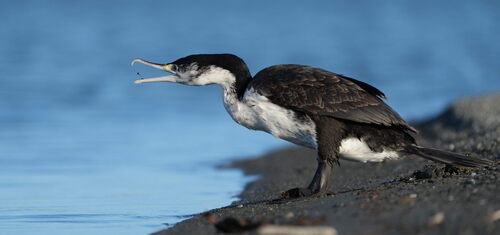 Pied Cormorant
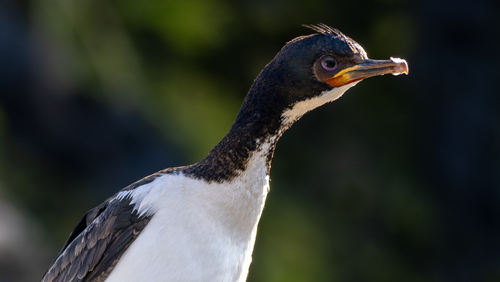 Auckland Islands Shag
In short
The most reliable field mark between Pied Cormorant and Auckland Islands Shag is the facial skin color: Pied Cormorant shows a distinct small yellow patch between the bill and eye, while Auckland Islands Shag lacks this feature. Both are large, black-and-white cormorants, but Pied Cormorant is found widely on the Australian and New Zealand mainland coasts, whereas Auckland Islands Shag is strictly endemic to the subantarctic Auckland Islands. In the field, check for the yellow facial patch and consider location: seeing a large pied cormorant on the Auckland Islands is almost certainly Auckland Islands Shag. Structural and plumage differences are subtle, so context and facial details are key.
Identification tips
- Facial skin color: Pied Cormorant shows a small, distinct yellow patch of bare skin between the bill and eye on each side of the head (all ages); Auckland Islands Shag lacks this yellow patch, showing only dark or pale bare skin. This is the most reliable field mark at any distance where the face is visible.
- Location: If you are on the Auckland Islands, any large pied cormorant is Auckland Islands Shag. On mainland New Zealand or Australia, it is Pied Cormorant. Range is absolute unless a vagrant is suspected.
- Eye color and ring: Pied Cormorant has green eyes with a blue eye ring; Auckland Islands Shag's iris and eye-ring color are not described here, but lack of the yellow facial patch is more important.
- Bill structure: Both have large, hooked bills typical of cormorants; no reliable difference is described in these notes.
- Upperwing and flight pattern: No age-specific upperwing or flight pattern differences are documented; both show black upperwings in flight with white underparts.
- Plumage pattern: Both are black above and white below; Auckland Islands Shag may have more extensive white on flanks and thighs, but this is subtle and variable, not a primary separator.
- Leg and foot color: Both have black legs and feet; not a separator.
- Behavior: Both species dive for fish and crustaceans and are often seen drying their wings after diving. Behavior is not a reliable separator.
- Size and structure: Pied Cormorant is large and robust (average mass ~1955 g); Auckland Islands Shag is also large but may appear more compact and heavy-bodied, though this is not a strong field mark.
- Juvenile/immature birds: No distinctive juvenile wing or body pattern differences are described; use facial skin color and location as primary marks for all ages.
- Habitat: Pied Cormorant occurs in a wide range of coastal and inland wetland habitats; Auckland Islands Shag is restricted to the subantarctic Auckland Islands and adjacent marine waters.
- Flock composition: Mixed flocks are not expected due to non-overlapping ranges; if you see both together, reconsider identification.
- Voice: No vocal differences are described in the notes; cormorants are generally silent away from colonies.
- Confusion with other species: Pied Cormorant can be confused with Black-faced Cormorant (slightly smaller) and Little Pied Cormorant (much smaller); Auckland Islands Shag is unlikely to be confused with other species within its restricted range.
- Summary tip: In practice, always check for the yellow facial patch and consider your location—these two features will separate Pied Cormorant from Auckland Islands Shag in almost all field situations.
Size
Pied Cormorant is a robust, medium-to-large cormorant with an average adult mass of about 1955 g [wikidata]. No direct mass data is available for Auckland Islands Shag, but both species are among the larger cormorants in their respective ranges. Pied Cormorant stands 65–85 cm tall with a wingspan of 110–130 cm [wikipedia]. Auckland Islands Shag is likely similar in size, but may appear slightly more compact and heavy-bodied, typical of island shags. In practice, size alone is not a reliable separator unless both species are seen side-by-side.
Plumage
No detailed age-specific wing or flight pattern differences are documented for these two species in the available notes. Both show the classic pied cormorant pattern: black upperparts and wings, white underparts. Pied Cormorant adults have a conspicuous small yellow patch of bare skin between the bill and eye, green eyes with a blue eye ring, and black legs and feet. Auckland Islands Shag, like other Leucocarbo shags, lacks the yellow facial patch and may have more extensive white on the flanks and thighs, but this is variable and subtle. Juvenile and immature plumages are not described in detail for either species in these notes, so caution is needed with young birds. In all ages, check for the yellow facial patch (present only in Pied Cormorant) as the most reliable mark.
Behaviour
Both species feed on fish and crustaceans, diving underwater with the aid of large webbed feet. Pied Cormorant is often seen drying its wings after diving, a behavior shared with most cormorants. Pied Cormorant may hunt singly or in groups, especially when prey is abundant near the surface. Auckland Islands Shag is sedentary and restricted to the Auckland Islands, likely foraging in coastal waters and showing similar wing-drying and diving behaviors. Behavioral differences are not diagnostic in the field.
Habitat
Habitat is a strong separator: Pied Cormorant is widespread along Australian and New Zealand coasts (except Tasmania), found in both marine and inland wetland habitats. In New Zealand, it occurs mainly on the North Island and northern South Island, with recent range extensions southward. Auckland Islands Shag is strictly endemic to the Auckland Islands archipelago, far south of mainland New Zealand, and does not occur elsewhere. Thus, any large pied cormorant seen outside the Auckland Islands is almost certainly not Auckland Islands Shag. Within the Auckland Islands, only Auckland Islands Shag is present.