

Picui Ground Dove vs Blue Ground Dove
Columbina picui versus Claravis pretiosa
Play a quiz with Picui Ground Dove and Blue Ground Dove
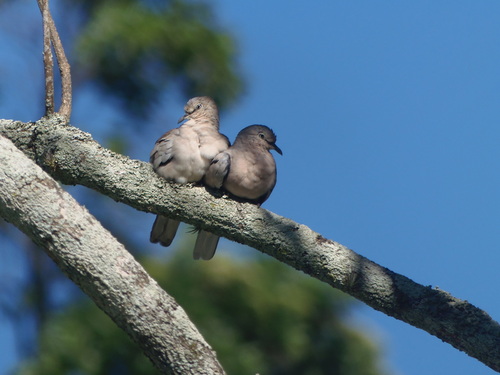 Picui Ground Dove
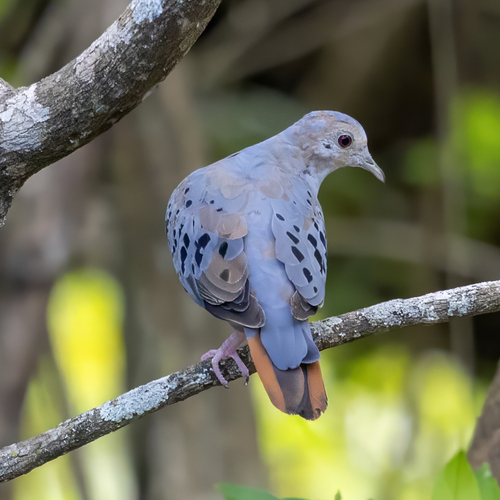 Blue Ground Dove
In short
The most reliable field mark between Picui Ground Dove and Blue Ground Dove is the wing pattern: Picui shows two white bands on a pinkish-fawn wing, while Blue Ground Dove males have blue-grey wings boldly spotted or banded with black, and females show chestnut-brown spots. Juveniles of both species are duller, but the Picui's wing bands remain distinctive. Structurally, Blue Ground Dove is noticeably heavier and slightly longer. Males are easier to separate by overall color, but females and immatures require careful attention to wing pattern and subtle plumage tones. Both species can occur together in open country, so context alone is not diagnostic.
Identification tips
- Wing pattern in flight or perched: Picui Ground Dove of all ages and sexes shows two white wing bands on a pinkish-fawn background, bordered by black—this is the single most reliable mark. Blue Ground Dove never shows white wing bands; instead, look for bold black (male) or chestnut-brown (female/juvenile) spots or bands on the wings.
- Juvenile/immature plumage: Juvenile Picui is duller and browner but still shows the double white wing bars. Juvenile Blue Ground Dove resembles the female, with ruddy scaling on the back and chestnut-brown wing spots.
- Adult male coloration: Picui male is gray-crowned with a pinkish-gray breast and brownish-gray back; Blue Ground Dove male is overall blue-grey with paler underparts and a grey-white face.
- Adult female coloration: Picui female is a duller, less pink version of the male, but still shows the white wing bands. Blue Ground Dove female is brownish above, with a chestnut rump and tail, and chestnut-brown wing spots.
- Size and structure: Blue Ground Dove is noticeably larger and heavier (69 g vs. 48 g), with a chunkier build and slightly longer body (20 cm vs. 18 cm). Picui is more delicate and slender.
- Tail pattern: Picui has brownish-gray central tail feathers; Blue Ground Dove female has a chestnut tail, and male has blackish outer tail feathers.
- Facial markings: Picui male shows a narrow black stripe in front of the eye and a whitish forehead and throat; Blue Ground Dove male has a plain grey-white face, lacking strong facial markings.
- Underpart color: Picui has a pinkish-gray breast and white belly; Blue Ground Dove male is paler grey below, female is blue-grey to grey-brown on the underparts.
- Iris and bare parts: Blue Ground Dove has a red or yellow iris, green bare eyering, and flesh-pink legs (when seen well); Picui's bare part colors are not described, so this is only useful if Blue Ground Dove's features are visible.
- Behavioral clues: Blue Ground Dove pairs often fly together, with a blue-grey and a brownish bird side by side—this is a strong clue if seen.
- Sex confusion: Female and juvenile Blue Ground Doves are the most likely to be confused with Picui, but the chestnut-brown wing spots (never blackish) and ruddy brown back are key; Picui's white wing bands are always present.
- Potential pitfalls: Do not confuse Blue Ground Dove females with Ruddy Ground Dove females (which are smaller and have blackish, not chestnut, wing markings), but Picui is separated from both by the white wing bands.
- Geographic overlap: Both species can occur together in much of South America; range is not a reliable separator in most of their shared area.
- Voice: No diagnostic vocal differences are provided in the notes; do not rely on song or call for separation.
- Seasonal variation: No strong seasonal plumage changes are noted for either species; focus on age and sex differences.
Size
Blue Ground Dove is distinctly larger and heavier than Picui Ground Dove: average body mass is about 69 g for Blue Ground Dove versus 48 g for Picui [wikidata]. In the field, this translates to a noticeably chunkier, more robust impression for Blue Ground Dove, which is also about 2 cm longer (20 cm vs. 18 cm). However, size can be hard to judge unless both species are seen together.
Plumage
Juvenile and immature birds: Picui Ground Dove juveniles are duller and browner than adults, but retain the two white wing bands on a pinkish-fawn background, bordered by black—this is visible both perched and in flight. Blue Ground Dove juveniles resemble females, with ruddy scaling on the back and chestnut-brown spots in the wings (not blackish).
Adult males: Picui males have a gray crown and nape, brownish-gray back, and pinkish-fawn wings with two white bands. Blue Ground Dove males are blue-grey above, paler below, with blackish flight and outer tail feathers, and bold black spots or bands on the wings.
Adult females: Picui females are duller and less pink than males, but still show the white wing bands. Blue Ground Dove females have a grey-brown head, neck, and breast, pale blue-grey underwings and belly, a ruddy brown back, chestnut rump and tail, and chestnut-brown wing spots. The female Blue Ground Dove's wing spots are always chestnut-brown, never blackish as in Ruddy Ground Dove.
In all ages and sexes, Picui's white wing bands are unique among small ground doves in its range; Blue Ground Dove's wing spots are always present but change color with sex and age.
Behaviour
Both species are ground doves and may be seen feeding on open ground or flying low. Blue Ground Dove is often seen as a pair (male and female) flying together, with the male blue-grey and the female brownish—this can be a useful behavioral clue. Picui Ground Dove is also gregarious, but the notes do not specify unique behavioral differences. Both species may flush from the ground with a whirring flight.
Habitat
Both species overlap widely in South America and use similar open habitats, including fields, edges, and open woodlands. Blue Ground Dove's range extends further north into Central America and Trinidad, but in much of South America both can be found together. Habitat alone is not diagnostic.