

Motmot

Philadelphia Vireo vs Prothonotary Warbler

Vireo philadelphicus versus Protonotaria citrea

Play a quiz with Philadelphia Vireo and Prothonotary Warbler
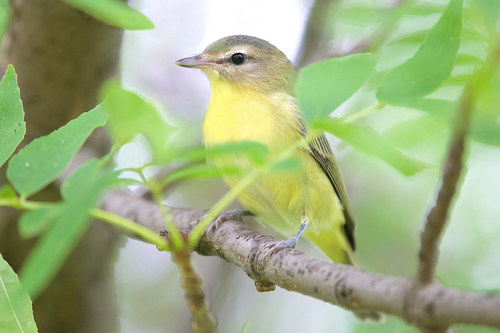
Philadelphia Vireo (Vireo philadelphicus) Philadelphia Vireo
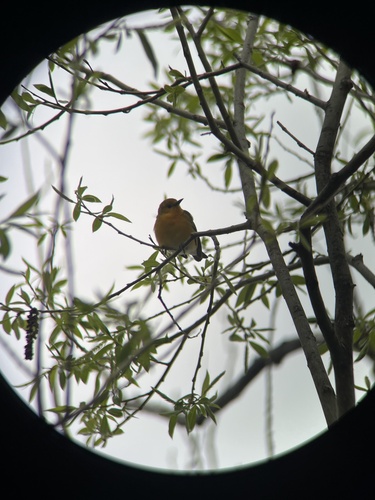
Prothonotary Warbler (Protonotaria citrea) Prothonotary Warbler

Media

Loading…

In short

The most reliable field mark to separate Philadelphia Vireo from Prothonotary Warbler is the presence of a dark eye-line and white supercilium on the vireo, versus the prothonotary's plain, bright yellow (or orange-yellow in adult males) head without face markings. In flight, Prothonotary Warbler of all ages shows a distinctive two-toned tail pattern—white at the base and dark at the tip—which Philadelphia Vireo lacks. Philadelphia Vireo is a drab, olive-brown bird with yellowish underparts and no wing bars, while Prothonotary Warbler is brighter overall, with blue-grey wings and tail and a more vivid yellow or orange-yellow head. Bill and leg color also differ: the vireo has a stout bill and blue-grey legs, while the warbler has a longer, thinner bill and black legs.

Identification tips

  1. Tail pattern in flight (all ages): Prothonotary Warbler shows a two-toned tail from below (white base, dark tip); Philadelphia Vireo never shows this pattern.
  2. Facial markings: Philadelphia Vireo has a dark eye-line (lore) and a white supercilium, giving a masked look; Prothonotary Warbler has a plain, unmarked yellow or orange-yellow head with no eye-line or supercilium.
  3. Head color (adult males): Prothonotary Warbler adult males have a striking orange-yellow head, much brighter than any vireo; females and immatures are also bright yellow but less orange.
  4. Upperparts: Philadelphia Vireo is olive-brown above with a grey crown; Prothonotary Warbler has an olive back but blue-grey wings and tail, making it look more contrasting and colorful.
  5. Wing bars: Neither species has wing bars, so this is not helpful for separation.
  6. Underparts: Philadelphia Vireo has yellow underparts, but the yellow is usually duller and less extensive than the saturated yellow of Prothonotary Warbler.
  7. Bill shape and color: Philadelphia Vireo has a stout, blue-grey bill; Prothonotary Warbler has a longer, thinner, pointed, and dark bill.
  8. Leg color: Philadelphia Vireo has thick blue-grey legs; Prothonotary Warbler has black legs.
  9. Behavior: Prothonotary Warbler moves quickly, often jerky or even upside down; Philadelphia Vireo is more deliberate, rarely acrobatic.
  10. Habitat: Prothonotary Warbler is almost always found in or near wooded wetlands, especially in breeding season; Philadelphia Vireo prefers forest edges and uplands, rarely in swamps.
  11. Crown color: Philadelphia Vireo has a grey crown contrasting with olive back; Prothonotary Warbler's crown is the same yellow or orange-yellow as the rest of its head.
  12. Supercilium: Philadelphia Vireo has a clear white supercilium above the dark eye-line; Prothonotary Warbler lacks any supercilium.
  13. Song: If heard, Philadelphia Vireo gives a series of three to five 'weeezh' notes with long pauses; Prothonotary Warbler's song is not described here, so use with caution.
  14. Jizz: Prothonotary Warbler often appears longer-tailed and more active, while Philadelphia Vireo is more compact and methodical.
  15. Seasonal context: During migration, both can occur together, but habitat and behavior remain strong clues—look for Prothonotary in wet woods, Philadelphia in drier forest edges.

Size

Both species are similar in size and can be confusing at a glance. Prothonotary Warbler averages about 14.9 g in body mass [wikidata], with a length of 13 cm and a wingspan of 22 cm [wikipedia]. Philadelphia Vireo's mass is not listed, but it is considered a small vireo, likely close in size to the warbler. Size alone is not a reliable separator in the field between these two, though the warbler may appear slightly bulkier and longer-tailed due to its structure.

Plumage

Juvenile and immature Prothonotary Warblers, as well as adults, show a unique two-toned tail pattern in flight: white at the base and dark at the tip, visible from below. This is never present in Philadelphia Vireo of any age. Philadelphia Vireo of all ages lacks wing bars and has olive-brown upperparts, yellowish underparts, a grey crown, and a distinctive dark line through the eye with a white supercilium. Prothonotary Warbler, by contrast, has an olive back, blue-grey wings and tail, and a bright yellow (male) or yellow (female/immature) head with no eye-line or supercilium. The warbler's underparts are a more saturated yellow, and its head is more vividly colored, especially in adult males (orange-yellow). The vireo's yellow is generally duller and restricted to the underparts, with a contrast to the grey crown and olive back. Bill color also differs: vireo has a stout, blue-grey bill, while the warbler's bill is longer, thinner, and dark.

Behaviour

Prothonotary Warbler is notably active, often moving with quick, jerky motions and sometimes crawling upside down on branches or tree trunks. It is frequently seen in wet habitats, especially in spring, gathering nesting material or food. Philadelphia Vireo is more methodical, foraging for insects in trees, sometimes hovering or sallying out to catch prey, but does not exhibit the same acrobatic or rapid movements as the warbler. The vireo is less likely to be seen in wetland settings and tends to forage higher in the canopy.

Habitat

Philadelphia Vireo breeds at the edges of deciduous and mixed woods, typically in upland or forest edge habitats across Canada, and is rarely found in wetlands. Prothonotary Warbler, by contrast, is closely tied to wooded wetlands and swampy areas, especially in the breeding season, and nests in natural or artificial cavities near water. If the bird is seen in a wet, swampy woodland or near standing water, Prothonotary Warbler is much more likely; Philadelphia Vireo is more expected in drier, upland forest edges.

Voice

Philadelphia Vireo's song is a series of three to five notes, 'weeezh weeezh weeezh,' with longer pauses between phrases and higher notes than Red-eyed Vireo. Prothonotary Warbler's song is not described in the provided notes, so vocalization is not a reliable separator here unless the vireo's distinctive phrasing is recognized.

Submit a better description

Use the same sections as the comparison. Your text is published immediately.

The most reliable field mark to separate Philadelphia Vireo from Prothonotary Warbler is the presence of a dark eye-line and white supercilium on the vireo, versus the prothonotary's plain, bright yellow (or orange-yellow in adult males) head without face markings. In flight, Prothonotary Warbler of all ages shows a distinctive two-toned tail pattern—white at the base and dark at the tip—which Philadelphia Vireo lacks. Philadelphia Vireo is a drab, olive-brown bird with yellowish underparts and no wing bars, while Prothonotary Warbler is brighter overall, with blue-grey wings and tail and a more vivid yellow or orange-yellow head. Bill and leg color also differ: the vireo has a stout bill and blue-grey legs, while the warbler has a longer, thinner bill and black legs.

  1. Tail pattern in flight (all ages): Prothonotary Warbler shows a two-toned tail from below (white base, dark tip); Philadelphia Vireo never shows this pattern.
  2. Facial markings: Philadelphia Vireo has a dark eye-line (lore) and a white supercilium, giving a masked look; Prothonotary Warbler has a plain, unmarked yellow or orange-yellow head with no eye-line or supercilium.
  3. Head color (adult males): Prothonotary Warbler adult males have a striking orange-yellow head, much brighter than any vireo; females and immatures are also bright yellow but less orange.
  4. Upperparts: Philadelphia Vireo is olive-brown above with a grey crown; Prothonotary Warbler has an olive back but blue-grey wings and tail, making it look more contrasting and colorful.
  5. Wing bars: Neither species has wing bars, so this is not helpful for separation.
  6. Underparts: Philadelphia Vireo has yellow underparts, but the yellow is usually duller and less extensive than the saturated yellow of Prothonotary Warbler.
  7. Bill shape and color: Philadelphia Vireo has a stout, blue-grey bill; Prothonotary Warbler has a longer, thinner, pointed, and dark bill.
  8. Leg color: Philadelphia Vireo has thick blue-grey legs; Prothonotary Warbler has black legs.
  9. Behavior: Prothonotary Warbler moves quickly, often jerky or even upside down; Philadelphia Vireo is more deliberate, rarely acrobatic.
  10. Habitat: Prothonotary Warbler is almost always found in or near wooded wetlands, especially in breeding season; Philadelphia Vireo prefers forest edges and uplands, rarely in swamps.
  11. Crown color: Philadelphia Vireo has a grey crown contrasting with olive back; Prothonotary Warbler's crown is the same yellow or orange-yellow as the rest of its head.
  12. Supercilium: Philadelphia Vireo has a clear white supercilium above the dark eye-line; Prothonotary Warbler lacks any supercilium.
  13. Song: If heard, Philadelphia Vireo gives a series of three to five 'weeezh' notes with long pauses; Prothonotary Warbler's song is not described here, so use with caution.
  14. Jizz: Prothonotary Warbler often appears longer-tailed and more active, while Philadelphia Vireo is more compact and methodical.
  15. Seasonal context: During migration, both can occur together, but habitat and behavior remain strong clues—look for Prothonotary in wet woods, Philadelphia in drier forest edges.

Both species are similar in size and can be confusing at a glance. Prothonotary Warbler averages about 14.9 g in body mass [wikidata], with a length of 13 cm and a wingspan of 22 cm [wikipedia]. Philadelphia Vireo's mass is not listed, but it is considered a small vireo, likely close in size to the warbler. Size alone is not a reliable separator in the field between these two, though the warbler may appear slightly bulkier and longer-tailed due to its structure.

Juvenile and immature Prothonotary Warblers, as well as adults, show a unique two-toned tail pattern in flight: white at the base and dark at the tip, visible from below. This is never present in Philadelphia Vireo of any age. Philadelphia Vireo of all ages lacks wing bars and has olive-brown upperparts, yellowish underparts, a grey crown, and a distinctive dark line through the eye with a white supercilium. Prothonotary Warbler, by contrast, has an olive back, blue-grey wings and tail, and a bright yellow (male) or yellow (female/immature) head with no eye-line or supercilium. The warbler's underparts are a more saturated yellow, and its head is more vividly colored, especially in adult males (orange-yellow). The vireo's yellow is generally duller and restricted to the underparts, with a contrast to the grey crown and olive back. Bill color also differs: vireo has a stout, blue-grey bill, while the warbler's bill is longer, thinner, and dark.

Prothonotary Warbler is notably active, often moving with quick, jerky motions and sometimes crawling upside down on branches or tree trunks. It is frequently seen in wet habitats, especially in spring, gathering nesting material or food. Philadelphia Vireo is more methodical, foraging for insects in trees, sometimes hovering or sallying out to catch prey, but does not exhibit the same acrobatic or rapid movements as the warbler. The vireo is less likely to be seen in wetland settings and tends to forage higher in the canopy.

Philadelphia Vireo breeds at the edges of deciduous and mixed woods, typically in upland or forest edge habitats across Canada, and is rarely found in wetlands. Prothonotary Warbler, by contrast, is closely tied to wooded wetlands and swampy areas, especially in the breeding season, and nests in natural or artificial cavities near water. If the bird is seen in a wet, swampy woodland or near standing water, Prothonotary Warbler is much more likely; Philadelphia Vireo is more expected in drier, upland forest edges.

Philadelphia Vireo's song is a series of three to five notes, 'weeezh weeezh weeezh,' with longer pauses between phrases and higher notes than Red-eyed Vireo. Prothonotary Warbler's song is not described in the provided notes, so vocalization is not a reliable separator here unless the vireo's distinctive phrasing is recognized.

Discard your changes?

You have unsaved edits. If you leave now, those changes will be lost.

Philadelphia Vireo · Prothonotary Warbler · My Tricky Birds